
Choosing the wrong private chef catering company doesn't just ruin a dinner. It can derail a corporate event, embarrass you in front of important guests, or create genuine food safety risks in your home. Knowing how to properly vet private chef catering companies is the difference between a flawless, memorable experience and an expensive disappointment. This guide walks you through every stage of the vetting process, from checking credentials and certifications to comparing companies side by side and maintaining quality long after the first event.
Table of Contents
- Key takeaways
- How to vet private chef catering companies effectively
- Assessing operational reliability and professionalism
- Comparing private chef catering companies
- Common mistakes when hiring private chef companies
- Maintaining quality after you hire
- My take on what most clients get wrong
- Find a vetted private chef catering company you can trust
- FAQ
Key takeaways
| Point | Details |
|---|---|
| Credentials matter first | Verify culinary education, ServSafe or HACCP certification, and 3 to 5 years of private service experience before anything else. |
| Operational skills are non-negotiable | Evaluate organization, hygiene, discretion, and adaptability, not just cooking talent, to avoid service failures. |
| Use structured comparison tools | A clear checklist and comparison table help you evaluate multiple companies objectively and avoid emotional decisions. |
| Avoid the most common hiring mistakes | Never rely on reviews alone. Verify references directly and clarify every expectation in writing before signing. |
| Build in ongoing quality checks | Post-event feedback loops and open communication with your chef team protect your investment over time. |
How to vet private chef catering companies effectively
The first thing most people do when searching for a private chef is look at photos and read a few online reviews. That approach misses most of what actually matters. The best private chef services for luxury events are built on a foundation of verifiable credentials, not just compelling Instagram feeds.
Culinary education and formal training
There is a meaningful difference between a chef who trained in a professional culinary program and one who worked their way up through restaurant kitchens. Both paths can produce excellent chefs, but for private service, formal culinary education from recognized institutions is increasingly valued because it signals structured knowledge of technique, food science, and professional standards.
When you contact a company, ask directly where their chefs trained and whether they can provide documentation. A reputable company should answer without hesitation.
Mandatory food safety certifications
This is non-negotiable. In 2026, ServSafe Manager and HACCP certifications are considered mandatory benchmarks for private chefs working in residential and event settings. These certifications cover temperature control, cross-contamination prevention, allergen management, and sanitation protocols. A chef without them is a liability.
Beyond the basics, look for specialty certifications if your events require them:
- Allergen management credentials for guests with serious dietary restrictions
- Vegan or plant-based culinary training for menus that go beyond simple substitutions
- Local health department approvals specific to the state or county where service will occur
- Certification in dietary protocols for medical or therapeutic meal planning
Pro Tip: Ask the company to send copies of certifications before your first consultation. If they hesitate or say the documents are "available upon request," treat that as a red flag.
Experience benchmarks for private service
Restaurant experience and private service experience are two different things. A chef who has worked in high-volume kitchens may struggle in an intimate home environment where discretion, timing, and one-on-one communication matter far more than speed. The standard benchmark for private service is 3 to 5 years of dedicated private experience, not just years in the industry overall. Always ask companies to specify how much of their team's experience is specifically in private homes, yachts, villas, or corporate settings.

Assessing operational reliability and professionalism
Culinary skill gets the food on the table. Operational reliability determines whether the entire experience holds together. Vetting operational skills is as important as evaluating cooking talent, and most clients skip this entirely.
Here is a structured process for assessing the non-culinary side of any company you are considering:
- Conduct a structured interview. Ask scenario-based questions: What happens if a key ingredient is unavailable the morning of the event? How do they handle a guest with an undisclosed allergy? Their answers reveal how they think under pressure.
- Request detailed references from private employers. Not restaurant managers. Not catering coordinators. Actual private clients who can speak to discretion, reliability, and how the chef performed in a home or corporate setting. Multi-stage reference verification is standard practice in high-net-worth household hiring for good reason.
- Evaluate menu planning and provisioning organization. Ask them to walk you through how they plan a menu, source ingredients, and handle logistics. A disorganized answer here predicts a disorganized event.
- Assess communication style. Private service demands someone who communicates proactively, adapts to last-minute changes, and does so without drama. Ask how they prefer to communicate and how they handle schedule shifts.
- Ask about hygiene practices in private kitchens. Hygiene standards and adaptability in a private home are different from a commercial kitchen. They should describe specific protocols without prompting.
- Confirm confidentiality commitments. Any chef working in a private home or corporate setting should be willing to sign a non-disclosure agreement. If a company pushes back on this, walk away.
"Small failures in timing or planning are far more damaging in private homes than in restaurants. There is no front-of-house buffer, no manager to absorb the problem. The client sees everything." — Quarterdeck Private Chef Vetting Standards
Pro Tip: When checking references, ask the previous client one specific question: "Would you hire this company again without hesitation?" The pause before the answer tells you as much as the answer itself.
Comparing private chef catering companies
Once you have a shortlist of companies that pass the credentials and operational checks, you need a systematic way to compare them. Doing a private chef vs catering company corporate evaluation without a framework leads to decisions based on price alone, which almost always backfires.
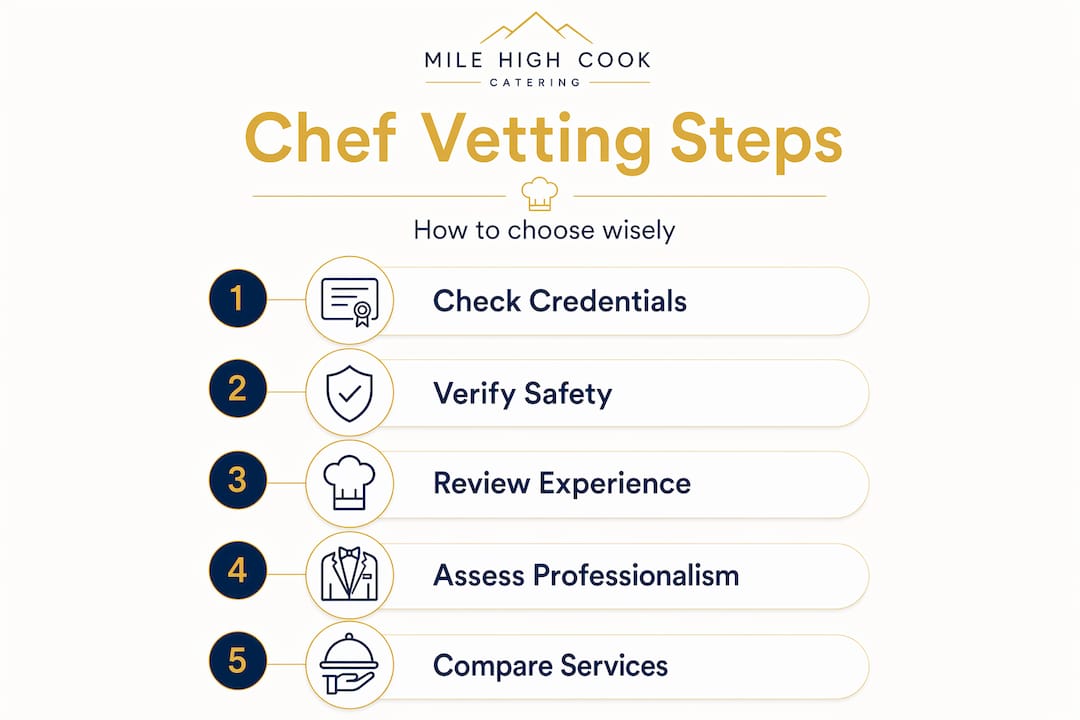
Use this comparison table as a starting point:
| Vetting checkpoint | What to look for | Red flag |
|---|---|---|
| Culinary credentials | Formal training, certifications on file | Vague claims, no documentation |
| Food safety compliance | ServSafe, HACCP, local permits | Missing or expired certifications |
| Private service experience | 3 to 5 years in private settings | Only restaurant or catering background |
| Pricing transparency | All-inclusive or clearly itemized | Hidden fees, vague estimates |
| References | Direct private client contacts | Only company-provided testimonials |
| Customization capability | Menu built around your needs | Fixed menus with minimal flexibility |
| Confidentiality policy | Willingness to sign NDA | Resistance or deflection |
Private chef pricing varies widely based on experience level, service environment, and the complexity of the event. When comparing companies, ask for fully itemized quotes that include groceries, staffing, service, and cleanup. Hidden costs discovered after signing are one of the most common complaints in this industry.
A few questions worth asking during every consultation:
- Do you offer a trial tasting or demo service before the full event?
- How do you handle dietary restrictions discovered after the menu is finalized?
- What is your policy if a chef becomes unavailable on the event date?
- Can you provide a sample contract for review?
Pro Tip: A trial tasting is one of the best investments you can make before committing to a company for a large event. It reveals culinary skill, presentation standards, and how the chef communicates in person, all at once.
Common mistakes when hiring private chef companies
Even well-intentioned clients make vetting mistakes that cost them later. Inadequate vetting creates real risks, including timing failures, hygiene lapses, and breaches of discretion that are far harder to recover from in a private setting than in a public venue.
Watch out for these specific pitfalls:
- Relying only on online reviews. Reviews are useful data points, but they are easy to curate and hard to verify. Always supplement reviews with direct reference calls to past clients.
- Prioritizing culinary skill over operational vetting. A chef who cooks beautifully but cannot manage timing, communication, or unexpected changes will still produce a failed event.
- Skipping the contract review. Every expectation, from arrival time to cleanup standards to confidentiality, should be in writing. Verbal agreements disappear the moment something goes wrong.
- Underestimating the confidentiality requirement. In corporate and high-profile private settings, a chef who discusses client details or shares photos without permission is not just unprofessional. It is a serious liability.
- Choosing based on price alone. The lowest quote rarely reflects the full cost. Surprise charges for groceries, staff overtime, or equipment rental can make a "budget" option more expensive than a transparent all-inclusive provider.
If something goes wrong during service, address it directly with the company's point of contact during the event, not after. Most professional companies have protocols for mid-event adjustments, but only if you communicate in real time.
Maintaining quality after you hire
Hiring a well-vetted company is the beginning, not the end. The best clients treat the relationship as an ongoing collaboration, not a one-time transaction.
Continuous guest feedback loops are one of the most effective tools for maintaining standards over time. After each event, document what worked and what did not. Share specific feedback with the company, not just a general rating. This gives them the information they need to improve and signals that you are an engaged client who expects consistent performance.
When working with a chef team during an event, designate one point of contact on your side. Multiple people giving instructions to the chef creates confusion and slows service. Agree on timing checkpoints in advance so there are no surprises on either side.
After the event, ask yourself three questions before deciding whether to rebook: Did the food meet the standard promised? Did the team handle unexpected moments professionally? Would your guests describe the experience as seamless? If the answer to any of these is no, have a direct conversation with the company before the next booking, or begin evaluating alternatives.
Pro Tip: Keep a simple event log after each engagement. Note the menu, the chef team, any issues, and guest reactions. Over time, this becomes an invaluable reference when planning future events or comparing providers.
My take on what most clients get wrong
I've seen clients spend hours comparing menus and almost no time verifying whether a company can actually deliver on the operational side. That imbalance is where most vetting failures happen.
The culinary talent is usually the easiest thing to assess. You can taste the food, look at plating photos, and read the menu. What you cannot see from the outside is how a chef handles a 6 a.m. grocery run when the market is out of a key ingredient, or how they communicate a delay to a host who has 20 guests arriving in 45 minutes. Those moments define the experience far more than the quality of the risotto.
In my experience, the companies that perform consistently well share one trait: they have invested in operational systems, not just culinary talent. They have clear protocols for provisioning, communication, and contingencies. They vet their own staff rigorously before putting them in front of clients. And they treat discretion and confidentiality as foundational, not optional.
The other thing I have learned is that the vetting conversation itself reveals a lot. A company that answers your credential questions clearly, provides references without being asked twice, and offers a transparent pricing breakdown has already demonstrated the organizational competence you are looking for. A company that hedges, deflects, or makes you feel like you are asking too much has shown you exactly what working with them will be like.
Trust that signal.
— Stephen
Find a vetted private chef catering company you can trust
If you have done the work of vetting and want to skip the uncertainty, Milehighcook is built for exactly that situation.
Milehighcook works with CIA-trained chefs across 30+ markets, including Colorado, Arizona, Utah, and Wyoming. Every chef in their network has been vetted for culinary credentials, food safety compliance, and private service experience. Their all-inclusive private chef services cover groceries, chef fees, service staff, and full cleanup, so there are no surprise charges after the event. Whether you are planning an intimate dinner in Aspen or a corporate event in Park City, Milehighcook delivers a consistent 4.9-star standard that removes the guesswork from private chef hiring entirely.
FAQ
What certifications should a private chef have?
At minimum, look for ServSafe Manager certification and HACCP compliance. Specialty certifications in allergen management or dietary protocols are a strong bonus for events with complex guest needs.
How do I vet a private chef catering company's references?
Contact previous private clients directly and ask scenario-specific questions, not just whether they were satisfied. Ask how the chef handled unexpected problems and whether they would rebook without hesitation.
What is the difference between a private chef and a banquet caterer?
A private chef vs banquet catering comparison comes down to customization and intimacy. Private chefs build menus around your specific guests and preferences, while banquet caterers typically work from fixed menus designed for high-volume service.
How much does a vetted private chef service cost?
Pricing varies based on experience, event size, and service environment. Always request an all-inclusive quote that covers groceries, staffing, and cleanup to avoid unexpected costs after the event.
What are the biggest red flags when hiring a private chef company?
Missing or expired food safety certifications, reluctance to provide direct client references, vague pricing, and resistance to signing a confidentiality agreement are the clearest warning signs that a company has not been properly vetted.