
A catering cancellation policy is only as good as the contract behind it. The signed agreement, not vague verbal promises, controls your notice window, your deposit, the fee tiers you owe, and whether you get any money back. Courts generally enforce these clauses when the fees represent a reasonable estimate of the caterer's actual losses, and reject them when they function as a punitive penalty instead.
A defensible policy spells out details such as how rental equipment deposits are treated, similar to those described in Carnivals | Camps & Event Rentals | Laser Clay Singapore.
- Notice method and timing — how you must cancel (email, certified letter) and when the clock starts
- Fee tiers or percentages tied to how close you are to the event date
- Deposit treatment — whether it's non-refundable outright or applied toward the fee
- A rebooking or mitigation duty the caterer owes you if they resell your date
- Rescheduling rules separate from outright cancellation
- Force majeure language covering things nobody controls
- Refund processing timeline once a cancellation is confirmed
Expect a well-drafted clause to echo industry-standard tiering practices, the contract-law principle of liquidated damages, and, in some states, local consumer-protection statutes that cap what a vendor can keep.
Key Takeaways
A fair catering cancellation policy ties every fee tier to documented, recoverable costs and requires the vendor to make a genuine effort to rebook your date before keeping the full amount.
| Point | Details |
|---|---|
| Contract controls everything | Notice windows, fee tiers, and refund rules come from the signed agreement, not general assumptions. |
| Fees should scale gradually | Reasonable tiers rise as the event nears, tied to costs like food, staffing, and rentals already committed. |
| Rebooking limits what's owed | If the caterer resells your date, retained fees should shrink to reflect the reduced loss. |
| Define exceptions narrowly | Force majeure and rescheduling clauses should name specific triggers, not vague catchall language. |
| Milehighcook uses transparent, all-inclusive pricing | Bundled costs for groceries, staffing, and cleanup make deposit and fee terms easier to evaluate before booking. |
This article is general information, not a substitute for advice from a qualified lawyer. Consult a qualified legal professional about your own circumstances before acting on anything here.
Table of Contents
- Typical Notice Windows and Cancellation Fee Tiers
- Why Cancellation Fees Exist (and How to Judge Whether Yours Is Fair)
- When You Get a Refund and How Rebooking Affects the Fee
- Force Majeure, Weather, and Other Exceptions That Complicate Cancellation
- How to Draft or Negotiate a Cancellation Clause That Protects Both Sides
- Sources
- FAQ
Typical Notice Windows and Cancellation Fee Tiers
Most caterers use a sliding scale: the closer you cancel to the event, the more you owe, because their ability to recover costs or rebook the date shrinks fast. There's no single legal standard dictating these numbers, which is exactly why the written contract matters more than what any website (including this one) says is "typical."
A common structure looks like this:
| Notice window | Typical retained amount | Why |
|---|---|---|
| 90+ days out | Deposit/retainer only | Ingredients unordered, staff unbooked, date easily rebooked |
| 30–89 days | Around 50% of contract value | Some planning and sourcing already underway |
| — | Full deposit plus a growing percentage | Menu finalized, some rentals reserved |
| — | 100% of contract value | Staffing and orders largely locked in |
| — | Full contract price | Food purchased, labor scheduled, date unlikely to be filled |
These bands roughly match what event contract specialists describe as standard tiering, though exact percentages vary by vendor and market.
A few details trip people up:
- Business days vs. calendar days. A "7-day notice" requirement can mean very different deadlines depending on which one your contract uses. Ask which applies.
- When the clock starts. Some contracts count from when notice is sent; others count from when the caterer actually receives it. That gap matters if you're cutting it close.
- Short-notice penalties exist even for small orders. Institutional and online catering policies often layer in stricter rules, like 72-hour or 24-hour cutoffs for guest-count changes or low-dollar processing fees, separate from the main cancellation tiers.
Why Cancellation Fees Exist (and How to Judge Whether Yours Is Fair)
Cancellation fees exist to reimburse real, unrecoverable costs, not to punish you for changing plans. A caterer who has already bought perishable ingredients, paid deposits on rental equipment, or committed to hourly staff has sunk real money into your date. The legal standard for these fees is that they must reasonably estimate actual harm. A flat, unexplained "you forfeit everything" clause with no tie to real costs starts to look like a penalty, and penalties are harder to enforce in court.
Before you sign, run any proposed fee through this checklist:
- Does the fee tie to specific, named costs (food orders, rental deposits, staffing contracts)?
- Does it escalate in reasonable steps as the date approaches, rather than jumping straight to 100%?
- Does the contract mention any duty for the caterer to try rebooking your date?
- Who documents the unrecoverable costs if a dispute happens?
Pro Tip: Ask the caterer directly how each tier is calculated and which specific purchases become nonrefundable at each stage. A vendor who can answer clearly has a defensible policy. One who shrugs probably doesn't.
When You Get a Refund and How Rebooking Affects the Fee
Refund eligibility often comes down to one question: did the caterer manage to rebook your date? If they did, they've limited their loss, and a portion of your fee should come back to you. If they didn't, they may be entitled to keep more, tied to their actual cost of performance, but they generally have to show they tried.
A real case illustrates this well. In Yen-Fu Chen v. Oheka Catering, LLC, a local consumer-protection rule capped what the caterer could retain to the lesser of 5% of the contract or $100 plus actual expenses if the date was rebooked. Where the caterer couldn't show it, the retained amount had to reflect genuine, documented losses.
The court's message was blunt: a caterer can't simply pocket a large cancellation fee and call it settled. If the venue books someone else for that date, the caterer has to prove diligent rebooking efforts to justify keeping more than the statutory minimum.
If you're the one canceling, take these steps in order:
- Send written cancellation notice to the contact named in your contract, not just a phone call.
- Request an itemized accounting of any unrecoverable expenses the caterer is claiming.
- Ask directly whether they've rebooked or attempted to rebook the date.
- Get a written timeline for refund processing, which vendors commonly set around 10 business days.
- Keep copies of every email, receipt, and the contract's fee schedule in case you need to dispute the amount later.
Force Majeure, Weather, and Other Exceptions That Complicate Cancellation
Not every cancellation is a simple change of heart. Illness, venue failures, government restrictions, and weather all raise the question of whether the standard fee schedule should even apply. A well-written policy defines these exceptions narrowly so they can't be stretched to cover ordinary cold feet.
Watch for:
- Force majeure clauses that name specific triggering events (natural disaster, government shutdown order) rather than vague "unforeseen circumstances" language that either side could exploit.
- Rescheduling options as an alternative to outright cancellation, letting you shift the date within a defined window and apply your payment as credit instead of losing it.
- Guest-count adjustments built into the contract instead of treated as a full cancellation event.
A few red flags mean you should push back before signing: a deposit that's 100% nonrefundable regardless of timing, no force majeure language at all, or no distinction between you canceling and the caterer failing to show up. That last gap matters more than most people realize, and it's the subject of the next section.
How to Draft or Negotiate a Cancellation Clause That Protects Both Sides
A fair clause isn't complicated. It just needs to state, in plain terms, what happens under every likely scenario. Here's language you can adapt or ask a vendor to match:
- Notice definition: "Cancellation notice must be submitted in writing to [named contact] and is effective on the date received."
- Tiered fee schedule: "Cancellations 90+ days before the event forfeit the deposit only; 30–89 days forfeit 50% of the total contract; fewer than 30 days forfeit the full contract amount."
- Mitigation duty: "Caterer will make reasonable efforts to rebook the date, and any amount recovered from a rebooking will reduce the client's owed fee."
- Refund timeline: "Any refund due will be processed within 10 business days of written confirmation."
- Rescheduling option: "Client may reschedule once, without penalty, if written notice is given at least 30 days before the original date."
- Termination for nonperformance: "If Caterer fails to provide contracted services, Client is entitled to a full refund plus any documented additional costs incurred to secure a replacement."
That last point deserves emphasis. Cancellation and termination aren't the same thing, and a one-sided contract sometimes conflates them so the client bears all the risk. Push for language that protects you if the caterer is the one who fails to deliver, reviewing a full catering service agreement if you want a broader template.
Before signing, work through this negotiation checklist:
- Request an itemized breakdown of what each fee tier actually covers.
- Ask for a cap on any processing or administrative fees layered onto cancellation charges.
- Insist that cancellation only counts if delivered in writing.
- Confirm the deposit size is reasonable relative to total contract value, since a smaller upfront deposit limits your downside.
- Get supplier or rental cancellation receipts if the caterer claims specific unrecoverable costs.
A caterer's take on fair cancellation terms
Setting a fair cancellation policy starts with pricing that's already transparent. Because Milehighcook's model bundles groceries, chef fees, staffing, and cleanup into one number, deposit treatment and fee tiers tie directly to real costs, not guesswork. With CIA-trained chefs working across more than 30 markets, we've seen how a clear, honest policy protects the client relationship as much as the vendor's bottom line. Confusing terms cost trust long after they cost money.

Book with a Caterer Whose Contract Terms Are Built to Be Read, Not Feared
Most cancellation disputes come from vague contracts, not unreasonable people. Milehighcook's all-inclusive pricing model means there are fewer hidden line items to argue about if plans change, since groceries, staffing, and cleanup are already folded into one transparent number instead of scattered across separate vendor invoices.
If you're planning a wedding, corporate event, or private dinner across Colorado, Arizona, Utah, or Wyoming, our team will walk through the cancellation terms with you before you sign, and we're open to negotiating reasonable tiers for larger bookings. Start by exploring Milehighcook's catering services or requesting a quote for your date to see exactly how the contract terms apply to your event.
Sources
- Food Catering Contract: Key Terms Every Agreement Needs - LegalClarity
- Exa
- Catering Cancellation Policy: Protect Your Revenue Without Losing Clients - Cynthia Concierge
- Cancellations - Tufts University Catering
FAQ
What Is a Typical Cancellation Policy for Catering?
Most policies use a tiered schedule where you forfeit only the deposit if you cancel far in advance (often 90+ days) and owe the full contract amount if you cancel within days of the event, with percentages scaling in between.
How Long Do I Legally Have to Cancel a Catering Order?
There's no federal standard number of days. Your specific notice window comes entirely from the terms in your signed contract, which is why reviewing that clause before booking matters more than searching for a general rule.
Are 30-Day Cancellation Policies Legal?
Yes. A 30-day notice requirement is legal and common, as long as the associated fees represent a reasonable estimate of the caterer's actual losses rather than an arbitrary penalty.
Do I Legally Have to Pay a Cancellation Fee?
If you signed a contract containing a cancellation fee schedule, you're generally obligated to pay it, but courts can strike down fees that function as punishment instead of covering documented, unrecoverable costs.
Does Milehighcook Offer Flexible Cancellation Terms?
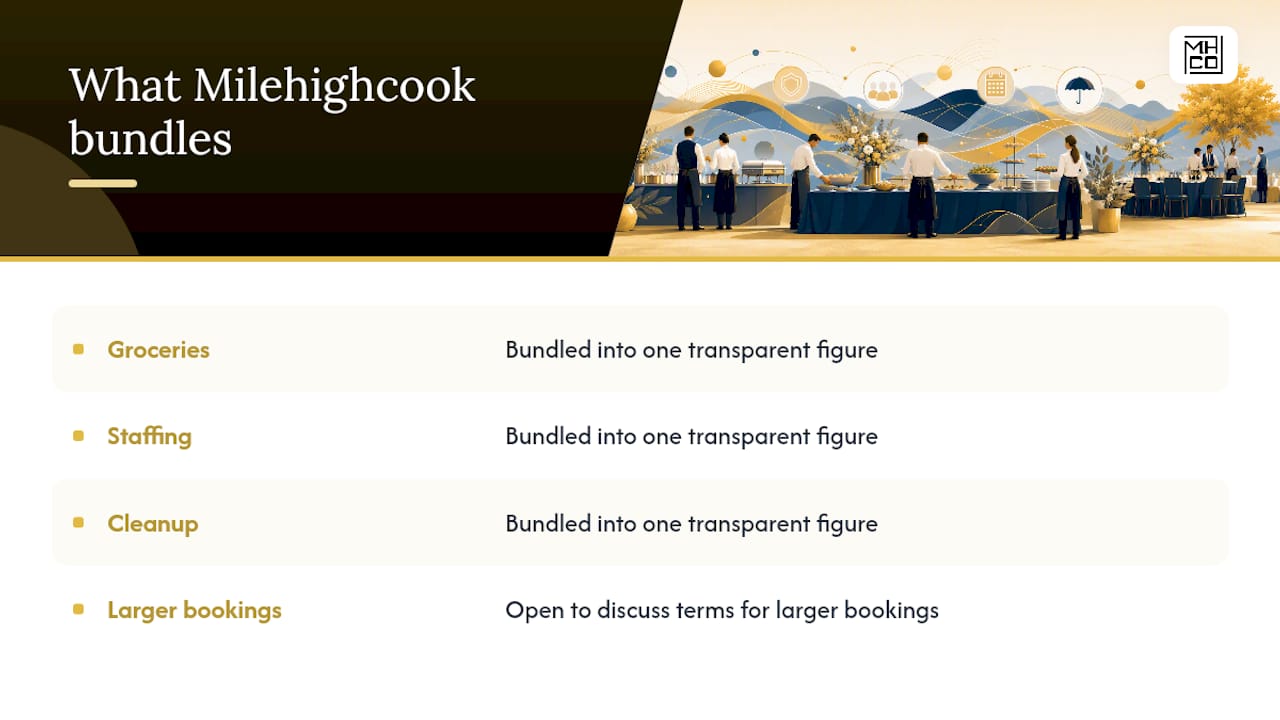
Milehighcook's all-inclusive pricing model makes cancellation costs easier to calculate since groceries, staffing, and cleanup are bundled into one transparent figure, and the team is open to discussing reasonable terms for larger bookings before you sign.