
Expect to pay a range of costs per person for corporate catering in Colorado, with the format you choose (boxed lunch versus a fully staffed plated dinner) being the main factor influencing price. Denver's local minimum wage is higher than the state average, which contributes to increased costs for staffed catering services.
TL;DR:
- Staffing costs significantly influence catering prices, with staffed buffets and full-service plated dinners costing much more than drop-off options.
- A detailed, itemized quote should include food, delivery, labor, rentals, service charge, gratuity, and sales tax separately; vague estimates are unreliable.
- Denver's higher minimum wages and labor costs inflate catering expenses compared to other cities, especially for services requiring multiple staff members.
- MileHighCook offers all-inclusive pricing starting at $150 per person, providing a simplified, predictable alternative to complicated itemized quotes.
Table of Contents
- What Does Corporate Catering Cost in Colorado?
- What's Included in a Catering Quote, and What Gets Added Later?
- Why Does Catering Cost More in Denver Than Other Cities?
- How Do You Calculate an All-In Catering Budget?
- What Should You Ask a Caterer Before You Book?
- How MileHighCook Simplifies Corporate Catering Budgets
- A Budgeting Mistake I See Constantly
- Get a Straightforward Quote for Your Next Corporate Event
- Sources
- FAQ
What Does Corporate Catering Cost in Colorado?
Corporate catering prices in Colorado break down almost entirely by service format, not by the food itself. A tray of the same sandwiches can cost $18 a head or $45 a head depending on whether someone drops it off or stands behind it serving your team. That's the first thing to understand before you request a single quote: you're not really pricing food, you're pricing labor and logistics wrapped around food.
Here's how the market breaks down in Denver and across the Front Range, based on current per-person ranges for office catering in Denver:
- Boxed lunches or sandwich platters: $16 to $28 per person, typically including packaging, napkins, and utensils. Some basic options run closer to $13 to $18, according to local Denver pricing data, but drinks and platter upgrades usually cost extra.
- Drop-off buffet: usually priced within a moderate range per person. You get food delivered in trays or chafing dishes, sometimes with basic setup, but no one stays to serve or clean up.
- Staffed buffet: generally costs more per person. This service adds an actual server presence, on-site setup, and someone monitoring food levels throughout the event.
- Plated or full-service dining: typically falls into the higher end of per-person catering costs. This format involves the highest labor effort with servers, often a chef presence, coordinated courses, and full cleanup.
- Snacks and beverage add-ons: usually priced separately either per person or by the platter for items like coffee service, pastries, or an afternoon snack spread.
The jump from drop-off to staffed buffet is where most planners get surprised. You're not paying more for better food. You're paying for people. A staffed buffet requires at least one server on-site for hours, and in Denver that labor line is expensive before you even factor in the meal itself.
Plated service sits in its own category entirely. At $72 to $155+ per person, you're often looking at multiple servers, a coordinated timeline, sometimes rental china and glassware, and a level of choreography that a boxed lunch drop-off never needs. For an executive dinner or a client-facing event where presentation matters, that premium buys something real. For a Tuesday team lunch, it's overkill.

Snack and beverage add-ons are typically budgeted separately from the base menu price. A coffee and pastry spread for a morning meeting, an afternoon snack table, or a hosted bar for an evening event all get quoted separately in most cases. Ask upfront whether beverages are included or itemized. It's one of the most common places a quote quietly grows after the fact.
What's Included in a Catering Quote, and What Gets Added Later?
A clean corporate catering quote should show you food cost, delivery, labor, rentals, service charge, gratuity, and sales tax as separate lines. If a quote gives you one flat number with no breakdown, that's a request for clarification, not a quote you can compare against anything else.
Here's what a properly itemized quote covers:
- Food and menu items: the actual per-person cost of the dishes selected.
- Delivery: often a flat fee based on distance, sometimes waived above a minimum order size.
- On-site labor: servers, chefs, or attendants, usually billed hourly with a minimum shift length.
- Equipment rentals: chafing dishes, linens, plates, glassware, or a warming station if the venue doesn't provide them.
- Setup and cleanup: sometimes bundled into labor, sometimes billed as its own line.
- Service charge: typically 18% to 22% of the subtotal, separate from gratuity.
- Gratuity: may be included automatically or left to your discretion, depending on the caterer.
- Sales tax: applied to prepared food per Colorado and local rules.
- Beverage service: coffee, soft drinks, or bar packages, frequently priced apart from the meal.
Pro Tip: Ask every caterer to send a sample itemized invoice from a past event similar in size to yours before you sign anything. A vendor who hesitates to share one is telling you something about how their final bill will look.
One line item planners consistently forget: insurance. If your venue requires outside caterers to carry a certificate of insurance naming the venue as an additional insured, expect a flat administrative fee tacked onto the quote to cover that paperwork. It's a small cost, but it catches people off guard when it shows up on the final invoice instead of the initial estimate.
Service charges deserve a closer look because they're often confused with gratuity. Gratuity, when it's separate, goes to staff. Some caterers combine the two into one line; others itemize both. Neither approach is wrong, but you need to know which one you're looking at before you compare two vendors' bottom lines.
Why Does Catering Cost More in Denver Than Other Cities?
Colorado's labor market is the single biggest reason your catering quote in Denver runs higher than a comparable quote in a lower-wage state. Colorado's statewide minimum wage sits at $15.16 per hour for 2026, but Denver sets its own city minimum wage at $19.29 per hour, well above the state floor. Every staffed event you book bakes that wage rate directly into the labor line of your quote.

Denver allows a tip credit affecting tipped workers' wages, enabling them to earn a lower base wage supplemented by tips that bring their total pay to the minimum wage. Caterers factor this into how they price staffed labor, and it's part of why a server-heavy plated event costs so much more than a self-serve buffet.
Sales tax on prepared food adds another layer. Always confirm with your caterer whether their quoted price is pre-tax or already includes it.
Seasonality is the other lever worth watching. Outdoor corporate events spike between May and September, and December brings a wave of holiday parties. During those windows, expect premiums of 10% to 25% on staffed events simply because demand for servers and chefs outpaces supply. Distance from a caterer's kitchen and limited parking or loading access at your venue can also trigger a delivery surcharge, so mention your venue's logistics upfront rather than after you get a quote.
How Do You Calculate an All-In Catering Budget?
The fastest way to estimate your real total cost is this formula: take your menu price per person, multiply by your headcount, then multiply that subtotal by roughly 1.3 to account for delivery, service charge, rentals, gratuity, and tax. That 28% to 32% buffer reflects typical add-on costs layered onto the base menu price in most Denver-area quotes.
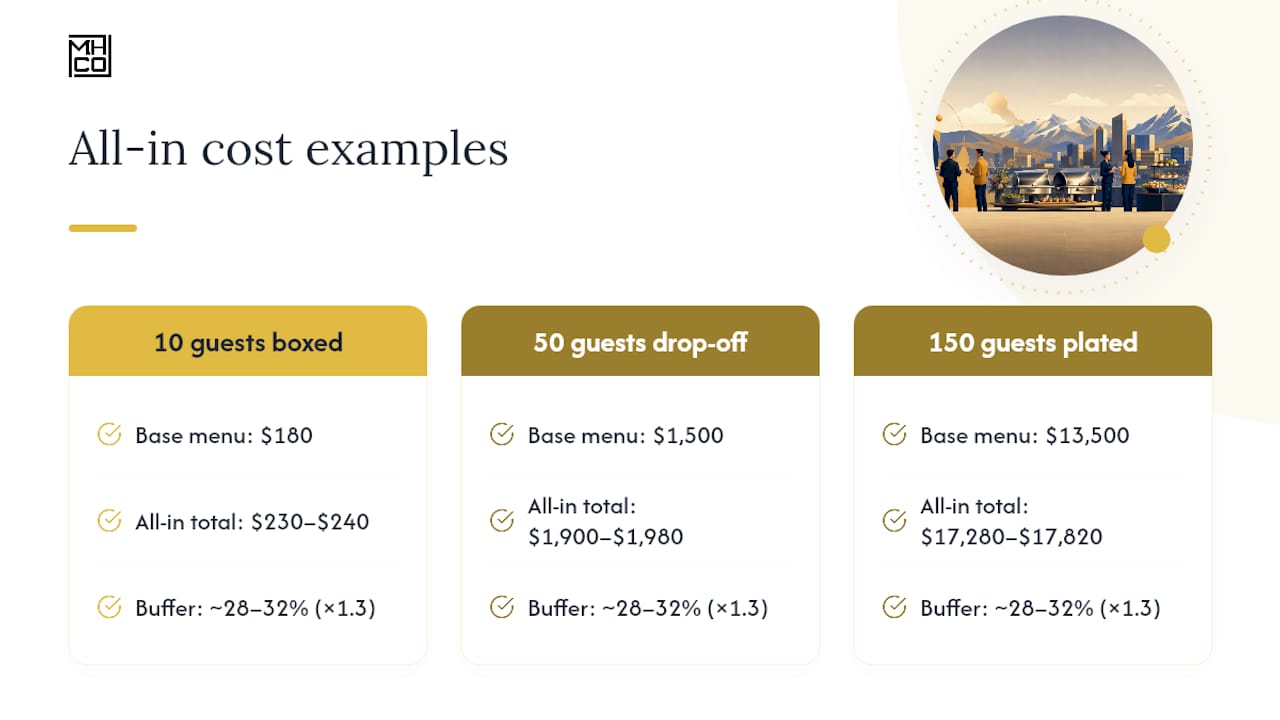
Here's how that plays out across three common headcounts and three service levels:
10 guests, boxed lunch: $18/person × 10 = $180 base. Add the buffer, and you land around $230 to $240 total, since delivery fees don't scale down much for small orders.
10 guests, staffed buffet: At $50/person × 10 = $500 base, this jumps to roughly $650 to $680 once labor minimums kick in. Most caterers require a 3 to 4 hour minimum shift per server, so a small event still pays close to what a mid-size one pays for staffing.
50 guests, drop-off buffet: $30/person × 50 = $1,500 base. Apply the buffer and you're at roughly $1,900 to $1,980 all-in.
50 guests, staffed buffet: $55/person × 50 = $2,750 base, landing around $3,520 to $3,630 total. At this headcount, expect two servers on-site, since typical staffing ratios run one server per 20 to 25 guests.
150 guests, drop-off buffet: $28/person × 150 = $4,200 base, roughly $5,375 to $5,545 all-in.
150 guests, plated full-service: $90/person × 150 = $13,500 base. With a full serving team, this scales to approximately $17,280 to $17,820, and that's before any specialty rentals or a customized menu tasting.
The sensitivity here matters. Going from drop-off to staffed buffet at 50 guests adds roughly $1,600 to your total, almost entirely in labor. Going from staffed buffet to plated service at 150 guests can add more than $10,000. Before you commit to a service level, decide what you actually need: a networking lunch where people grab a plate and mingle doesn't need the same labor investment as a seated dinner honoring a client.
What Should You Ask a Caterer Before You Book?
Getting an accurate, comparable quote starts with what you send the vendor, not what they send back. Vague requests get vague pricing. Specific requests get specific numbers.
- Confirm the date, time, and exact headcount, including a buffer for last-minute additions.
- Specify the service format you want: boxed lunch, drop-off, staffed buffet, or plated service.
- List dietary restrictions upfront (vegetarian, gluten-free, allergies) so pricing reflects the real menu, not a placeholder one.
- Describe your venue's access, including parking, loading dock availability, elevator access, and any building rules about outside vendors.
- Note power and prep space needs, especially if the caterer needs an outlet for warming equipment or a staging area.
- Ask for a fully itemized written estimate that separates food, labor, delivery, rentals, service charge, gratuity, and tax.
- Ask about cancellation policy, insurance requirements, and health permits before signing anything.
- Confirm the server-to-guest ratio and whether gratuity is included or discretionary.
Pro Tip: If a vendor's pricing description uses words like "starting at" with no itemized breakdown, ask directly for the highest-case scenario in writing. That single question filters out most of the vendors who plan to surprise you later.
Watch for red flags: pricing that's quoted as one flat number with no line items, unclear minimums that only surface after you've committed, or automatic gratuities buried in fine print rather than stated clearly upfront. A caterer who welcomes detailed questions about their pricing structure is usually the one whose final invoice matches their original estimate. If you want a sense of how venue logistics factor into these conversations, this private chef catering guide for Denver venues walks through what to check before you book a space. It also helps to align on shared vocabulary with vendors early. This corporate travel and event terminology guide covers terms like setup time and breakdown that often get glossed over in early conversations.
How MileHighCook Simplifies Corporate Catering Budgets
Every itemized checklist above exists because most catering quotes are built from separate moving parts. MileHighCook takes a different approach for corporate clients who want one number instead of six line items to reconcile.
The all-inclusive model covers groceries, chef fees, service staff, and full cleanup in a single quoted price. There's no separate rental fee to negotiate, no guessing whether gratuity is baked in, and no follow-up invoice for cleanup labor. Private dining experiences with MileHighCook in Denver start from $150 per person, which sits in the same range as full-service plated catering elsewhere in this guide, but arrives as one predictable number rather than a stack of add-ons.
This model tends to fit best for:
- Executive dinners or leadership retreats where presentation and hospitality matter more than volume.
- Client-facing events where you need a consistent, high-end experience without managing multiple vendors.
- Smaller, premium corporate gatherings where a full plated buffet quote would otherwise run into the same price range anyway.
MileHighCook works with CIA-trained chefs and holds a 4.9-star average across more than 65 verified reviews, with active service across Colorado, Arizona, Utah, and Wyoming. For planners managing a budget spreadsheet, that consolidated pricing structure removes a lot of the reconciliation work that itemized catering quotes require. Full package details live on the corporate catering services page.
A Budgeting Mistake I See Constantly
The single biggest mistake I see planners make is locking in a per-person food price without confirming whether service charge and gratuity are already included.
My prioritization rule is simple: match your staffing level to your event's actual goal. A networking mixer doesn't need plated service. A client dinner where you're building a relationship probably does. Don't upgrade service format because it sounds more professional. Upgrade it because the room full of people actually needs someone standing there serving them.
— Stephen
Get a Straightforward Quote for Your Next Corporate Event
If you've read this far, you already know the frustration: itemized catering quotes are useful for comparison shopping, but they're a lot of moving parts to manage when you just need one reliable number for your budget approval. MileHighCook exists for exactly that gap. Instead of stitching together food cost, delivery, staffing, rentals, and cleanup fees from a caterer's separate line items, you get one all-inclusive price that covers groceries, CIA-trained chef service, staff, and complete cleanup.
That structure works especially well for executive dinners, client hospitality events, and smaller premium gatherings where you'd otherwise be paying plated-service prices anyway, just spread across a confusing invoice. Private dining in Denver starts from $150 per person, and the full range of catering packages across Colorado, Arizona, Utah, and Wyoming is outlined on the catering services page. If your next event calls for something more polished than a drop-off buffet but you don't want to manage six vendor line items to get there, request a custom quote and get a real number back within a day or two.
Sources
- How Much Does Office Catering Cost in Denver? - Zerocater
- Colorado Minimum Wage 2026: Rates, Denver Wages, Tip Rules
- Cateringcostguide
FAQ
How much does professional catering cost?
Professional catering in Colorado typically ranges from $16 per person for a boxed lunch to $155 or more per person for full plated service, with staffed buffets falling in the $40 to $70 range.
How much does a catering company charge?
Most catering companies charge based on service format rather than a flat rate, with the food cost representing only part of the total.
How much should you charge, or expect to pay, per head for catering?
Per-head pricing depends heavily on service level: expect $16 to $28 per head for boxed lunches, $22 to $40 for drop-off buffets, $40 to $70 for staffed buffets, and $72 to $155+ for plated full-service dining.
How much should you tip on a corporate catering order?
Gratuity practices vary by caterer.
Does MileHighCook offer all-inclusive corporate catering pricing?
Yes, MileHighCook's private-chef and catering packages bundle groceries, chef fees, service staff, and cleanup into one quoted price, starting from $150 per person for private dining in Denver.