

Kosher-style catering means food served in the tradition of Jewish cuisine without formal kashrut supervision. No mashgiach, no certified equipment separation, no hechsher on the ingredients. It can work well for many social events, but it is not acceptable for guests who keep strict kosher, and calling it "kosher" in your invitations or marketing can create real legal and social problems. According to My Jewish Learning, kosher-style is a stylistic designation only, and planners should always ask for written clarification from any caterer using the term.
Here is the short verdict for event planners:
- Kosher-style is a reasonable choice when your guest list is largely secular or culturally Jewish but not observant.
- If any guest keeps strict kosher, treat kosher-style as insufficient and arrange sealed, certified kosher meals for those guests.
- Get written clarification from your caterer about ingredients, sourcing, and whether a mashgiach will be present before signing any contract.
Key Takeaways
Kosher-style catering serves Jewish culinary tradition without kashrut supervision and works for secular or mixed guest lists, but it requires certified kosher meals for any observant guest.
| Point | Details |
|---|---|
| Kosher-style is not kosher | It lacks mashgiach supervision, certified ingredients, and equipment separation required for kashrut compliance. |
| Certified meals for observant guests | Order sealed, certified kosher meals from a licensed kosher caterer for any guest who keeps strictly kosher. |
| Ask the right questions | Require written confirmation of ingredients, supervision, and labeling before signing any catering contract. |
| Legal labeling matters | Use "kosher-style: no pork or shellfish; not certified kosher" in invitations and signage to avoid consumer confusion. |
| Milehighcook for mixed events | Milehighcook designs kosher-style menus and coordinates certified meal logistics for observant guests across CO, AZ, UT, and WY. |
Table of Contents
- What is kosher style catering, and how does it differ from strictly kosher?
- When does kosher-style catering make sense for your event?
- Sample menus and dish ideas for kosher-style events
- How to make sure observant guests are fed at your event
- Venue and kitchen logistics that affect your kosher-style plan
- How kosher-style and certified kosher catering differ in cost and timeline
- Questions to ask your caterer before you sign anything
- How a private-chef approach handles kosher-style events
- Legal and labeling concerns around the term "kosher-style"
- The case for being honest with your guests about what you are serving
- Milehighcook handles the dietary complexity so you do not have to
- Sources
- FAQ
What is kosher style catering, and how does it differ from strictly kosher?
The phrase "kosher-style" covers a wide range of practices, which is exactly what makes it tricky. At its loosest, it means a deli that serves pastrami and rye and feels Jewish. At its most careful, it means a caterer who avoids pork and shellfish, keeps meat and dairy off the same plate, and sources ingredients thoughtfully, but still operates without a certified supervisor on site.

Strictly kosher catering is a different category entirely. It requires a hechsher (a recognized kosher certification mark from an agency such as the OU, Star-K, or Kof-K), a mashgiach who supervises preparation and service, completely separate equipment and storage for meat and dairy, and adherence to rules governing slaughter, ingredient sourcing, and Sabbath observance. As the Mitzvah Guide's hechsher decoder explains, kosher-style lacks the mashgiach and equipment separation that define supervised kosher service, so observant guests will not accept it as kosher.
Well-known kosher-style establishments like Katz's Delicatessen and Russ & Daughters in New York serve Jewish foods steeped in tradition, but neither operates under full kashrut supervision. They are cited on Wikipedia's kosher-style entry as classic examples of the category: culturally Jewish, culinarily familiar, but not religiously certified.
| Category | Kosher-Style | Strictly Kosher |
|---|---|---|
| Ingredient sourcing | May avoid pork/shellfish; not certified | Certified kosher ingredients required |
| Kitchen supervision | No mashgiach; no formal oversight | Mashgiach present during prep and service |
| Meat/dairy separation | Often avoided on the menu; not enforced | Strictly enforced with separate equipment |
| Utensils and equipment | Shared kitchen equipment | Dedicated, separately maintained sets |
| Accepted by observant guests | No | Yes, with valid hechsher |
| Sabbath service | No restrictions | Requires Sabbath-compliant protocols |
What this means practically:
- A kosher-style caterer may serve chicken and a cream-based sauce at the same event, even if not on the same plate.
- Without a mashgiach, there is no guarantee that ingredient substitutions mid-service comply with kashrut.
- Equipment used for non-kosher prep cannot be made kosher without a formal process; a kosher-style kitchen has likely not gone through that process.
When does kosher-style catering make sense for your event?
The honest answer is: it depends entirely on who is coming and what they expect.
Kosher-style works well when your guest list is predominantly secular or culturally Jewish, when the event is a casual celebration rather than a synagogue-affiliated ceremony, and when no guests have communicated that they keep strictly kosher. A birthday dinner, a corporate lunch, a Hanukkah party with a mixed crowd, a bat mitzvah reception where the family has confirmed that kosher supervision is not required — these are all reasonable contexts for kosher-style cuisine.
When to avoid it:
- Any guest keeps strictly kosher. One observant guest changes the calculus. Provide sealed certified meals for that person rather than assuming the kosher-style menu covers them.
- The event is held at a synagogue or Jewish community center. Many venues require fully certified kosher catering and will not accept kosher-style service. Confirm this with the venue early, before you book a caterer.
- The family or hosts have communicated that kashrut observance matters to them, even if they have not specified a certification level.
- The event is a bar or bat mitzvah where grandparents or extended family who keep kosher will be present.
A practical decision rule: if you are unsure whether any guest keeps kosher, ask on the RSVP. A simple line, "Please note any dietary requirements, including kosher," takes thirty seconds to add and saves significant logistical headaches later.
Sample menus and dish ideas for kosher-style events
Wedding and event guides commonly describe kosher-style menus as "non-offensive" catering: menus that avoid the most obvious kashrut violations while still offering variety and crowd appeal. The most practical approach is to build around fish, vegetarian, and pareve (neither meat nor dairy) options, which satisfy the widest range of guests.
Dessert labeling deserves particular attention. If your main course includes meat, a dairy dessert like cheesecake violates the spirit of kosher-style and will confuse guests who are even moderately observant. Pareve desserts, fruit-based options, and non-dairy chocolate preparations sidestep that problem entirely.
For beverage stations, mocktail bars work well at kosher-style events because they are inclusive by default, require no wine certification questions, and give guests who do not drink alcohol a genuinely appealing option.

Pro Tip: Design your kosher-style menu around a fish or vegetarian anchor course. It eliminates the meat/dairy conflict entirely, keeps the menu pareve-friendly, and reads as thoughtfully Jewish without requiring any supervision. Guests who keep kosher will still need certified meals, but the rest of your guests will not notice the difference.
How to make sure observant guests are fed at your event
The standard approach, recommended consistently across event planning resources, is to order sealed, certified kosher meals from a licensed kosher caterer and deliver them separately to observant guests. Practical guides for Jewish event catering confirm this as the reliable workaround when the main catering is not certified.
Steps to execute this well:
- Identify observant guests at the RSVP stage. Ask directly; do not assume based on age or affiliation.
- Order sealed certified meals from a kosher caterer. The meals should arrive in tamper-evident packaging with a visible hechsher label. Do not transfer them to other serving dishes.
- Assign a staff member to handle certified meals separately. That person should not be plating or serving the kosher-style food simultaneously.
- Label certified meals clearly at the table. A small card reading "Certified Kosher Meal" with the certification agency's name is sufficient.
- Train servers on the distinction. Staff should be able to answer "Is this kosher?" accurately, which means knowing which dishes are certified and which are kosher-style only.
- Avoid cross-contact during warming. Certified meals should be warmed in their sealed containers or in a separate oven, not alongside unsupervised food.
- Communicate in advance. Let observant guests know before the event that certified meals will be available. It removes anxiety and prevents awkward moments at the table.
Seating matters too. Some observant guests prefer to sit near others who are also eating certified meals, simply for social comfort. A brief note on the RSVP confirmation, or a direct call from the host, goes a long way.
Venue and kitchen logistics that affect your kosher-style plan
Operational constraints are where many kosher-style plans quietly fall apart. A caterer may be willing to prepare a thoughtful kosher-style menu, but if the venue's kitchen has no separate prep space, no way to keep meat and dairy physically apart, and no provision for a mashgiach to enter, the logistics get complicated fast.
Key considerations:
- Separate prep space. Even for kosher-style service, having a dedicated area for fish and vegetarian prep reduces cross-contact and signals care to guests.
- Venue policy on outside food and supervision. Some venues prohibit outside caterers entirely. Others allow outside caterers but restrict access for supervisors. Confirm these rules before booking, because retrofitting a venue's kitchen for certified kosher service mid-planning is expensive and often impossible.
- On-site cooking vs. off-site prep. Kosher-style menus can often be prepped off-site and finished on-site with minimal equipment. Certified kosher service usually requires either a certified on-site kitchen or fully prepared, sealed delivery, which affects your timeline and staffing.
- Warming and service flow. Sealed certified meals need a warming protocol that does not compromise their certification. Plan for a separate warming station or a second oven if your venue has one.
Venue and kitchen constraints, including the absence of separate prep space and restrictions on outside supervisors, often contribute to certified kosher service costing more and requiring longer lead times than a kosher-style menu at the same venue.
How kosher-style and certified kosher catering differ in cost and timeline
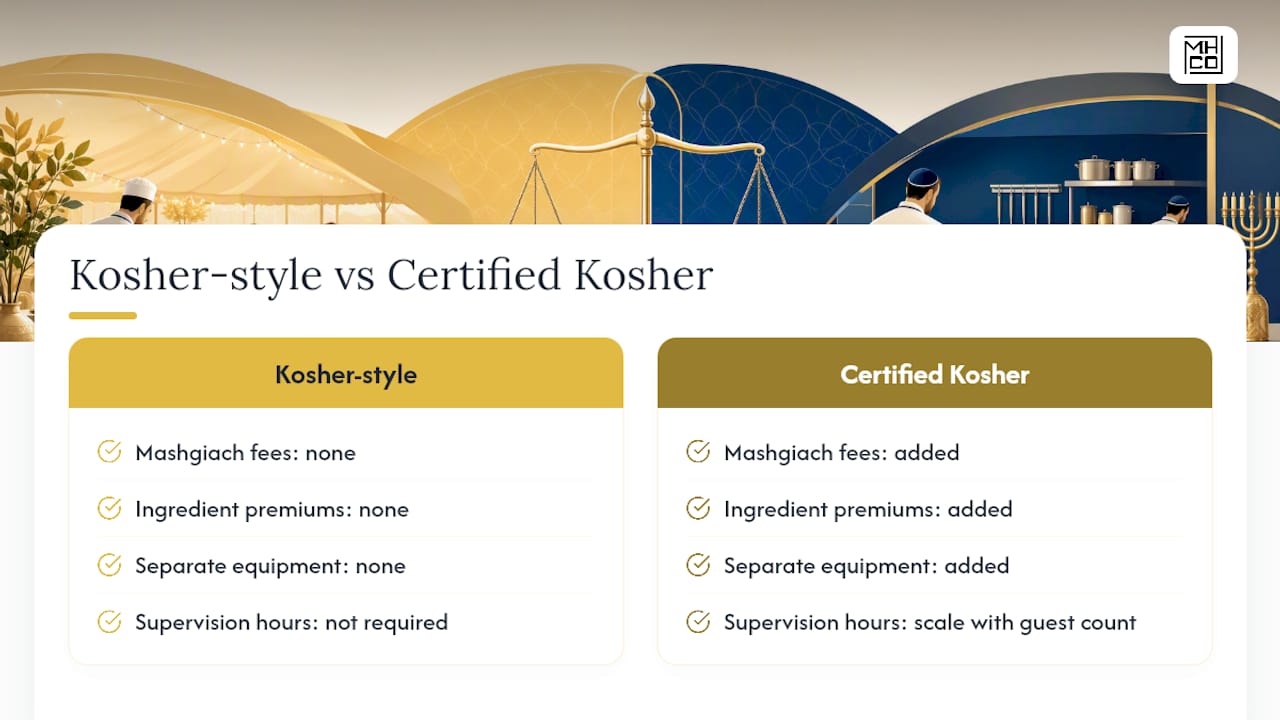
Cost is one of the most practical reasons planners choose kosher-style over certified kosher catering, and the gap is real. Certified kosher service adds several line items that kosher-style does not: mashgiach fees (typically charged by the hour or day), certified ingredient premiums, separate equipment rental or cleaning, and in some cases a second caterer for the certified meals.
Cost and timeline considerations:
- Mashgiach fees are a direct add-on for certified service. Rates vary by market and supervision agency, but they are a fixed cost regardless of guest count.
- Certified ingredient premiums apply to meat especially. Kosher-certified beef and poultry cost more than conventional equivalents because of the additional slaughter and inspection requirements.
- Sealed certified meal orders for individual observant guests are typically priced per person and ordered through a separate kosher caterer, adding a second vendor relationship to manage.
- Lead time for certified kosher catering is longer. Coordinating with a supervision agency, confirming the venue's kitchen status, and sourcing certified ingredients all require earlier booking, often six to twelve weeks ahead of the event rather than the four to six weeks typical for standard catering.
- Ask for itemized pricing from any caterer who quotes a kosher or kosher-style package. Line items for supervision, ingredient sourcing, and equipment should be visible separately, not bundled into a single per-head rate.
For holiday catering planning, the same lead-time logic applies: the more dietary coordination your event requires, the earlier you need to start.
Questions to ask your caterer before you sign anything
Bring this checklist to every tasting and contract conversation. Vague answers are a red flag.
Questions to ask:
- Do you use kosher-certified ingredients, and can you provide documentation?
- Will a mashgiach be present during prep and service, or is this kosher-style only?
- How do you handle meat and dairy separation in your kitchen and during service?
- Can you provide sealed, certified kosher meals for observant guests, and who is your kosher caterer source?
- How will kosher-style and certified meals be labeled at the event?
- What happens if an ingredient substitution is needed on the day? Who approves it?
- Can you provide written confirmation of everything we have discussed before the deposit?
Red flags to watch for:
- The caterer uses "kosher" and "kosher-style" interchangeably without distinguishing them.
- They cannot name the certification agency for any ingredient they claim is certified.
- The contract describes the menu as "kosher" without specifying supervision or certification.
- They resist putting dietary claims in writing.
- They have no established relationship with a certified kosher caterer for sealed meal orders.
Contract dealbreaker: Any contract that uses the word "kosher" without specifying whether it means certified (with a named hechsher and mashgiach) or kosher-style (unsupervised) should be revised before you sign. Ambiguity in the contract becomes your problem at the event.
How a private-chef approach handles kosher-style events
On the day of the event:
- Staff are briefed before service on which dishes are kosher-style and which are certified, and on how to answer guest questions accurately.
- Certified meals are warmed in sealed packaging, plated only at the table (or delivered sealed), and labeled with a visible certification card.
- Kosher-style dishes are labeled clearly as "kosher-style: no pork or shellfish, not certified kosher."
- A single staff member is designated to handle certified meal service to prevent cross-contact.
Caterers experienced with Jewish events often recommend tiered menu planning, with traditional, modern, and pareve/dairy-free stations running simultaneously. This approach satisfies multiple guest groups without requiring a completely separate service line.
Pro Tip: When serving a mix of kosher-style and certified meals, keep the plating style consistent. Use the same plate shape, the same garnish approach, and the same portion size for both. Observant guests should not feel they received a lesser meal, and other guests should not be able to identify who ordered what at a glance.
Legal and labeling concerns around the term "kosher-style"
"Kosher-style" is legally ambiguous, and in some U.S. jurisdictions it has been treated as potentially misleading under consumer protection laws. Wikipedia's entry on kosher-style notes that the term can confuse consumers who assume religious compliance when none exists. Critics, including commentary from Orthodox sources, argue that the phrase dilutes the meaning of kashrut and creates false impressions about religious supervision.
For event planners, the practical implications are straightforward:
- Do not describe your event catering as "kosher" in invitations or signage unless it is certified. Use "kosher-style" explicitly, and add a clarifying note.
- Recommended wording: "Kosher-style menu: no pork or shellfish; not certified kosher. Certified kosher meals available upon request."
- Get caterer claims in writing before the deposit. If a caterer tells you verbally that their food is "basically kosher," that statement means nothing if a guest raises a complaint or if the event is held at a venue with kashrut requirements.
- Document the certification agency for any ingredient or meal the caterer claims is certified. A name like OU, Star-K, or Kof-K is verifiable; "we use kosher products" is not.
- Review your venue contract for any language about kashrut compliance. Some venues include clauses that require certified kosher service for events held in their space.
The case for being honest with your guests about what you are serving
Most planners who choose kosher-style catering are not trying to mislead anyone. They are trying to be thoughtful about Jewish culinary tradition while managing a real budget and a mixed guest list. That is a legitimate position, and it works, as long as the communication is clear.
The mistake is in the framing. Describing a menu as "kosher" when it is kosher-style, or assuming that avoiding pork and shellfish is sufficient for observant guests, creates a situation where guests who keep kashrut arrive expecting one thing and receive another. That is not a dietary inconvenience; for some guests, it is a genuine religious problem.
The safe default is simple: if you know any guest keeps strictly kosher, provide certified meals. Do not ask them to evaluate your caterer's sourcing practices or trust an unsupervised kitchen. A sealed certified meal from a reputable kosher caterer costs more and requires earlier coordination, but it removes any ambiguity. The guests who keep kosher will appreciate it. The guests who do not keep kosher will not notice.
Where planners often underestimate the complexity is in the middle ground: guests who are "somewhat observant" or who "usually keep kosher at home." There is no reliable way to know where each person draws their line without asking directly. The RSVP question is not intrusive; it is respectful.
Milehighcook handles the dietary complexity so you do not have to
Planning a kosher-style event with mixed dietary needs means managing two parallel service tracks, clear labeling, staff training, and vendor coordination, all while keeping the food genuinely good. Milehighcook's CIA-trained private chefs handle exactly this kind of layered event across Colorado, Arizona, Utah, and Wyoming, with all-inclusive pricing that covers groceries, chef fees, service staff, and complete cleanup.

For kosher-style events, Milehighcook designs menus around fish, vegetarian, and pareve anchor dishes that work for the widest range of guests, and coordinates sealed certified kosher meals for observant guests when needed. Every detail, from labeling to warming logistics to server briefings, is managed before the first guest arrives. The 4.9-star rating from over 65 verified reviews reflects what happens when dietary accommodation is treated as a core service, not an afterthought.
Reach out early if your event requires kosher coordination. Certified meal sourcing and dietary logistics take time to arrange properly. Request a custom quote and let the team build a plan that works for every guest at your table.
Sources
- What is Kosher Style? | My Jewish Learning
- Kosher style
- Hechsher Decoder: OU vs Star-K vs Kof-K (and Why It…)
- Jewish wedding catering: Ideas for kosher-style, or 'non-offensive' menus vs. strictly kosher food
FAQ
What is kosher style catering?
Kosher-style catering serves food in the Jewish culinary tradition, typically avoiding pork and shellfish, but without formal kashrut supervision, a mashgiach, or certified ingredients. It is a cultural designation, not a religious one.
What is a kosher-style menu?
A kosher-style menu typically avoids pork and shellfish, limits obvious meat and dairy combinations, and features dishes like smoked salmon, matzo ball soup, roasted chicken, and pareve desserts. It does not carry a hechsher certification and is not accepted as kosher by observant guests.
What should you feed kosher guests at an event?
Order sealed, certified kosher meals from a licensed kosher caterer, delivered in tamper-evident packaging with a visible hechsher label. Serve them separately, label them clearly, and train staff to handle them without cross-contact with unsupervised food.
Is kosher-style catering cheaper than certified kosher?
Generally yes. Certified kosher catering adds mashgiach fees, certified ingredient premiums, and separate equipment costs that kosher-style service does not require. The gap widens for larger events where supervision hours and certified sourcing scale with guest count.
When is kosher-style catering not enough?
Kosher-style is insufficient whenever a guest keeps strictly kosher, when the event is held at a venue or synagogue that requires certified kashrut compliance, or when the hosts have communicated that religious observance matters to the guest list.