

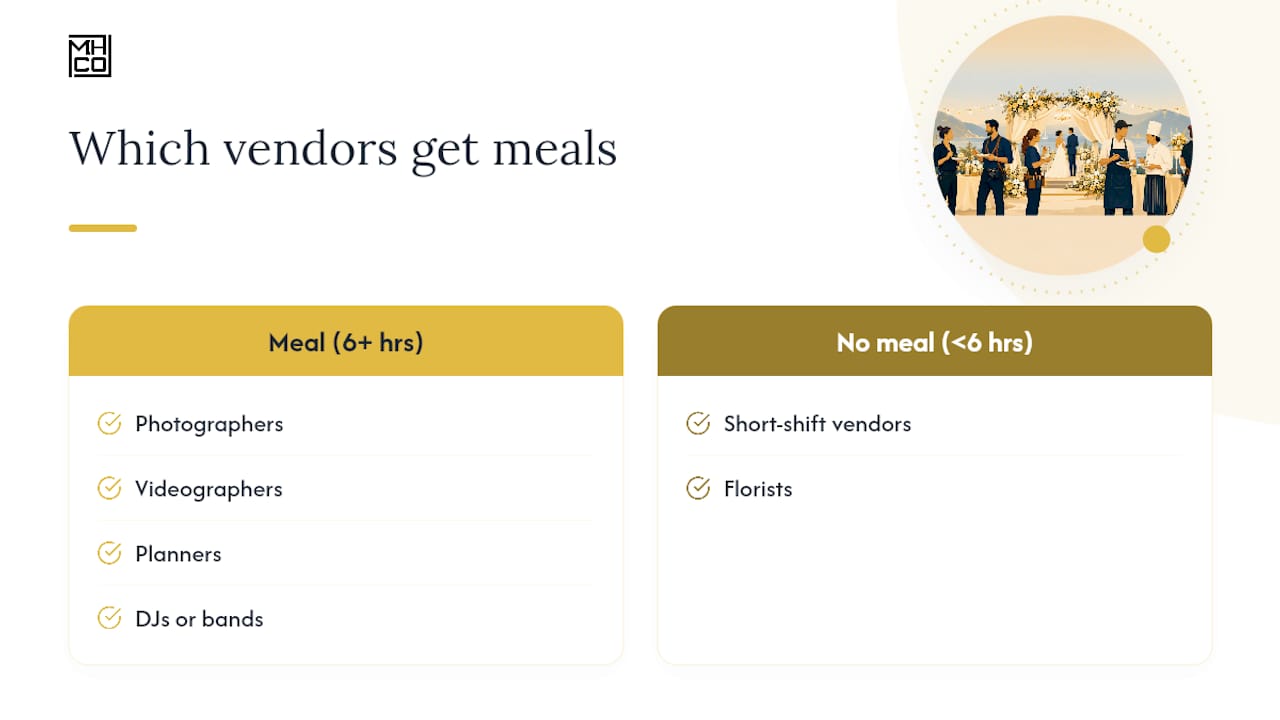
Yes, you should feed any wedding vendor who works through your reception, and the rule of thumb is simple: if they're on-site six hours or more, they get a meal. Check every vendor contract for a meal clause, count everyone who can't leave the venue to grab dinner, and budget for a hot meal or its equivalent. Vendor meals typically run $25 to $45 per person, roughly half the cost of a guest entrée.
- Feed vendors working 6+ hours
- Audit contracts for a meal clause
- Budget $25 to $45 per vendor meal
Quick Number: Vendor meals typically cost about half the price of a plated guest entrée, often in the $25 to $45 range per person.
Key Takeaways
Vendor meals work best when couples treat them as a contract detail confirmed early, not an afterthought handled the week of the wedding.
| Point | Details |
|---|---|
| Feed long-shift vendors | Provide a meal for any vendor working six or more hours on-site. |
| Audit contracts early | Check every vendor contract for a meal clause about five months before the wedding. |
| Budget realistically | Plan for $25 to $45 per vendor meal, roughly half a guest entrée's cost. |
| Time meals carefully | Serve vendors slightly before guest entrées to protect coverage of key moments. |
| Consider a turnkey option | Milehighcook folds vendor meal planning, dietary needs, and cleanup into one all-inclusive event package. |
Table of Contents
- What Are Vendor Meals for a Wedding?
- Which Vendors Get a Meal at Your Wedding?
- When Should Vendors Eat During the Reception?
- What Should You Serve Wedding Vendors?
- How Much Do Vendor Meals Cost?
- What Should Vendor Meal Contracts Say?
- Where Should Vendors Eat at Your Reception?
- How Do You Coordinate Vendor Meals Step by Step?
- Does Feeding Vendors Actually Affect Their Work?
- What Wedding Vendors Wish Couples Knew
- Let Milehighcook Handle Your Vendor Meals
- Sources
What Are Vendor Meals for a Wedding?
A vendor meal is the food you provide to the professionals working your wedding, usually served during the reception dinner or during their break. It's not a courtesy add-on; it's functional. Vendors working an 8 to 12 hour day need fuel to keep their attention sharp during the last, most important hours of your night.
- Reception dinner service
- A designated break period during setup or teardown
- A packed meal for vendors leaving before service ends
Pro Tip: When you sign vendor contracts, ask directly whether they expect a hot meal or if a boxed alternative is acceptable. Getting this in writing early prevents a scramble later.
Which Vendors Get a Meal at Your Wedding?
Feed anyone who works through your reception and whose absence would create a gap in coverage. That generally includes your photographer and second shooter, your videographer and any assistant, your planner or coordinator, and your DJ or band along with their techs.
- Photographer and second shooter
- Videographer and assistant
- Planner or day-of coordinator
- DJ or band, plus sound techs
The test is simple: will they be working through dinner, and would stepping away to eat disrupt what they're covering? Vendors on short shifts, like a florist who delivers and leaves or an officiant who departs after the ceremony, usually don't need a reception meal, according to older but still relevant industry guidance.
- List every vendor booked for the day
- Mark arrival and departure times
- Circle who's on-site during dinner
- Add one spare meal for any assistant you might have missed
A couple with a photographer, second shooter, videographer, coordinator, and a four-piece band lands at eight vendor meals before counting a single guest.
When Should Vendors Eat During the Reception?
Most caterers default to serving vendors during guest entrée service, since kitchens are already plating and it's the path of least resistance. The trade-off is that your photographer might be eating instead of shooting your first dance or your parents' toast.
Many experienced planners push vendors to eat slightly before guests, right as cocktail hour winds down or just as the reception opens, so the team is fueled and ready when the moments that actually matter happen. Bands and DJs often prefer eating during cocktail hour since they're not performing yet.
- During guest entrées (caterer default)
- Just before guest service starts
- During cocktail hour for musicians and DJs
Pro Tip: Talk to your photographer and videographer directly about timing. They know exactly which fifteen-minute windows during your reception cannot be missed.
What Should You Serve Wedding Vendors?
Vendors generally want one of four things: a dedicated hot vendor meal, a simplified version of the guest entrée, a plate from the buffet, or a boxed meal when the venue has no space to sit down. A hot, substantial plate matters more than it sounds. A vendor running on a dry sandwich at hour nine of a twelve-hour day is a vendor whose focus starts slipping right when your reception peaks.
- Hot vendor-specific meal (protein, starch, vegetable)
- Simplified guest entrée
- Buffet plate
- Boxed meal or wrap for tight timelines
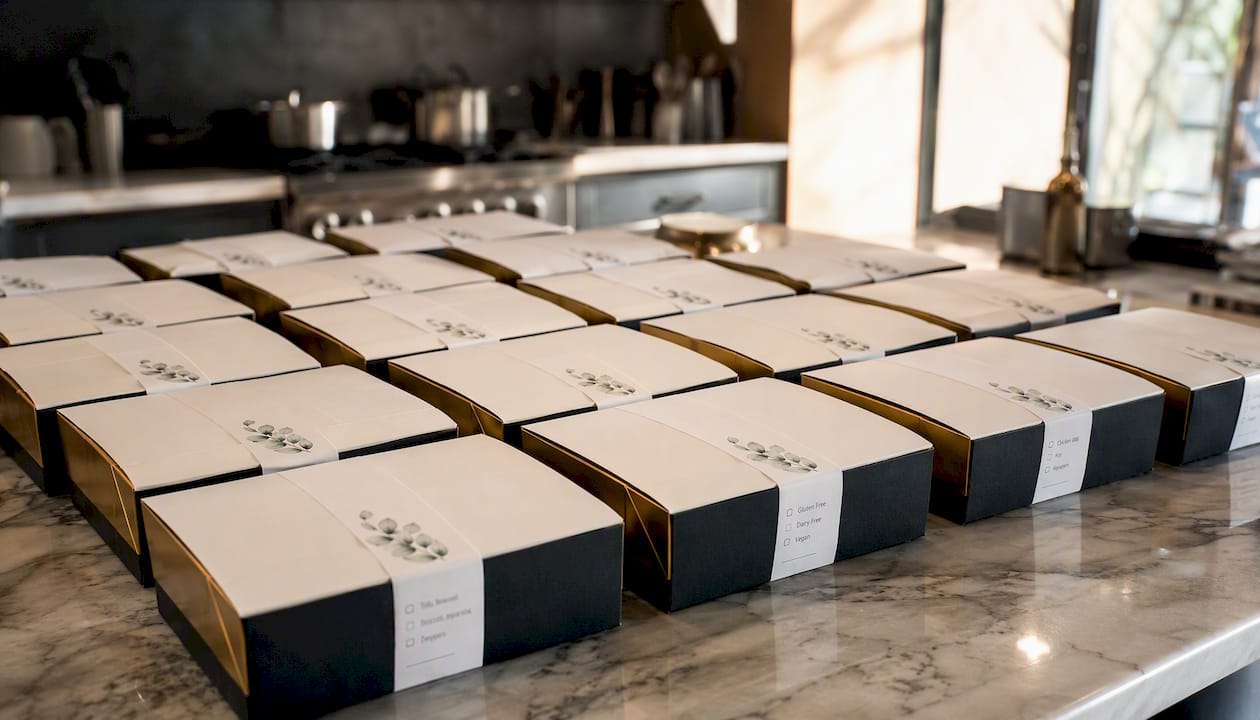
Collect dietary restrictions from every vendor when you book them, not the week before. Label each meal clearly with the vendor's name and diet note so nothing gets mixed up during a chaotic service window. Milehighcook builds dietary accommodation into every event it staffs, which removes this guesswork entirely from the couple's plate.
Pro Tip: Ask your caterer for a one-page vendor meal label system. It sounds minor, but it's the detail that prevents a gluten-free DJ from getting handed the wrong box.
How Much Do Vendor Meals Cost?
Vendor meals commonly run $25 to $45 per person, or roughly half the price of a plated guest entrée, since caterers simplify the menu and skip the plating flourishes reserved for guest tables.
Quick Number: Expect vendor meals to cost about 50% less per plate than your guest entrée, according to pricing guidance from Brides.
- Budget vendor meals separately from your guest headcount
- Expect a lower per-plate cost than guest meals
- Confirm whether vendor meals count toward any catering minimum
Ask your caterer directly whether vendor meals are billed as a flat add-on, priced per plate, or already folded into your service minimum. Some caterers offer a discounted "vendor meal" package built specifically for this, which can simplify your catering budget considerably.
What Should Vendor Meal Contracts Say?
Read every vendor contract for a meal clause specifying whether a meal is required, how many, whether it must be hot, and roughly when it's served. Vague language here is where most day-of disputes start, since a photographer expecting a hot plate and a caterer planning a cold box will clash right when you need them both focused.
- Meal type required (hot vs. boxed)
- Number of meals covered
- Timing relative to guest service
- Dietary accommodation language
Set a reminder to audit every vendor contract about five months before your wedding, then confirm final numbers with your caterer once you lock your guest headcount, per The Knot's contract guidance.
That's a workable line to paste directly into a vendor or catering agreement.
Where Should Vendors Eat at Your Reception?
Vendors generally prefer eating away from guest tables, in a kitchen area, staging room, or a quiet corner near their equipment. It keeps their downtime private and their gear within reach.
- Never seat vendors at guest tables
- Provide a dedicated, low-traffic rest area
- Stock water, utensils, napkins, and a trash bin
- Keep a clear path back to the dance floor or DJ booth
How Do You Coordinate Vendor Meals Step by Step?
Handling this well comes down to timing three conversations correctly.
- At booking: ask each vendor about dietary restrictions and expected shift length.
- Five months out: audit every vendor contract for a meal clause.
- At final headcount: confirm vendor meal counts, menu, and timing with your caterer.
- Assign one person (planner or a trusted family member) to deliver meals day-of
- Label each meal clearly by vendor and diet
- Confirm who handles vendor-area cleanup afterward
A reliable headcount method, per Sortra's planning guide, is logging arrival and departure times for every vendor, marking who's onsite for dinner, and adding one spare meal to cover any assistant you forgot to count.
Does Feeding Vendors Actually Affect Their Work?
It does, and the evidence backs up what planners have said for years. Vendors who work long shifts without a proper meal show measurable dips in attention during the final hours of coverage, exactly when speeches, cake cutting, and last dances happen. Silverhearth Lodge's planning guidance notes that feeding vendors preserves the energy and focus needed for those closing moments.
A vendor running on empty at hour ten isn't lazy. They're human, and hunger shows up in shakier shots and slower transitions.
Circle back to your contract audit around the five-month mark and confirm hot-meal language, vendor count, and timing before locking your final numbers with the caterer.
What Wedding Vendors Wish Couples Knew
I've watched more than one reception hit a rough patch simply because nobody planned for the band's dinner break, and suddenly the dance floor went quiet at the worst possible moment. The fix is almost always the same: someone asks early, writes it down, and confirms it again closer to the date. Working across Colorado, Arizona, Utah, and Wyoming, Milehighcook has seen firsthand how a little proactive planning around vendor meals keeps a wedding day running the way it's supposed to.

Let Milehighcook Handle Your Vendor Meals
Milehighcook is the alternative to juggling separate vendor-meal orders and caterer confirmations yourself. Its all-inclusive event pricing already folds in groceries, CIA-trained chef labor, service staff, and cleanup, which means vendor meals get planned, cooked, and served as part of one coordinated event, not a separate line item you have to chase down.
That includes reading your vendor contracts for meal clauses, confirming hot-meal requirements, and handling dietary accommodations for every professional on your team, not just your guests. You get a fixed, all-inclusive quote and one point of contact instead of five separate conversations. If you're planning a wedding in Colorado, Arizona, Utah, or Wyoming, start with a custom quote through Milehighcook's private chef services and ask about folding vendor meals directly into your event package.
Sources
FAQ
How do vendor meals work at weddings?
Couples typically arrange with their caterer to provide a simplified hot meal for vendors working through the reception, usually served during or just before guest entrées.
What is the 50/20/30 rule for weddings?
This budgeting rule allocates roughly 50% of your wedding budget to the reception (venue and catering), with vendor meals included within that portion.
Which vendors get a meal at a wedding?
Vendors working six or more hours on-site, such as photographers, videographers, planners, and DJs or bands, typically receive a meal, while short-shift vendors like florists usually don't.
What is the cheapest way to feed 100 people at a wedding?
Buffet-style or family-style service generally costs less per person than a plated dinner, and pairing that with a simplified vendor meal package (often $25 to $45 per vendor) keeps your full catering budget lower without sacrificing quality.
Recommended
- Rehearsal Dinners and Welcome Parties: Catering the Denver–Boulder Wedding Weekend | MileHighCook
- Estes Park Wedding Catering: Venues, Costs & How to Plan | MileHighCook Blog
- Backyard Wedding Catering: Ideas, Costs, and Hire Tips
- Salt Lake City Wedding Catering: Venues, Costs & How to Plan | MileHighCook