
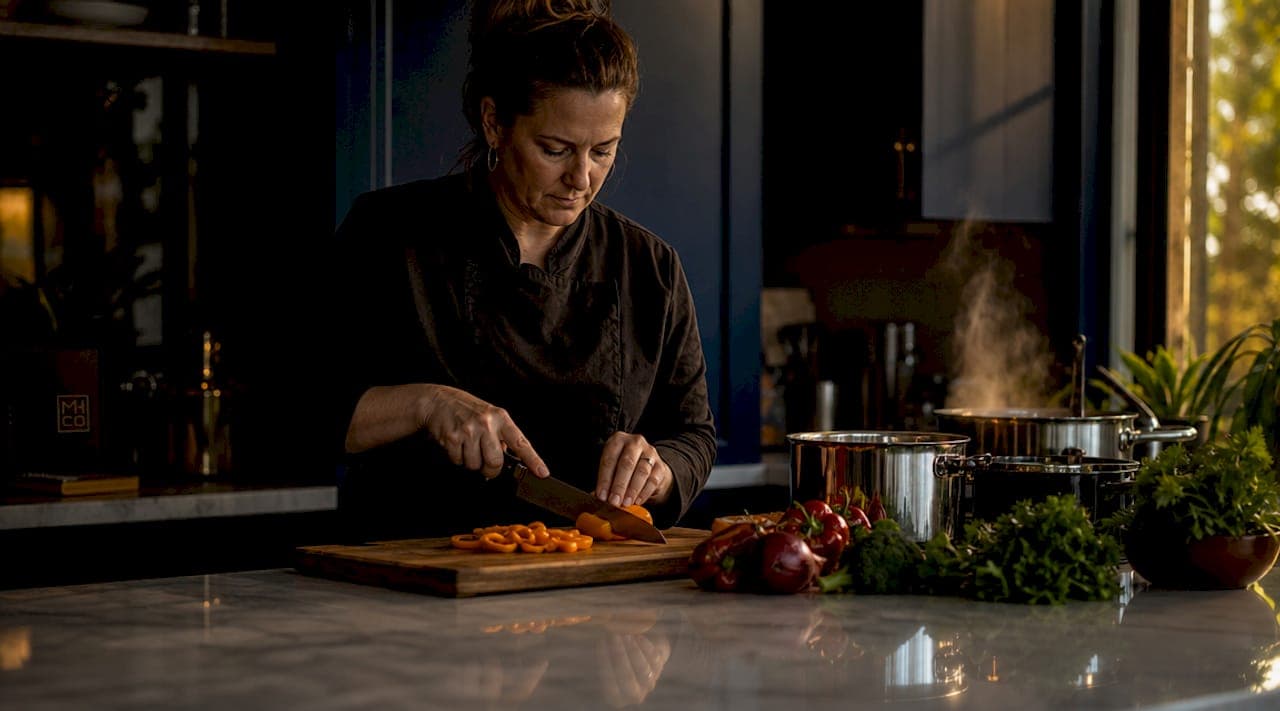
A private chef, also called an in-home chef, is a culinary professional who cooks in your home, tailoring every meal to your household's exact preferences, dietary needs, and schedule. The core reason why an in-home chef beats meal delivery comes down to one word: adaptability. Meal delivery services like Home Chef operate on fixed subscription menus with pre-portioned ingredients that cannot adjust to your family's evolving tastes or medical requirements. An in-home chef, by contrast, responds to your household in real time. Milehighcook, which deploys CIA-trained chefs across 30-plus markets including Colorado, Arizona, Utah, and Wyoming, represents the standard this level of service can reach.
Why in-home chefs beat meal delivery on customization
Meal kits prioritize scale and consistency, which means personalization is always a secondary concern. That trade-off works fine for households with simple, stable preferences. It breaks down the moment your family includes a child with a tree nut allergy, a parent managing Type 2 diabetes, or a teenager who has decided to go vegan this month.
An in-home chef solves all three of those problems in a single conversation before the grocery run. The menu shifts, the ingredients change, and dinner still happens on time. Meal delivery services require you to select a different subscription tier, wait for the next weekly box, and hope the new options satisfy everyone at the table.
The operational difference is structural. Subscription menus and limited flexibility define how meal kits work at scale. An in-home chef runs on a household feedback loop: what you loved last Tuesday, what your spouse could not finish, and what your doctor recommended this week all feed directly into next week's menu. That feedback loop is the core in-home chef advantage that no subscription box can replicate.
- Real-time menu changes: An in-home chef adjusts a dish mid-preparation if a family member's preference changes or an ingredient looks subpar at the market.
- Allergy and restriction management: Complex multi-allergy households get meals that are safe by design, not by label-reading.
- Occasion flexibility: A weeknight family dinner and a Saturday dinner party require completely different menus. An in-home chef handles both without a separate order.
- Pantry integration: Chefs work with what is already in your kitchen, reducing redundancy and waste that fixed-portion kits cannot address.
Pro Tip: Before your first session with an in-home chef, prepare a written list of every dietary restriction, texture preference, and cuisine preference for each household member. The more specific you are upfront, the faster the chef can build a menu rotation that feels personal rather than generic.
What are the nutrition and health advantages of in-home chefs?
Ingredient quality is where the gap between in-home chefs and meal delivery becomes most visible. Private chefs source heritage breed proteins, fresh truffles, A5 wagyu, and single-origin ingredients that bulk meal kit operations cannot stock. This is not luxury for its own sake. Fresher, higher-quality ingredients carry greater nutrient density, and a chef who selects produce at peak ripeness delivers measurably different nutrition than a kit assembled days earlier in a fulfillment center.

The health research supports this direction. Studies on home-delivered meal programs show that medically tailored meals improve anthropometric and metabolic parameters, and that groups receiving dietary counseling alongside customized meals showed greater reductions in key health markers. An in-home chef who communicates with your nutritionist or physician operates at exactly that intersection of food and health management.
Participants in medically tailored meal programs also demonstrate that taste and portion adaptations sustain dietary improvements over time. This finding matters for families managing chronic conditions. A meal kit delivers the same portion to every subscriber. An in-home chef adjusts your father's sodium intake, your daughter's caloric target, and your own macronutrient split simultaneously, at the same table, in the same meal.
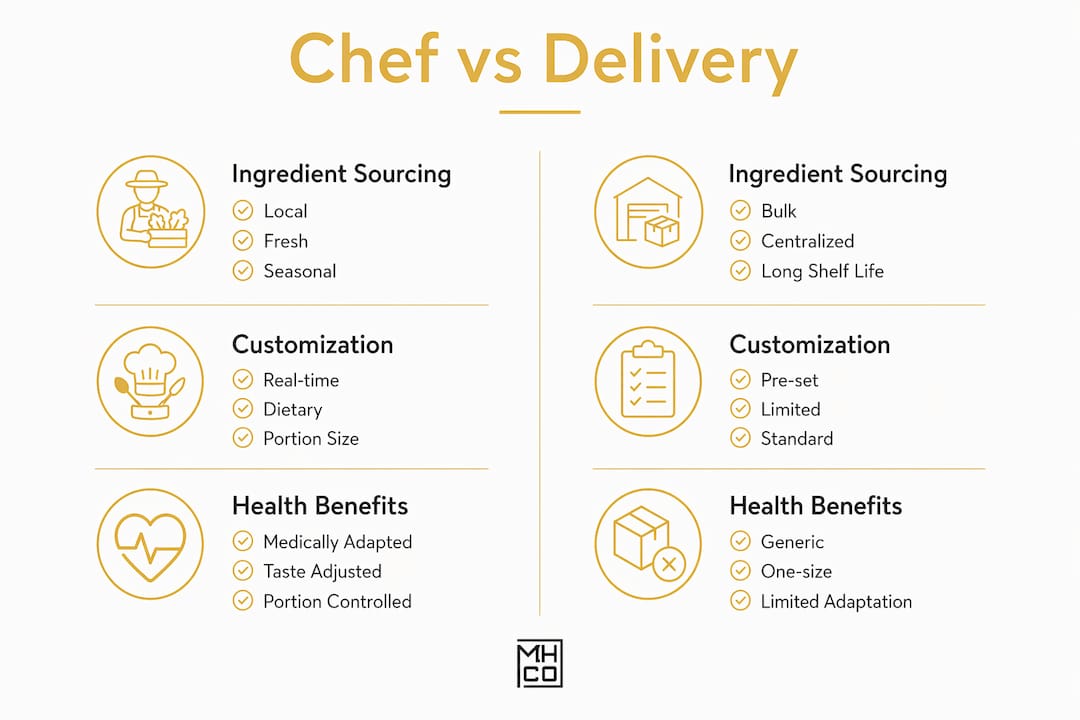
| Factor | Meal delivery service | In-home chef |
|---|---|---|
| Ingredient sourcing | Centralized, bulk purchasing | Local, seasonal, supplier relationships |
| Dietary customization | Tier-based subscription options | Household-specific, real-time adjustment |
| Medical diet support | Limited; label-based guidance | Direct integration with health protocols |
| Portion control | Fixed pre-portioned servings | Adjusted per individual household member |
| Nutrient freshness | Variable; fulfillment center timing | Market-fresh, chef-selected at peak quality |
Pro Tip: If a household member follows a medically prescribed diet, share the written protocol with your in-home chef before the first session. A trained chef can translate clinical nutrition guidelines directly into meals that are both compliant and genuinely enjoyable.
How in-home chefs enhance lifestyle convenience beyond meal delivery
Hiring a private chef buys back ten to fifteen hours of your week by handling meal planning, grocery shopping, cooking, and kitchen cleanup. That figure covers what most families spend across planning, shopping, cooking, and cleaning on a weekly basis. Meal delivery services reduce the cooking portion of that time but leave planning, shopping, and cleanup largely in your hands.
The lifestyle benefits extend well beyond time savings. An in-home chef integrates into your household's rhythm in ways that a weekly box cannot. Consider what that looks like across a typical week:
- Monday through Thursday: The chef prepares weeknight meals calibrated to your family's schedule, portion needs, and flavor preferences, leaving the kitchen clean and the refrigerator stocked with ready-to-heat portions for late nights.
- Friday: The menu shifts to something more celebratory. The chef sources a special ingredient, builds a multi-course dinner, and manages the full service experience without you lifting a finger.
- Saturday entertaining: Guests arrive to a custom menu designed around the occasion, dietary restrictions of attendees, and the season's best ingredients. You are present as a host, not a cook.
- Pantry and inventory management: The chef tracks what is running low, coordinates with your preferences, and eliminates the impulse grocery runs that inflate household food spending.
"Private chefs optimize for household execution, source premium ingredients, manage pantry, and adapt daily schedules in ways that no meal delivery model is designed to replicate." — 10 Reasons High-Net-Worth Families Prefer Private Chefs
The experiential dimension also matters. An in-home chef brings culinary storytelling to your table. A dish built around a specific region of Japan or a technique from a French brasserie creates a dining experience that a meal kit, regardless of its quality, cannot manufacture. That dimension of private chef flexibility is what separates a service from an experience.
What are the cost and value considerations for in-home chefs vs. meal delivery?
The upfront cost of an in-home chef is higher than a meal delivery subscription. That comparison becomes less straightforward when you account for what each service actually delivers. Meal kits are perceived as expensive and are primarily used by households earning above $100,000 annually. This means the audience already paying for premium meal delivery is the same audience for whom an in-home chef represents a realistic upgrade.
The hidden costs of meal delivery accumulate quickly. Fixed portions mean you either run short or throw food away. Plastic packaging adds environmental cost. The service does not cover grocery runs for items outside the box, restaurant meals on nights the kit does not satisfy, or the time you spend cooking and cleaning. An in-home chef, particularly one operating under an all-inclusive model like Milehighcook, bundles groceries, chef fees, service staff, and cleanup into a single predictable price.
- Food waste reduction: A chef who manages your pantry and cooks to your household's actual appetite generates less waste than fixed-portion kits.
- Impulse spending reduction: Families with an in-home chef make fewer unplanned restaurant visits and last-minute grocery runs.
- Ingredient value: Premium sourcing by a chef with supplier relationships often delivers better quality per dollar than retail pricing on meal kit ingredients.
- Time value: Ten to fifteen hours of recovered weekly time has real financial value for households where professional time is limited.
How to decide if an in-home chef fits your household
The decision between an in-home chef and meal delivery is not purely financial. It reflects how you prioritize time, health, and the quality of your daily dining experience. These questions help clarify which direction fits your household:
- Does your family include members with complex dietary restrictions, allergies, or medically prescribed diets?
- Do you regularly host guests and want to offer a dining experience rather than a catered meal?
- Is recovering ten or more hours of weekly time a meaningful lifestyle change for your household?
- Are you dissatisfied with the repetition and limited flexibility of your current meal delivery subscription?
- Do you value ingredient provenance and seasonal sourcing as part of how you eat?
Meal delivery remains a practical choice for single-person households, students, or families with simple, stable preferences who primarily need cooking time reduced. The calculation shifts when personalization, health management, or hosting quality become priorities. Exploring the real benefits for family meals is a useful starting point for households on the fence.
Pro Tip: When interviewing an in-home chef, ask for three specific examples of how they have adapted a menu for a household with dietary restrictions. The quality and specificity of the answer tells you more about their actual capability than any credential.
Key takeaways
An in-home chef outperforms meal delivery on every dimension that matters to households with specific health needs, busy schedules, or high standards for the dining experience.
| Point | Details |
|---|---|
| Customization is structural | In-home chefs adjust menus in real time; meal kits operate on fixed subscription cycles. |
| Health outcomes improve with personalization | Medically tailored, customized meal preparation supports better dietary adherence and health markers. |
| Time savings are significant | A private chef recovers ten to fifteen hours of weekly household time across planning, shopping, and cleanup. |
| Cost comparison requires full accounting | All-inclusive chef pricing often competes with meal delivery when hidden costs and food waste are included. |
| Ingredient quality is not comparable | Private chefs source seasonal, premium, and supplier-exclusive ingredients unavailable to bulk meal kit operations. |
What I have learned from watching families switch from meal kits to private chefs
I have spent years watching households make this transition, and the pattern is consistent. Families start with meal delivery because it feels like the practical middle ground. It reduces cooking time without the perceived complexity of hiring someone. Then the limitations surface: the box arrives and two family members cannot eat half the ingredients, the portions are wrong, the kitchen still needs cleaning, and nobody is particularly excited about what is on the table.
The shift to an in-home chef is rarely about luxury. It is about solving problems that a subscription model was never designed to solve. The families I have seen benefit most are not necessarily the wealthiest. They are the ones with the most specific needs: a child with multiple food allergies, a parent recovering from a cardiac event, a household where two adults work demanding schedules and dinner has become a source of stress rather than connection.
What surprises people most is how quickly the chef becomes integrated into the household's rhythm. Within a few weeks, the chef knows that one child will not eat anything green, that the adults prefer bold flavors on weekends, and that Friday nights call for something worth sitting down for. That institutional knowledge is the real asset. No meal kit builds it. You can read more about why hiring a private chef is worth it for households at exactly this inflection point.
— Stephen
Experience the Milehighcook difference for your household
Milehighcook brings CIA-trained private chefs directly to your home across Colorado, Arizona, Utah, Wyoming, and 30-plus additional markets. Every service includes groceries, chef fees, service staff, and complete kitchen cleanup under a single all-inclusive price, so there are no surprise costs after the meal. The brand holds a 4.9-star rating from over 65 verified reviews, reflecting a consistent standard that marketplace models cannot guarantee. Whether you need weeknight family meals tailored to complex dietary needs or a multi-course dinner for a special occasion, Milehighcook delivers the kind of personalized private chef experience that meal delivery was never built to provide. Explore the full range of sample menus to see the depth of customization available.
FAQ
What is an in-home chef and how do they differ from meal delivery?
An in-home chef is a culinary professional who cooks in your home, tailoring every meal to your household's specific preferences and dietary needs. Meal delivery services provide pre-portioned ingredients on fixed subscription menus with no real-time adjustment capability.
Are in-home chefs worth the cost compared to meal delivery subscriptions?
When you account for food waste reduction, time recovered, and the elimination of supplemental grocery runs and restaurant visits, the total cost difference narrows considerably. All-inclusive pricing models like Milehighcook's make the comparison even more direct.
Can an in-home chef accommodate complex medical diets?
Yes. In-home chefs can work directly with a household member's nutritionist or physician to translate clinical dietary protocols into meals that are both compliant and enjoyable, a level of integration that meal delivery services cannot provide.
How much time does hiring a private chef actually save?
A private chef handles meal planning, grocery shopping, cooking, and kitchen cleanup, which recovers ten to fifteen hours weekly for most households. Meal delivery services reduce only the cooking portion of that time.
Is an in-home chef only for wealthy households?
Private chef services are increasingly accessible to upper-middle-income households, particularly those already spending on premium meal delivery subscriptions, restaurant dining, and specialty grocery stores. The value calculation favors a private chef for households with complex dietary needs or demanding schedules.