
A ready-to-order brunch catering menu typically runs in the mid to high price range for a fully staffed buffet or plated service, while drop-off packages start at a more affordable rate. Most packages at any tier include pastries, a selection of savory mains, sweet mains, seasonal fruit, and a basic coffee and juice setup. Order minimums usually start at small group sizes for drop-off and somewhat larger groups for staffed events.
Quick price reference by format includes drop-off brunch boxes without staff, buffets with servers, plated full-service options, and private-chef brunches with custom menus and full staffing.
Most caterers require a minimum spend or headcount, generally for moderate group sizes for staffed events. Adding a mimosa station or premium protein like smoked salmon usually adds $8–$18 per person on top of the base package. To compare three ready-to-book tiers or request a Milehighcook quote, keep reading.
Key Takeaways
A well-planned brunch catering order comes down to four decisions: format, headcount with buffer, menu tier, and beverage package. Get those right and the rest follows.
| Point | Details |
|---|---|
| Per-person price ranges | Drop-off runs $15–$25 pp; staffed buffet $28–$45 pp; plated $45–$90 pp; private-chef all-inclusive $80–$150+ pp. |
| Always add a 10–15% buffer | For groups over 20, order 10–15% more than your confirmed headcount to avoid running short. |
| Family-style beats full à la carte | A two-sweet/two-savory prix-fixe with shared sides simplifies pricing, reduces waste, and covers most dietary needs. |
| Beverage upgrades punch above their cost | A mimosa station or cold-pressed juice bar at $8–$18 per person consistently drives the highest guest satisfaction per dollar spent. |
| Milehighcook all-inclusive pricing | CIA-trained chefs, groceries, staff, and cleanup in one price across CO, AZ, UT, and WY — request a custom quote to confirm availability. |
Table of Contents
- What does a brunch catering menu actually include at each price tier?
- What drives brunch catering costs up — and what hidden fees to watch for
- Which brunch service format fits your event?
- How much food to order: portion rules and a 50-guest example
- How to handle dietary needs without custom-making every plate
- Beverage packages: what to budget and how to set them up
- Lead times, setup logistics, and keeping food at safe temperatures
- How to place a brunch catering order: the checklist and questions to ask
- Why family-style menus outperform full à la carte for groups
- How to customize your brunch menu and request substitutions
- What to know about cancellation and refund policies
- Milehighcook brings a private chef to your brunch, all-inclusive
- Sources
- FAQ
What does a brunch catering menu actually include at each price tier?
Three tiers cover most events. Here is how they break down in practice.
| Package | Per Person | Savory Mains | Sweet Mains | Sides & Fruit | Beverages | Min. Guests |
|---|---|---|---|---|---|---|
| Budget | $18–$28 | Scrambled eggs, breakfast sausage | Pancakes or French toast | Seasonal fruit, hash browns | Drip coffee, OJ | 15 |
| Mid | $30–$45 | Quiche, bacon or turkey sausage | Waffles, pastry basket | Fruit platter, mixed greens, yogurt parfait | Coffee, cold-pressed juice | 20 |
| Premium | $50–$75 | Shakshuka, smoked salmon board, herb frittata | Belgian waffles, croissants, brioche French toast | Grain salad, roasted vegetables, acai bowls | Cold-pressed juices, sparkling water, mimosa station | 25 |
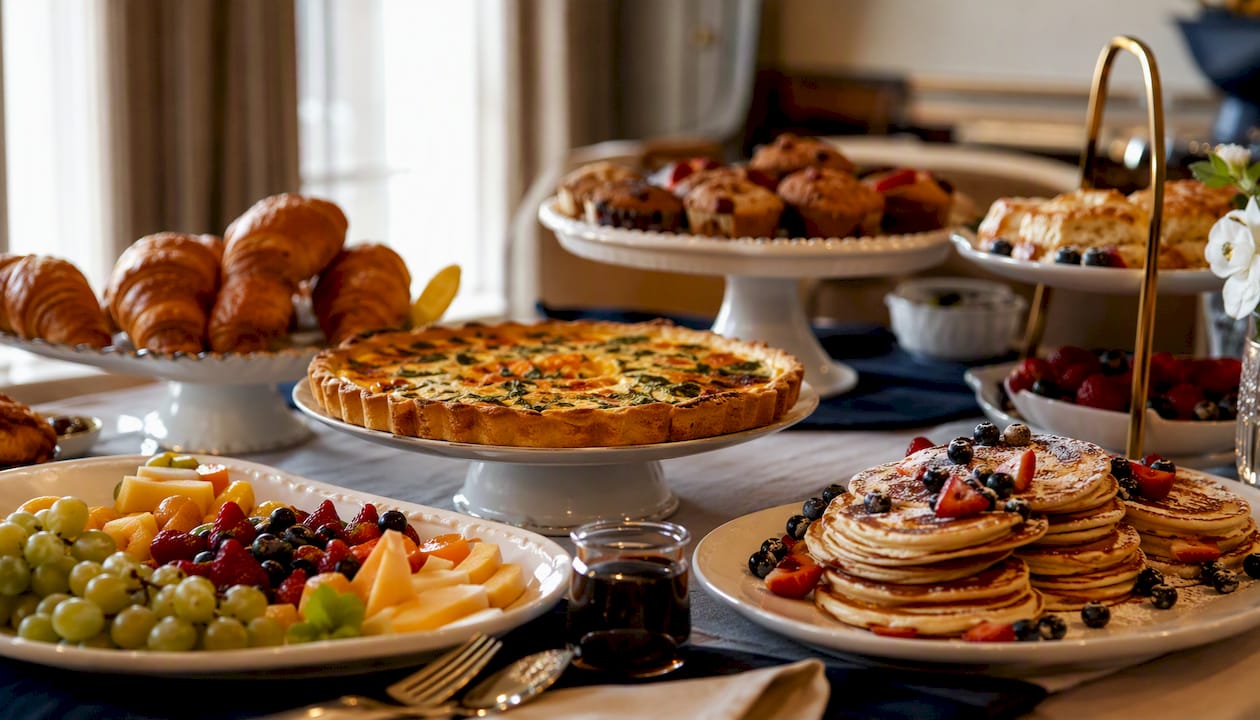
The budget tier works for office drop-offs and casual team gatherings. The mid tier is the most popular for post-wedding brunches and corporate events because it covers sweet and savory without pushing the per-person cost past what most planners have approved. The premium tier suits gourmet brunch catering for weddings, retreats, or brand events where presentation matters as much as the food.
À la carte add-ons let you upgrade any base package:
- Egg station (made-to-order omelets): $10–$15 per person
- Smoked salmon / lox board: $8–$12 per person
- Waffle station with toppings: $7–$10 per person
- Mimosa station (sparkling wine + juices): $12–$18 per person
- Acai or smoothie bar: $8–$14 per person
Adding two stations to a mid-tier package may increase the per-person cost significantly once staffing for those stations is factored in. Plan the add-ons before you finalize headcount math.
According to Food & Beverage New Trends, a well-balanced brunch menu pairs sweet mains, savory mains, sides, and a beverage program, with interactive stations adding perceived value beyond the food itself.
What drives brunch catering costs up — and what hidden fees to watch for
Service format is the single biggest lever. A drop-off box and a plated brunch with servers can use identical ingredients and still differ by $40 per person because of labor.
Main cost drivers:
- Service format: Drop-off is cheapest; plated full-service is most expensive
- Staffing: One server per 25–30 buffet guests; one per 10–15 for plated service
- Premium proteins: Smoked salmon, lobster benedict, or charcuterie boards add $8–$20 per person
- Alcohol: A licensed bartender and alcohol permit can add $15–$25 per person
- Rentals: Chafing dishes, linens, glassware, and serving equipment often run $5–$15 per person if not included
- Travel and holiday surcharges: Remote venues or holiday-weekend bookings typically add 10–20% to the base quote
Sample per-person math for a 30-guest mid-tier buffet:
Food cost at $18 per person = $540. Staffing (one server, four hours) = $200. Equipment rental = $120. Delivery = $75. Total = $935, or roughly $31 per person before gratuity and tax.
Checklist of fees to confirm before signing:
- Service fee (typically 18–22% of food and labor)
- Delivery and setup fee (flat or distance-based)
- Gratuity (sometimes included in service fee, sometimes separate)
- Sales tax on food and/or labor (varies by state)
- Overtime charges if the event runs long
- Corkage or alcohol-permit fees
For a broader look at catering cost breakdowns, Milehighcook publishes real per-person numbers across service formats.
Which brunch service format fits your event?
The format shapes everything: staffing, pacing, cost, and how social the meal feels.
| Format | Best For | Staffing | Guest Experience |
|---|---|---|---|
| Drop-off / boxed | Office teams, small groups | None | Convenient, low interaction |
| Buffet | Corporate events, 20–80 guests | 1–2 servers | Flexible, self-paced |
| Stations | Networking events, weddings | 1 per station | Interactive, social |
| Family-style / prix-fixe | Post-wedding brunches, seated events | 1 per 15–20 guests | Communal, curated |
| Plated | Formal brunches, VIP events | 1 per 10–12 guests | Elegant, controlled |
DoorDash's business blog notes that stations and shared platters make brunch more social and operationally easier to manage, particularly for groups over 20 where a single buffet line creates bottlenecks.
A few quick format recommendations:
- Office brunch (15–40 people): Buffet or drop-off. Fast, low-staff, easy to replenish.
- Post-wedding brunch: Family-style prix-fixe. Guests are seated, the pace is relaxed, and a curated two-sweet/two-savory menu feels intentional rather than cafeteria-style.
- Phoenix wedding brunch or outdoor event: Stations with shade-covered setups. Multiple gathering points prevent crowding and work well in warm weather.
For a deeper comparison of buffet vs. boxed formats, the trade-offs in speed and presentation are worth reviewing before you commit.
How much food to order: portion rules and a 50-guest example
The standard rule for a mid-morning brunch: plan for roughly 1.5 times a standard breakfast portion per person, since guests arrive hungry and the meal spans two to three hours.
Per-person portion targets (buffet):
- Bread / pastries: 3–4 slices or pieces
- Eggs or egg-based dish: 1.5–2 eggs (or equivalent frittata/quiche serving)
- Meat or protein: 80–100 g (about 3–3.5 oz)
- Fruit: 100–150 g (roughly 1 cup)
- Sides (potatoes, salad, grain): 80–120 g per side dish offered
- Coffee: 1.5–2 cups per person; juice: 6–8 oz per person
KitchenNmbrs recommends adding a 10–15% buffer on top of all totals to avoid running short, especially for groups over 20.
Worked example: 50 guests, mid-tier buffet
For a plated event, portions typically are smaller because waste is lower. A buffet with more variety encourages guests to sample smaller amounts of each dish, which can reduce individual item quantities moderately when multiple options are offered.
Pro Tip: *When you have more than four menu items on a buffet, guests naturally take smaller portions of each.
How to handle dietary needs without custom-making every plate
A varied brunch spread naturally covers most common restrictions without requiring individual custom plates. The key is building the base menu with inclusivity in mind from the start, rather than retrofitting it.
Menu items that cover multiple restrictions by default:
- Shakshuka (vegetarian, gluten-free if served without toast)
- Herb frittata or crustless quiche (vegetarian, gluten-free)
- Seasonal fruit platter (vegan, gluten-free)
- Grain salad with roasted vegetables (vegan, gluten-free)
- Tofu scramble with peppers and onions (vegan, gluten-free)
- Yogurt parfait with granola (vegetarian; offer GF granola separately)
- Smoked salmon board with cucumber and capers (gluten-free, dairy-free)
For labeling and service, a short checklist keeps things clean:
- Place a printed card at each dish with the dish name and allergen icons (GF, V, VG, DF)
- Use separate serving utensils for each dish; never share tongs between dishes
- Keep gluten-free items on a separate table or clearly separated section
- Use a dedicated toaster or warming tray for GF breads and pastries
- Brief your servers on the two or three most common allergens in the menu
For corporate events, dietary restriction best practices go deeper on allergy protocols and labeling systems worth adopting.
Pro Tip: Ask your caterer specifically about cross-contact protocols, not just cross-contamination. Cross-contact happens when an allergen transfers via shared surfaces or utensils even without direct mixing. A caterer who knows the difference is one who takes allergies seriously.
Beverage packages: what to budget and how to set them up
Beverages are where brunch events either feel complete or fall flat. A basic drip coffee and orange juice setup is table stakes. The question is how far to go.
Typical beverage tiers:
- Basic (coffee + OJ): $4–$7 per person. Drip coffee station, carafe of OJ, water. Works for office drop-offs.
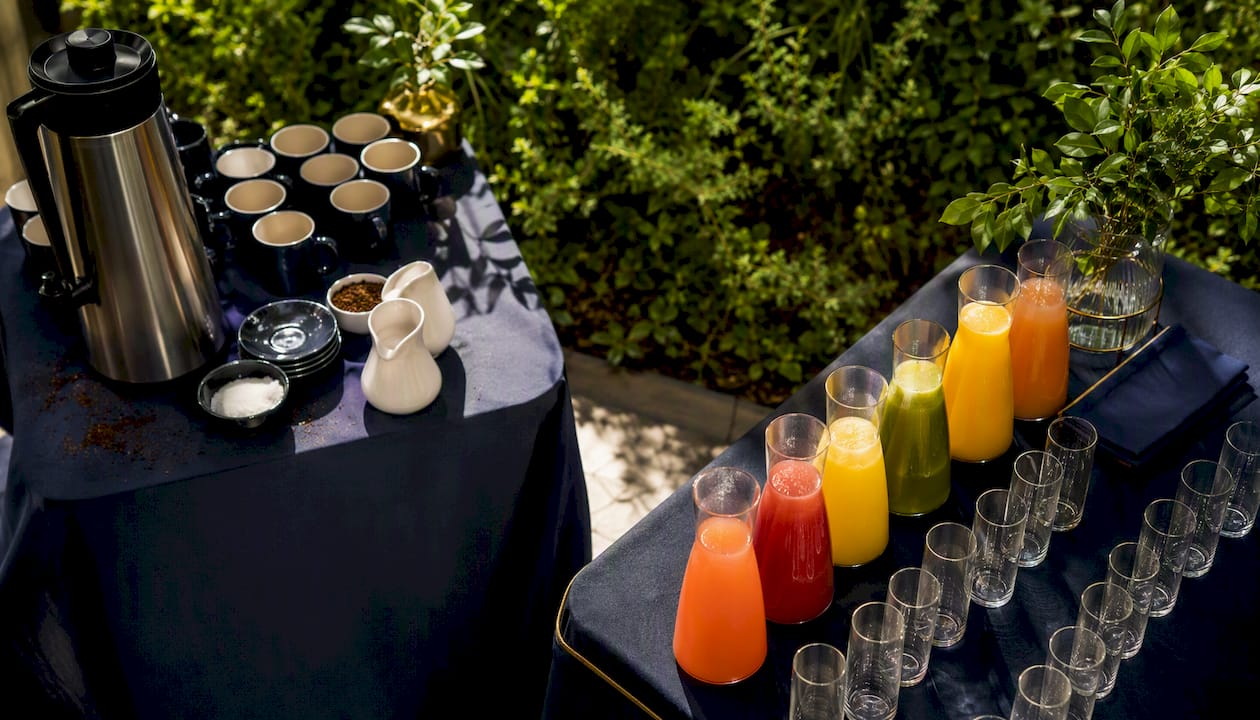
- Premium non-alcoholic: $8–$14 per person. Cold-pressed juices (green, beet, citrus), sparkling water, herbal iced teas, and a proper espresso setup.
- Mimosa station (alcoholic): $12–$18 per person. Sparkling wine, three to four juice options, garnishes. Requires a licensed bartender in most states.
- Bottomless mimosas: $18–$28 per person for a two-hour window. High guest satisfaction, but requires a licensed server and clear cutoff time.
Adding a beverage upgrade is one of the highest-return moves in brunch planning. Food & Beverage New Trends notes that an optional beverage upgrade drives guest satisfaction disproportionately to its cost.
For alcohol service, confirm your caterer holds a valid catering liquor license for your state. In Arizona, Colorado, Utah, and Wyoming, the rules on who can pour and where vary significantly. Utah in particular has strict alcohol-service regulations that affect both venue choice and service format.
Station setup tip: Place the coffee station and juice station at opposite ends of the room. It sounds minor, but splitting the two most-requested beverages into separate locations cuts the line at each by roughly half and keeps guests moving through the space.
Lead times, setup logistics, and keeping food at safe temperatures
Booking lead time depends on group size and service format. A drop-off for 15 people can often be arranged with 48–72 hours' notice. A staffed buffet for 50 needs at least one to two weeks. A full private-chef brunch with custom menus and rentals typically requires two to four weeks, longer for weekend dates in peak season.
| Format | Minimum Lead Time | Setup Arrival Before Event |
|---|---|---|
| Drop-off (under 20 guests) | 48–72 hours | 30 minutes |
| Staffed buffet (20–50 guests) | 1–2 weeks | 90 minutes |
| Plated / full-service (any size) | 2–3 weeks | 90–120 minutes |
| Private-chef brunch (custom) | 2–4 weeks | 2–3 hours |
| Large event (50+ guests) | 3–6 weeks | 2–3 hours |
Staffing guidelines: One server per 25–30 guests for a buffet; one per 10–15 for plated service. Add a dedicated beverage attendant for any event with a mimosa or espresso station.
Temperature control:
- Hot dishes (eggs, sausage, frittata) must stay at or above 140°F in chafing dishes with sterno or electric heat
- Cold items (fruit, yogurt, smoked salmon) must stay at or below 40°F; use ice beds or refrigerated trays
- Stagger food rollout: bring out cold items first, then hot dishes 15–20 minutes before guests arrive
- Replace hot dishes every 90 minutes if the event runs long; never reheat food that has been in the danger zone (40°F–140°F) for more than two hours
For remote or mountain venues, catering logistics in Breckenridge illustrates how travel time and altitude affect both timing and food safety planning.
How to place a brunch catering order: the checklist and questions to ask
Before you contact a caterer, have these details ready. It cuts the back-and-forth in half.
Order checklist:
- Confirmed event date, start time, and end time
- Headcount (firm) plus 10–15% buffer number
- Service format (drop-off, buffet, plated, stations)
- Beverage plan (basic, premium non-alcoholic, mimosa station)
- Dietary needs and allergen list
- Venue address and setup access time
- Point of contact on the day
- Cleanup expectations (caterer removes everything vs. venue handles it)
Questions to ask your caterer:
| Question | Why It Matters |
|---|---|
| What is included in the per-person price? | Confirms whether staff, rentals, and cleanup are in or extra |
| What is the service fee, and is gratuity included? | Prevents a 20–25% surprise on the final invoice |
| What is your cancellation and refund policy? | Critical for events with uncertain attendance |
| Do you carry general liability insurance? | Required by most venues; protects you if something goes wrong |
| Do you hold a catering liquor license? | Necessary if you want alcohol service |
| Can the menu be customized after booking? | Important for dietary changes that come in late |
| What is the minimum order or headcount? | Avoids booking a caterer whose minimum exceeds your group size |
For corporate event menu formats, the questions around service fees and staffing ratios are especially worth pressing on before you sign.
Sample quote request email:
Hi [Caterer name], I'm planning a brunch for approximately [X] guests on [date] at [venue/address]. I'm looking for a staffed buffet with a beverage package. We have [X] vegetarian and [X] gluten-free guests. Could you send a sample menu and per-person pricing, including all fees? Our budget is approximately $[X] per person all-in. Thank you.
Why family-style menus outperform full à la carte for groups
The evidence here is consistent. Intermenu's brunch menu guide recommends a family-style or limited prix-fixe structure (two sweet, two savory, shared sides, and a drink package) as the most manageable option for large brunch groups because it simplifies kitchen operations and makes per-head pricing predictable.
The practical case for prix-fixe: A two-sweet/two-savory family-style package reduces kitchen prep time, cuts food waste, and gives guests enough variety to feel satisfied without the operational complexity of a full à la carte list. Egg dishes and pastries are high-margin items that anchor both the sweet and savory sides of the menu, and pairing them with a drink upgrade increases perceived value without a proportional cost increase.
To convert an existing à la carte list into a family-style package: pick the two highest-margin savory items (usually an egg dish and a protein), the two most popular sweet items (waffles and French toast tend to win), add two shared sides, and bundle a beverage option. That structure covers most dietary preferences, prices cleanly per head, and gives your kitchen a manageable production list.
Pro Tip: Eggs and batter-based dishes like waffles and pancakes are among the highest-margin items on any brunch menu. Build your package around them, then add one premium protein as an upsell, and the per-person economics work in your favor.
For seasonal menu inspiration that fits this structure, festive meal offerings for event planners offers a useful starting point.
How to customize your brunch menu and request substitutions
Most caterers will accommodate substitutions if you ask before the contract is signed. After that, changes get harder and sometimes cost more.
Common substitutions that rarely cause issues: swapping pork sausage for turkey or chicken sausage, replacing dairy milk with oat or almond milk in coffee service, offering a gluten-free pastry option alongside the standard basket, or substituting a grain salad for hash browns. These are standard requests that any experienced caterer handles without repricing.
Substitutions that typically carry a surcharge: replacing a standard egg dish with a smoked salmon benedict, upgrading from drip coffee to a full espresso bar, or adding a carving station in place of a standard protein. Anything that requires additional equipment, a specialized skill, or a significantly more expensive ingredient will usually add $5–$15 per person.
The cleanest approach is to send your full dietary and preference list at the time of inquiry, not after booking. Caterers build menus around what they know upfront. Late changes after a menu is finalized can mean substitutions that are technically possible but not well-executed because the kitchen planned around the original spec.
For a custom brunch menu built around your guest list from the start, Milehighcook designs each event menu before the chef arrives, so substitutions are part of the planning process, not an afterthought.
What to know about cancellation and refund policies
Cancellation terms vary widely, but most catering contracts follow a tiered structure based on how far in advance you cancel.
Cancel within 72 hours and you typically owe the full amount, because the caterer has already purchased ingredients and scheduled staff.
A few things worth confirming before you sign:
- Whether the deposit is refundable under any circumstances (illness, venue cancellation, weather)
- Whether the caterer offers a credit toward a future event instead of a cash refund
- What happens if the caterer cancels on you (force majeure, illness) and whether you get a full refund or just a reschedule
- Whether event insurance is worth purchasing for larger gatherings (it typically costs $100–$300 and covers cancellation costs from covered events)
For post-wedding brunches and destination events, cancellation risk is higher because of travel logistics. Build at least a 30-day buffer between your booking date and the event date if the guest list is still fluid.
What planners actually ask for most — and what guests remember
The most common planner requests, in order: clear per-person pricing with no hidden fees, a beverage program that feels like more than an afterthought, and enough dietary coverage that no guest has to ask "is there anything I can eat?"
The detail that guests actually remember is almost never the food itself. It is whether the service felt smooth and whether there was something to drink that felt special. A mimosa station or a cold-pressed juice bar costs $8–$18 per person and consistently outperforms its price in guest satisfaction. If you have to choose between a premium protein upgrade and a beverage upgrade, take the beverage upgrade.
The other thing that shortens planning time significantly: choosing an all-inclusive private-chef model where pricing covers groceries, staff, and cleanup in a single line item. When every cost is bundled, you spend less time reconciling invoices and more time on the event itself. Milehighcook's all-inclusive catering model covers exactly that, with a 4.9-star rating across 65+ verified reviews to back it up.
Milehighcook brings a private chef to your brunch, all-inclusive
The difference between a standard caterer and a Milehighcook private-chef brunch is straightforward: one price covers everything. Groceries, a CIA-trained chef, service staff, and complete cleanup are all included. No separate invoice for rentals, no surprise service fee at the end, no coordinating three vendors for one event.
Milehighcook operates across Colorado, Arizona, Utah, and Wyoming, covering 30+ markets. For a brunch event in Denver, Phoenix, Salt Lake City, or a mountain venue, the chef comes to your location with a custom menu designed around your guest list and dietary needs. Typical lead time for a private-chef brunch is two to four weeks, with flexibility for smaller gatherings.
For a private chef brunch experience that handles every detail from menu design to the last dish washed, request a custom quote directly on the Milehighcook services page.
Sources
- Brunch Menu Ideas: 40+ Sweet & Savory Dishes by Category (2026) | Intermenu
- Brunch catering ideas — DoorDash business blog
- How do I calculate the amount of products I need for a brunch buffet for 50 people? | KitchenNmbrs knowledge base
- Brunch Catering: The Ultimate Guide to a Crowd-Pleasing Daytime Menu — Food & Beverage New Trends
FAQ
What should a brunch catering menu include?
A balanced brunch catering menu covers two savory mains (an egg dish plus a protein), two sweet mains (pancakes, waffles, or French toast), at least one side, seasonal fruit, and a beverage option. Adding a grain salad or yogurt parfait covers most dietary restrictions without a separate custom plate.
How much does brunch catering cost for 50 people?
For 50 guests, expect $28–$45 per person for a staffed buffet, or $45–$90 per person for plated service, before service fees and tax. A drop-off package runs $15–$25 per person with no staffing included.
What are good menu ideas for a catered brunch?
Shakshuka, herb frittata, smoked salmon boards, Belgian waffles, brioche French toast, seasonal fruit platters, and grain salads are all strong choices. A mimosa station or cold-pressed juice bar rounds out the experience and consistently ranks as the detail guests mention most.
What is the cheapest food to cater for a brunch party?
Egg-based dishes (scrambled eggs, frittata, quiche) and batter-based items (pancakes, waffles) are the most cost-effective brunch proteins and mains. Paired with seasonal fruit and a drip coffee station, a drop-off package can come in at $15–$25 per person.
How far in advance should I book brunch catering?
Book a drop-off for under 20 guests at least 48–72 hours out. A staffed buffet for 20–50 guests needs one to two weeks. A private-chef or full-service brunch with a custom menu typically requires two to four weeks, longer for peak-season weekend dates.