
If any guest at your wedding has celiac disease or a severe gluten sensitivity, hire a caterer with documented gluten-free protocols or an all-inclusive private-chef service. Full stop. A caterer who says "we can accommodate that" without a written allergen matrix and a dedicated prep area is not a safe choice, no matter how good the food sounds.
For couples in Colorado, Arizona, Utah, or Wyoming, Milehighcook offers a turnkey private-chef service with CIA-trained chefs, custom menus, and explicit allergen protocols built into every booking. If you need a specialty item only a local dedicated gluten-free bakery makes, pair them. Otherwise, a single all-inclusive service is simpler and safer than coordinating multiple vendors.
Use this as your immediate hiring filter:
- Dedicated GF prep area — separate from the main kitchen, or a scheduled dedicated window with full equipment sanitization
- Written allergen matrix — a dish-by-dish breakdown of every allergen, provided before you sign anything
- Tasting availability — you should be able to taste modified dishes before the wedding day
- Transparent, all-inclusive pricing — no surprise fees for specialty ingredients or extra labor
- Staff training documentation — ServSafe or equivalent certification for anyone handling food
Key Takeaways
Safe, delicious gluten-free wedding catering requires a written allergen matrix, dedicated prep protocols, trained staff, and a confirmed day-of labeling system before you sign any contract.
| Point | Details |
|---|---|
| Hire for documented protocols | Require a written allergen matrix and dedicated GF prep area before booking any caterer. |
| Book early | Dedicated GF caterers and private-chef services fill 9–12 months out; start outreach before that. |
| Budget realistically | Full-service GF catering runs $75–$300 per person depending on tier; all-inclusive pricing removes hidden fees. |
| Confirm day-of logistics | Named plates, server briefings, and a contingency contact prevent the most common service failures. |
| Milehighcook for turnkey GF | Milehighcook's CIA-trained chefs cover CO, AZ, UT, and WY with allergen protocols and all-inclusive pricing built into every booking. |
Table of Contents
- How do you find gluten-free wedding caterers in your area?
- Which service styles work best for gluten-free weddings?
- What questions should you ask a caterer before you book?
- How do you prevent gluten cross-contact in the kitchen and on the day?
- What does gluten-free wedding catering actually cost?
- How do you handle gluten-free wedding cake and desserts?
- Sample gluten-free wedding menus by service style
- Why an all-inclusive private-chef service simplifies safe GF catering
- Day-of coordination timeline for gluten-free service
- Why I trust process over promises for GF events
- Milehighcook handles gluten-free wedding catering from menu to cleanup
- Sources
- FAQ
How do you find gluten-free wedding caterers in your area?
Start with your venue's approved vendor list, but don't stop there. Venue-approved caterers are vetted for logistics, not necessarily for allergen safety. Cross-reference any name on that list against Google reviews, wedding forums, and local celiac support groups. People who manage celiac disease daily are often the most reliable source of honest vendor feedback.
Beyond the venue list, dedicated GF caterers are the safest option, but a trusted restaurant that caters can work if you verify their cross-contact controls directly. Search for local gluten-free bakeries and caterers through directories like Find Me Gluten Free, then ask whether they handle full wedding catering or only desserts.
Three realistic provider types:
-
100% gluten-free caterers — lowest cross-contact risk, but limited in some markets and often booked far in advance
-
Trusted restaurants that cater — viable if they have a documented protocol; ask for it in writing before your first tasting
-
All-inclusive private-chef services — handle menu design, groceries, prep, and service under one contract, which removes the coordination gap between vendors
One detail couples miss: "based in Denver" does not mean "serves your mountain venue." Always confirm the caterer's actual service radius and whether travel fees apply. For weddings outside city limits, an all-inclusive service that builds travel into the quote is often cleaner than a local caterer who adds fees later.
Most reputable wedding caterers book many months out. If you have celiac guests, start outreach earlier than that. Dedicated GF caterers have smaller capacity and fill faster.
Pro Tip: On your first call, ask one question before anything else: "What is your cross-contact protocol for gluten-free orders?" A caterer who can answer that clearly and specifically, without hesitation, is worth a follow-up. One who pivots to "we're very careful" is not.
Which service styles work best for gluten-free weddings?
Plated service is the safest format for allergy-friendly catering. Each dish is prepared, labeled, and delivered to a named seat. There is no shared serving spoon, no guest reaching across a buffet, and no ambiguity about which plate belongs to whom. For celiac guests especially, plated service with a named-plate system is the standard recommendation from experienced GF wedding planners.
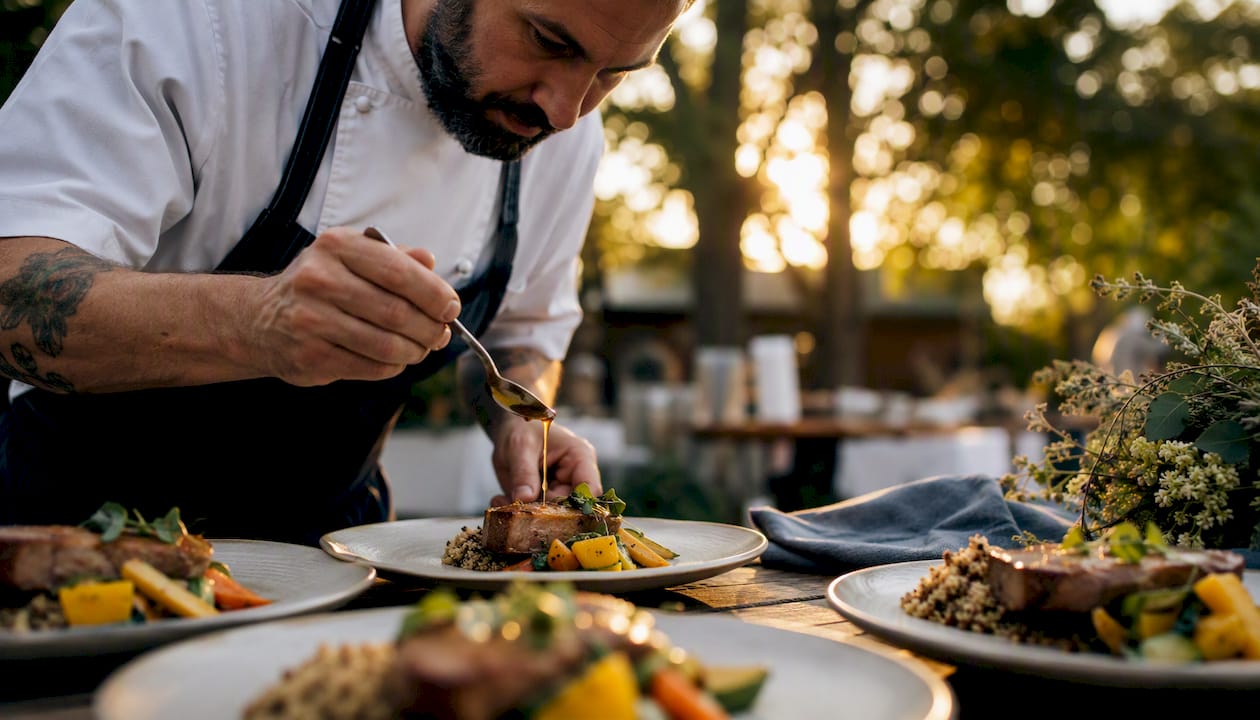
Buffets and stations are flexible and popular, but they carry real cross-contact risk. Shared utensils, guests who don't read labels, and dishes placed near each other create contamination opportunities that are hard to control at scale. If you want a buffet, the safer approach is a segregated GF station with its own serving utensils, positioned away from gluten-containing dishes, with a dedicated server who does not rotate to other stations.
Passed appetizers sit in the middle. They're elegant and low-volume, which helps with temperature control, but they require servers who know exactly which tray is GF and can answer guest questions accurately. That means a pre-service briefing is non-negotiable.
Menu formats that are naturally gluten-free and wedding-appropriate:
- Grilled or roasted proteins (beef tenderloin, salmon, chicken thighs)
- Roasted vegetable medleys and potato-based sides
- Rice pilaf, risotto, and polenta
- Seafood stations (oysters, shrimp cocktail, ceviche)
- Corn tortilla-based taco stations (verify the tortillas and all sauces)
- Charcuterie and cheese boards (confirm no wheat-based crackers are mixed in)
Pasta stations can work with certified GF pasta, but equipment must be dedicated and protocols carefully followed. Sauces thickened with flour need to be replaced with cornstarch or arrowroot versions. Ask your caterer to confirm every sauce base in writing. Event planners in 2026 are increasingly treating GF and vegan options as standard menu categories, which means more caterers are building these protocols into their base offerings rather than treating them as special requests.
What questions should you ask a caterer before you book?
Get specific. Vague reassurances are not protocols. Bring this list to your tasting meeting and ask for written answers where noted.
Kitchen and equipment:
- Do you have a dedicated GF prep area, or do you schedule dedicated prep windows with full sanitization between batches?
- Are fryers, toasters, and colanders dedicated to GF items, or shared?
- What flour do you use for thickening sauces, and what is the GF substitute?
Documentation:
- Can you provide a written allergen matrix for every dish on our menu before we sign the contract?
- How will modified meals be tracked from prep through service? (Ask for the specific system: named plates, colored tickets, separate transport containers.)
Staff training:
- Are your kitchen and service staff ServSafe certified?
- Who is responsible for GF plates on the day of the event, and how will they be briefed?
For bakers specifically:
- Is the cake baked in a dedicated GF facility, or in a shared kitchen?
- Do any decorations, fillings, or fondants contain gluten?
- Can I see photos of the production area and request a tasting sample?
Foodsafety that caterers receive a complete guest allergen list before the event so they can plan safe, modified meals. Make that list part of your contract, not an afterthought.
Red flags that should end the conversation:
- Refuses to provide a written allergen matrix
- Cannot name their cross-contact protocol
- No tasting option for modified dishes
- Vague answers about equipment sharing
How do you prevent gluten cross-contact in the kitchen and on the day?
Cross-contact prevention starts in production, not at the reception table. The critical controls are sequencing and separation. GF dishes should be prepared first, before any gluten-containing items, using dedicated equipment. If a caterer cannot guarantee that sequence, they cannot guarantee the dish is safe.
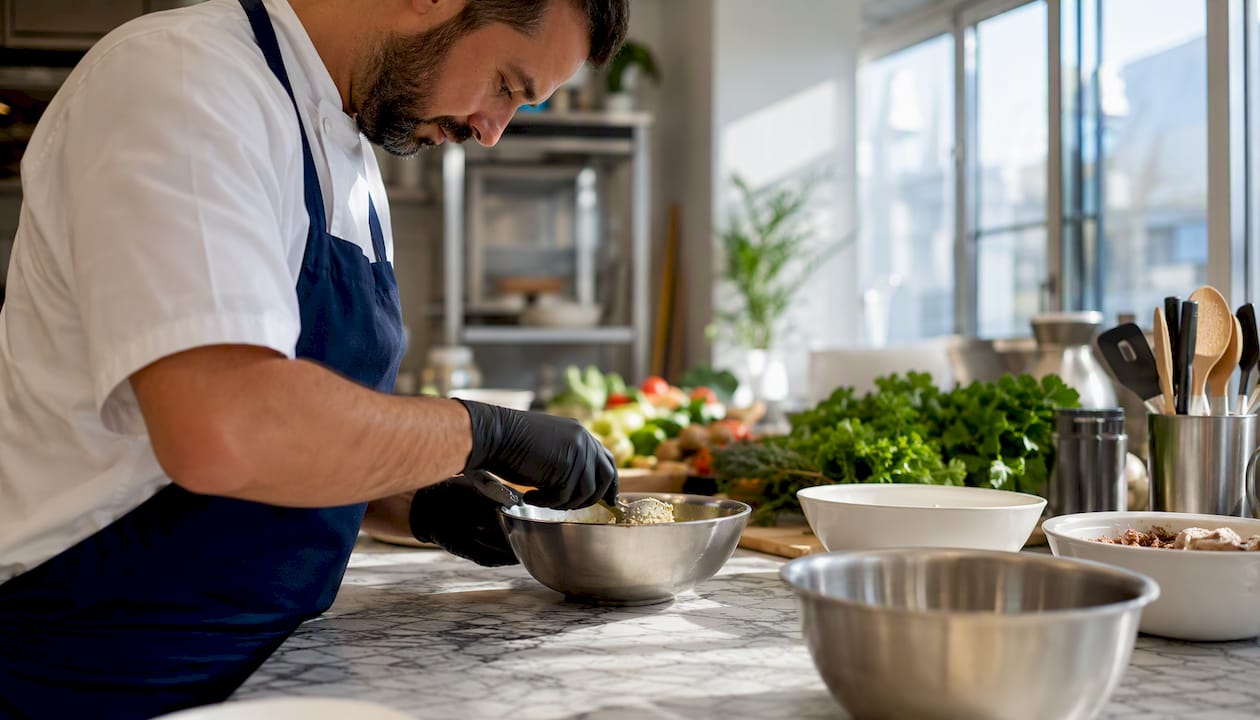
Transport is a critical control point that must be planned and documented in an event-specific HACCP record. That means sealed, labeled containers for GF items, separate from everything else, with temperature logs from kitchen to venue. An event-specific HACCP checklist covering transport logs, venue assessment, and labeled modified meals is standard practice for reducing food-safety risk in off-site catering.
Day-of controls to confirm with your caterer:
- Named plates for every GF guest, confirmed against the final allergen list
- A dedicated server or runner for GF plates who does not handle gluten-containing dishes
- A separate plating or staging area at the venue for modified meals
- Visible labels at any buffet or station (physical labels and, increasingly, QR codes linking to full allergen breakdowns)
- A contingency contact, typically the head chef, who holds the final allergen list and can answer questions during service
Modern event practice increasingly uses QR-code menus linking to full digital allergen breakdowns, which reduces labeling errors and scales better for larger guest counts.
Pro Tip: If your venue kitchen access is limited, ask your caterer whether they bring a portable prep kit with dedicated equipment. For couples with celiac guests who cannot get a venue exception, this is often the difference between a safe meal and a risky one. Under ADA, you may also be able to request a venue accommodation to bring in an outside GF caterer even when the venue has an exclusive list.
What does gluten-free wedding catering actually cost?
Gluten-free requirements add cost in three specific places: specialty ingredients (certified GF flours, dedicated pasta, GF soy sauce), extra labor for separate prep and sequencing, and dedicated transport equipment. A caterer who quotes you the same price for a GF menu as a standard menu is either absorbing those costs or not actually running separate protocols.
Insulated carriers, heated cabinets, and temperature logging are hidden cost drivers for safe GF service. They require investment, but they are critical for food safety. That investment shows up in the per-person price.
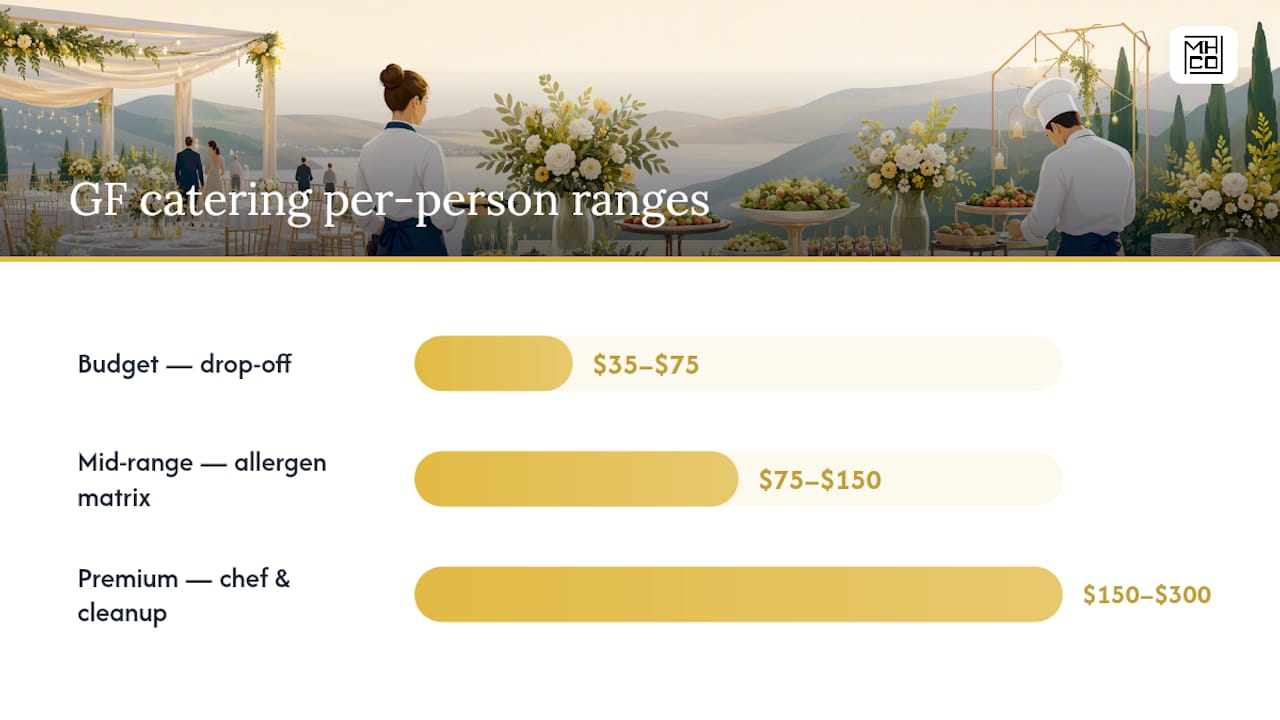
Realistic per-person ranges for wedding catering in the U.S. (full service, including labor and groceries):
| Service Tier | Per-Person Range | Typical Inclusions |
|---|---|---|
| Budget | $35–$75 | Drop-off or limited-service buffet, basic GF options |
| Mid-range | $75–$150 | Full-service plated or buffet, written allergen matrix, staff |
| Premium / private chef | $150–$300 | All-inclusive: custom menu, CIA-trained chef, service staff, cleanup |
For a moderate guest count, mid-range full-service catering can run several thousand dollars before cake and bar. For detailed, current pricing by service type, Milehighcook's catering cost guide breaks down what's included at each level.
A hybrid approach, where most guests eat a standard menu and a small number of GF plates are prepared separately, can reduce cost but increases coordination complexity. If a small percentage of guests need GF meals, a hybrid approach can work. If the couple or a significant portion of guests require GF food, a fully GF menu is simpler and often not much more expensive per person.
Ways to manage GF catering costs without cutting safety:
- Choose naturally GF proteins and sides as the base menu so fewer substitutions are needed
- Limit GF dessert variety rather than offering a full parallel dessert table
- Use a single all-inclusive service rather than multiple vendors with separate contracts and fees
How do you handle gluten-free wedding cake and desserts?
The wedding cake is where couples most often underestimate the complexity. A GF cake from a shared-kitchen bakery carries real cross-contact risk, even if the recipe itself contains no gluten. The only way to know is to ask where it's baked and what else is baked in the same space.
Your safest options, in order of reliability:
- 100% GF dedicated bakery — the gold standard; confirm they bake nothing with gluten on the premises
- Trusted baker with a documented GF protocol — ask for photos of the production area and a written statement on cross-contact controls
- GF cupcakes or individual desserts — easier to transport safely and easier to label clearly than a tiered cake
- Bring-your-own GF cake — some venues allow this for guests with medical dietary needs; confirm the policy in writing
A popular and practical approach: a standard cake for the cutting ceremony (the sweetheart cake), with a separate GF sheet cake or cupcakes served to guests. This keeps the visual moment intact while ensuring GF guests get a safe dessert without being singled out.
Ask every baker these before you book: Do any fillings, frostings, or decorations contain gluten? Is the fondant GF? What is your cross-contact protocol for decorating tools?
Lower-cost alternatives that work beautifully at weddings: a sorbet and ice cream bar (verify flavors are GF), a GF cookie display, or a fresh fruit and chocolate fondue station. For gluten free wedding desserts that feel celebratory rather than compensatory, the key is presentation, not complexity.
Sample gluten-free wedding menus by service style
These are starting-point templates you can hand directly to a caterer. Every item listed is naturally GF or easily adapted with the noted substitution.
| Menu Style | Sample Dishes | GF Adaptation Notes | Service Advantage |
|---|---|---|---|
| Plated dinner | Arugula salad, beef tenderloin with herb jus, roasted fingerling potatoes, flourless chocolate cake | Confirm jus is thickened with cornstarch, not flour | Easiest to label and control per-guest |
| Buffet / stations | Grilled salmon, roasted vegetables, rice pilaf, taco station with corn tortillas | Verify all sauces; dedicated serving utensils per station | Flexible for mixed guest counts |
| Cocktail / passed apps | Shrimp cocktail, prosciutto-wrapped melon, stuffed mushrooms, GF crostini with toppings | Confirm crostini are certified GF; brief servers on tray ID | Elegant; lower volume per item |
| Wedding brunch | Smoked salmon platter, frittata, roasted potatoes, fresh fruit, GF muffins | Verify muffins are from a dedicated GF source | Naturally GF-friendly format |
For scaling, a plated dinner for 50 guests requires roughly the same kitchen setup as 100, but labor increases proportionally at buffets and stations. At 200 guests, a buffet with dedicated GF stations is often more practical than individual plated GF meals, provided the station segregation is strict. Milehighcook's sample menus include options that can be adapted for GF requirements across all service styles.
A few adaptation notes worth flagging:
- Soy sauce contains wheat; substitute tamari for any Asian-inspired dish
- Many pre-made stocks and broths contain gluten; confirm your caterer uses GF-certified versions
- Oats are frequently cross-contaminated; if oats appear in any dish, they must be certified GF
Why an all-inclusive private-chef service simplifies safe GF catering
The coordination problem in gluten-free wedding catering is not the menu. It's the gap between vendors. When a couple hires a caterer, a separate baker, a rental company for equipment, and a venue with its own kitchen staff, each handoff is a potential point of failure for allergen safety.
An all-inclusive private-chef service collapses those handoffs into one contract and one team.
With Milehighcook, CIA-trained chefs design the menu, source the groceries, manage prep and service, and handle cleanup, all under a single all-inclusive price. Allergen protocols are built into the event plan from the first conversation, not added as an afterthought. That structure means one person is accountable for every dish that leaves the kitchen.
Milehighcook holds a 4.9-star rating from over 65 verified reviews, and its chefs are trained at the Culinary Institute of America, where food-safety and allergen protocols are part of the core curriculum. For couples managing dietary restrictions at events, that training matters more than any checklist.
What the all-inclusive model covers for GF weddings:
- Custom menu design with allergen accommodation built in from the start
- Grocery sourcing, including certified GF specialty ingredients
- Dedicated prep sequencing and equipment management
- Service staff included, briefed on allergen protocols before service
- Complete cleanup, so no cross-contact risk from shared post-event equipment
When to use a local dedicated GF bakery instead: if you want a specialty GF wedding cake that requires a local baker's specific expertise, pair them with Milehighcook for the meal. The private-chef service handles everything else; the baker handles the cake. That's a clean, low-risk split.
Day-of coordination timeline for gluten-free service
The most common failure point in GF wedding catering is not the kitchen. It's the 90 minutes between when food leaves the kitchen and when it reaches the guest. A written timeline prevents that.
T-72 hours through service:
- T-72 hours: Confirm the final guest allergen list with the caterer. Any late additions or changes to dietary needs must be communicated now.
- T-48 hours: Receive the written allergen matrix for every dish. Review it against the guest list and confirm no gaps.
- T-24 hours: Caterer confirms transport plan: labeled containers, temperature logs, separate GF transport if needed.
- Day of, 2 hours before service: Server briefing. Every server who will handle GF plates is briefed on the named-plate system, which trays or plates are GF, and what to say if a guest asks.
- Day of, 1 hour before service: GF meals staged in a separate area at the venue. Head chef confirms labeling and signs off on plating.
- During service: Named plates delivered first, before general service begins, to reduce the window for mix-ups.
Day-of checklist for the couple or wedding planner:
- Final allergen list carried by: venue manager, head server, and the couple's wedding planner (all three)
- Named plates confirmed against the seating chart
- Backup GF dish available for any last-minute guest change
- Temperature log from transport reviewed and filed
- Contingency contact (head chef's direct number) shared with the venue coordinator
The venue coordinator should know exactly where GF meals will be staged, who signs off on plating, and who to call if there is a question during service. That person should not be the couple.
For local planning guidance specific to your market, Milehighcook's Salt Lake City wedding catering guide covers venue vetting and vendor coordination timelines in detail.
Why I trust process over promises for GF events
The couples who have the worst experiences with gluten-free wedding catering are almost never the ones who hired the wrong caterer on purpose. They hired someone who seemed confident, who said all the right things, and who then improvised on the day because there was no written plan behind the confidence.
Certified processes, written allergen matrices, and trained staff are not bureaucratic overhead. They are the only thing that stands between a guest with celiac disease and a medical emergency at your reception. A caterer who resists documentation is telling you something important about how they operate under pressure.
At Milehighcook, our CIA-trained chefs operate across Colorado, Arizona, Utah, and Wyoming with event-specific allergen plans built into every booking. That's not a marketing claim. It's the structure that makes safe GF catering repeatable, not lucky.
Milehighcook handles gluten-free wedding catering from menu to cleanup
Couples in Colorado, Arizona, Utah, and Wyoming have a direct option for allergy-friendly catering that doesn't require coordinating five vendors: Milehighcook's all-inclusive private-chef service covers custom menu design, certified GF ingredient sourcing, dedicated prep, service staff, and full cleanup under one flat price.
CIA-trained chefs build the allergen protocol into your event plan before a single dish is prepped. Tasting sessions are available so you can confirm every modified dish before the wedding day. The all-inclusive price covers groceries, labor, service staff, and cleanup, so there are no surprise fees for specialty GF ingredients or extra prep time. Milehighcook's catering services are available across 30+ markets in CO, AZ, UT, and WY.
Request a quote or schedule a tasting at Milehighcook.
Sources
These resources are worth bookmarking as you plan and vet vendors:
- Foodsafety
- Planning Your Gluten Free Wedding - from GF Expert Jules Shepard
- HACCP Plan for a Catering Company: Off-Site Considerations | HACCP | Paddl
FAQ
What is the average cost to feed 100 people at a wedding?
Full-service wedding catering for 100 guests typically runs several thousand dollars at mid-range pricing ($75–$150 per person), before cake and bar. Gluten-free requirements add cost due to specialty ingredients and dedicated prep labor.
How do you accommodate gluten-free guests at a wedding?
Hire a caterer with a written allergen matrix and a dedicated GF prep area, use a named-plate system for GF guests, and brief servers before service. Sharing the guest allergen list with your caterer before the event is the single most effective step.
What is the most affordable way to cater a wedding for 100 guests?
A buffet or drop-off service in the $35–$75 per-person range is the lowest-cost option, but for GF guests, budget formats carry higher cross-contact risk. A hybrid approach, where most guests eat a standard menu and a small number of GF plates are prepared separately, can reduce overall cost while maintaining safety for the guests who need it.
Can a non-dedicated caterer safely serve celiac guests?
Yes, but only if they can document their cross-contact controls in writing, including dedicated equipment, prep sequencing, and a named-plate system for service. A caterer who cannot provide that documentation is not a safe choice for a guest with celiac disease.