
Sustainable wedding catering comes down to four decisions: a plant-forward menu, an accurate guest count, a serving style that controls portions, and a written leftovers plan with your caterer. Get those four right and you've solved most of the problem before you've even picked a tablecloth color.
The scale of what you're solving is bigger than most couples realize. The average wedding produces roughly 400 pounds of waste, and food is one of the biggest contributors. Separately, Eventective's research puts discarded wedding food at around 10 percent of what's prepared. That's not a rounding error. On a 150-guest event, that's dozens of untouched plates heading to a dumpster.
Here's a checklist to text your caterer or tape to the fridge:
- Choose a plant-forward menu with one or two meat options, not three.
- Lock guest counts as close to the caterer's ordering deadline as your contract allows.
- Pick plated or family-style service over an open buffet.
- Confirm rentals or verified-compostable serviceware, not vague "eco-friendly" packaging.
- Get a written leftovers plan (donation, staff meals, or compost) before you sign.
Key Takeaways
Sustainable wedding catering succeeds when plant-forward menus, accurate guest counts, controlled serving styles, and a written leftovers plan work together instead of in isolation.
| Point | Details |
|---|---|
| Lock your RSVP deadline early | Set it about a week before the caterer's ordering cutoff to give real, not estimated, headcounts. |
| Choose a plant-forward menu | Build the main course around legumes or vegetables with a limited meat option, not the reverse. |
| Pick plated over open buffet | Plated service paired with RSVP meal selections gives the tightest portion control. |
| Verify compostable claims | Confirm your venue or a third party actually processes compostable serviceware before booking it. |
| Consider a private chef model | Milehighcook builds menus around confirmed guest counts with named local suppliers and all-inclusive pricing. |
Table of Contents
- How Do You Start Planning Sustainable Wedding Catering?
- Why Does Local Sourcing Matter for Wedding Menus?
- What Are the Best Plant-Forward Wedding Menu Ideas?
- Should You Rent Dinnerware or Use Compostable Disposables?
- Which Serving Style Wastes the Least Food?
- What Should You Do With Leftover Wedding Food?
- How Do You Ask a Caterer About Sustainability Practices?
- Does Sustainable Catering Cost More?
- Quick Wins and Mistakes to Avoid in Sustainable Catering
- How Does a Private Chef Model Reduce Wedding Catering Waste?
- A Reporter's Take: Sustainability Doesn't Mean Sacrifice
- Let Milehighcook Handle Your Sustainable Wedding Menu
- Sources
- FAQ
How Do You Start Planning Sustainable Wedding Catering?
Before you touch a menu, decide what "sustainable" actually means for your wedding. For some couples it's carbon footprint. For others it's zero food waste, or spending money only with local farms. Pick one or two priorities and let them drive every catering decision. Trying to optimize for everything at once is how couples end up overspending on rentals while ignoring the bigger lever, which is guest count accuracy.
Timeline matters more here than in almost any other part of wedding planning. Most caterers lock final headcounts and menu selections two to three weeks before the event, and that number becomes their ordering guide. If your RSVP deadline sits a month before the wedding, you've built in a full extra month of guesswork, and guesswork is exactly what drives overproduction.
Scope your decisions early, too. You control the menu, the serving style, and often the tableware. The venue usually controls the trash and recycling infrastructure, and sometimes composting access. Ask about venue-side waste handling in your first walkthrough, not your final one.
- Set one or two sustainability priorities (carbon, waste, local sourcing, budget).
- Confirm your caterer's ordering cutoff date before finalizing your RSVP deadline.
- Ask the venue what waste and composting infrastructure already exists on-site.
- Assign one person (planner, coordinator, or you) to own the sustainability checklist.
Pro Tip: Set your RSVP deadline about a week ahead of your caterer's ordering cutoff, not the same day. That buffer gives you time to chase down stragglers and hand the caterer a real number instead of an estimate.
Why Does Local Sourcing Matter for Wedding Menus?
Seasonal, locally sourced ingredients travel shorter distances, taste fresher, and tend to cost less than out-of-season imports flown in from another hemisphere. There's also a creative upside most couples miss: a menu built around what's actually in season this month often reads as more thoughtful than a generic "chicken or salmon" default. Farm-to-table language on a wedding menu isn't just aesthetic. It signals a real sourcing relationship, and it gives your caterer a reason to talk about where the tomatoes came from instead of just plating them.
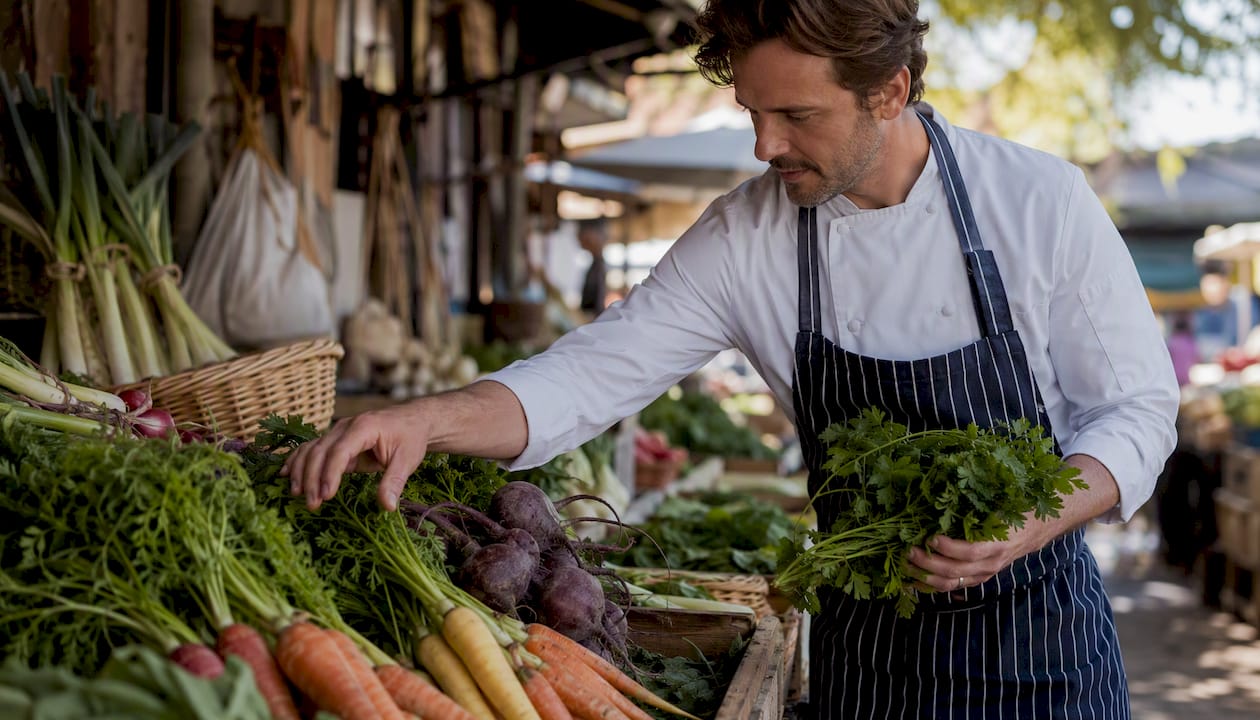
That said, local sourcing isn't a rule without exceptions. Cultural dishes tied to family heritage, or ingredients needed for specific dietary accommodations, are worth importing when there's no reasonable local substitute. Sustainability shouldn't mean erasing the dishes that make the wedding feel like yours.
When you interview caterers, push past "we use local ingredients" and ask specifics:
- Which farms or suppliers do you source from regularly, by name?
- How far, on average, do your main proteins and produce travel?
- Do you adjust the menu seasonally, or is it the same year-round?
- Can you accommodate one or two culturally important dishes even if the ingredients aren't local?
- Do you have a relationship with a local dairy, bakery, or produce supplier you can name on request?
A caterer who answers with named suppliers and specific mileage is operating differently from one who says "we try to be sustainable" and stops there.
What Are the Best Plant-Forward Wedding Menu Ideas?
Shifting the menu toward plants is the single most effective food-related lever for cutting a wedding's environmental footprint. Meat, especially beef, carries a heavier water and carbon footprint than most vegetables, grains, and legumes, and FoodPrint's research on water footprints makes that gap clear across food categories. The trick is presenting plant-forward as upscale, not as a downgrade. Nobody wants to feel like they settled for the vegetarian option at their own wedding.
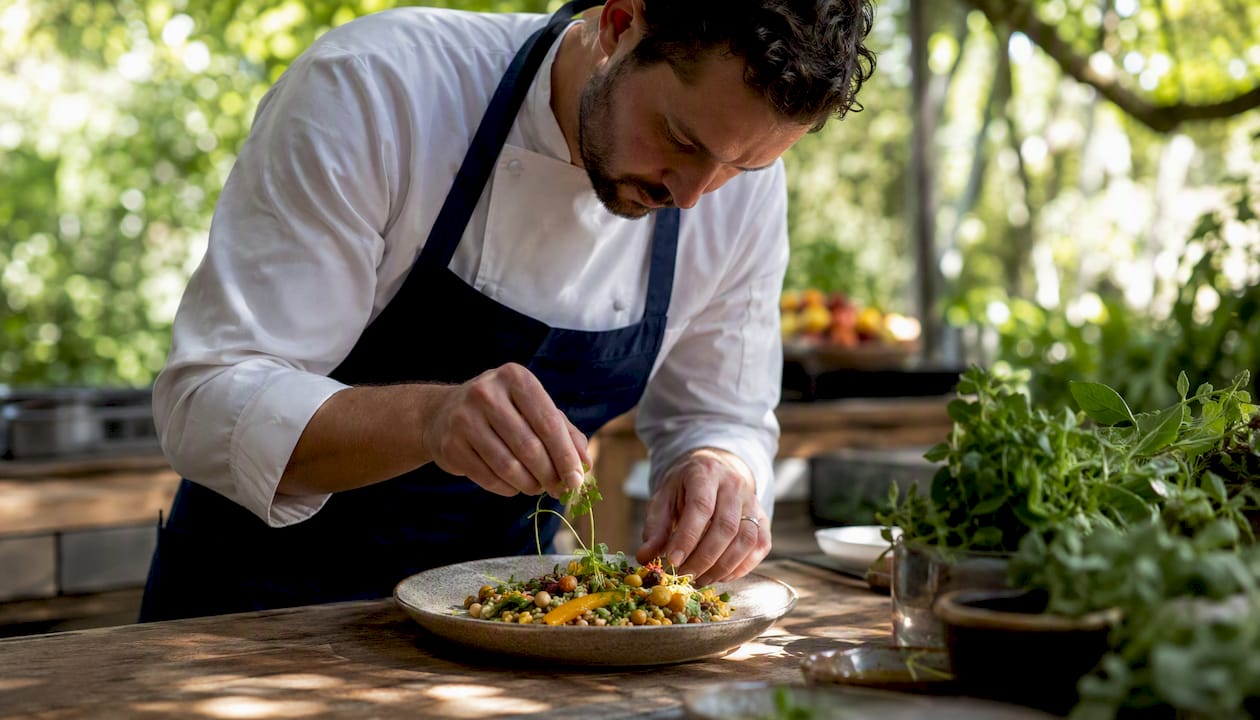
A simple protein-swap ladder works well here: instead of an all-beef main, offer a poultry option alongside a legume-forward dish like a mushroom and white bean wellington or a charred eggplant steak with chimichurri. Guests rarely notice they're eating less meat overall when the plant dish is built to be the star, not the afterthought.
A few menu directions that read as celebratory rather than restrictive:
- Cocktail hour: heirloom tomato tarts, whipped ricotta crostini, or grilled peach and burrata skewers.
- Plated main: a wild mushroom risotto or root vegetable tagine paired with one limited-quantity meat option for guests who want it.
- Late-night snack: loaded street-corn tacos or a build-your-own flatbread station using whatever produce is peaking that season.
The Wild Foodz seasonal vegan menu guide is a solid starting point if you want inspiration organized by month rather than by dietary label.
Should You Rent Dinnerware or Use Compostable Disposables?
Rented real plates and flatware almost always beat single-use disposables on environmental impact, because you're reusing the same items across hundreds of events instead of manufacturing and discarding new ones every time. The catch is logistics: rentals need staff to bus, wash, and return them, which adds labor cost and a tighter cleanup timeline.
Compostable disposables sound like the easy middle ground, but there's a catch most couples never hear about until it's too late. Many compostable products only break down properly in industrial composting facilities, not backyard compost bins, and a lot of venues have no access to industrial composting at all. If nobody's arranged pickup, that "compostable" plate ends up in a landfill next to a regular plastic one, breaking down just as slowly.
| Option | Best For | Watch Out For |
|---|---|---|
| Rented realware | Venues with kitchen access and cleanup staff | Higher labor cost, tighter turnaround for washing |
| Verified compostable disposables | Outdoor or remote venues without dishwashing capacity | Confirm local industrial composting access before booking |
| Standard single-use plastic | Rarely recommended for sustainability-focused weddings | Highest landfill impact, avoid where budget allows |
Before locking in rentals, check the venue's rules. Some venues restrict what rental companies can bring on-site, require a specific loading dock window, or charge extra for extended cleanup time. None of that shows up until you ask directly.
Pro Tip: Call the venue coordinator and ask, specifically, "What time does our rental company need to be out by, and is there a cleaning fee if we run late?" That one question saves more headaches than any menu decision.
Which Serving Style Wastes the Least Food?
Plated service gives you the tightest portion control of any serving style, because the kitchen plates exact amounts based on your RSVP meal selections instead of guessing at bulk trays. Eventective's research recommends pairing plated meals with RSVP-based selections specifically because it lets the caterer cook to the number, not past it.
Buffets tend to generate the most visible waste, since full serving trays sit out and often get replenished before they're empty, leaving food that never gets touched. A replenishment-round model, where staff bring out smaller batches and refill only as trays run low, cuts that waste significantly compared to a single massive spread sitting out for two hours.
Family-style service lands in between. It feels warm and generous, but it also invites over-plating at the table, since guests often serve themselves more than they'll eat when dishes are passed around.
The bigger lever, regardless of serving style, is your final guest count. Locking numbers as close to the caterer's ordering deadline as your contract allows cuts overproduction more reliably than any menu tweak. Build your RSVP form to collect meal selections and allergy or dietary notes directly, so the caterer gets real numbers per dish instead of one blended total.
- Plated service: tightest portion control, best paired with RSVP meal choices.
- Family-style: warm feel, but higher risk of table-level over-serving.
- Buffet with replenishment rounds: manageable waste if staff actively monitor trays.
- Standard open buffet: highest visible waste risk of the three styles.
What Should You Do With Leftover Wedding Food?
Handling leftovers well means deciding on a plan before the wedding, not scrambling the morning after. Food52's guide to waste-free weddings lays out the same hierarchy most sustainability-minded caterers use: donate first, compost what can't be donated, and send home what's left.
Donation works best for food that hasn't been served or plated, since food-safety rules generally restrict what can leave a venue once it's touched a buffet line or guest plate. Some caterers already partner with local redistribution organizations; ask if yours does, and if not, ask whether they're willing to coordinate a pickup.
Composting depends heavily on venue infrastructure. If the venue has no on-site composting, you'll need a third-party collection service, which adds a coordination step and sometimes a fee. It's worth asking about this in your first vendor call rather than discovering the gap the week of the wedding.
Sending food home works well for anything already portioned or boxed, plus staff meals for your band, photographer, and other vendors working through the reception. Labeling matters here. A quick note with the dish name and prep time keeps things food-safe for whoever's eating it later.
A short checklist to put directly in your catering contract:
- Name who is responsible for donation pickup, if applicable.
- Confirm whether the venue or a third party handles composting.
- Specify how leftovers get packaged (guest takeaway, staff meals, or both).
- Set a deadline for when leftover food must be removed from the venue.
How Do You Ask a Caterer About Sustainability Practices?
The fastest way to separate genuine sustainability practices from marketing language is to ask for specifics and see how the caterer responds. Vague answers are the biggest red flag. "We care about the environment" tells you nothing. "We source dairy from a farm forty minutes out and compost through a third-party service" tells you everything.
Questions worth asking directly:
- Can you name two or three suppliers or farms you regularly work with?
- What's your written process for handling unused food after an event?
- Do you have a donation or redistribution partner, and can I see how that's arranged?
- How do you calculate portions, and what happens to over-ordered stock?
- What transportation do you use to move food and equipment to the venue?
Watch for these warning signs during the conversation:
- No written waste-handling plan, just verbal reassurance.
- Inability to name a single supplier or farm relationship.
- Hesitation when asked about composting or donation logistics.
- Sustainability language that never gets more specific than "eco-friendly."
Ask instead for documented trust signals: certifications like those tracked by the Green Restaurant Association, a written food-waste policy, a named supplier list, chef credentials, and verified client reviews. A caterer with nothing to show beyond a nice website is asking you to take their word for it.
Does Sustainable Catering Cost More?
Some sustainable choices add cost, and some quietly save money. Rentals and third-party composting usually run higher than disposables and landfill pickup, since they require extra labor, transport, or a service fee. But plant-forward menus and accurate headcounts often come in cheaper than a heavy-meat, over-ordered buffet, because you're buying and preparing less food overall while paying less per pound for produce and grains than for premium proteins.
A few low-cost moves that punch above their weight:
- Build the menu around what's in season instead of flying in specialty ingredients.
- Cap or cut the late-night snack station, which is one of the most commonly over-ordered items.
- Serve batch cocktails or shared bottles of wine instead of individually packaged single-serve drinks, an approach Zero Smart's catering guide recommends specifically for cutting packaging waste.
When comparing quotes between caterers, check whether waste handling is bundled into the per-person price or billed separately. A quote that looks $8 cheaper per person might exclude composting pickup entirely, which you'd then have to source and pay for yourself.
Quick Wins and Mistakes to Avoid in Sustainable Catering
A few changes take almost no extra effort and move the needle fast:
- Push your RSVP deadline as close to the ordering cutoff as your contract allows.
- Choose a plated main over an open buffet.
- Add a compost bin near the kitchen exit, even if it's just for staff use.
- Serve local beer, wine, or spirits instead of imported bottles.
- Ask your caterer for one written sentence describing their leftovers plan.
The mistakes that trip up most couples are predictable once you've seen them a few times. Locking guest counts too early, often when save-the-dates go out, forces the caterer to plan around a number that's guaranteed to shrink by the time RSVPs actually come in. Assuming "compostable" means "will be composted" is another common one, since that depends entirely on whether the venue or a third party actually processes it. And defaulting to a big buffet spread because it "feels generous" tends to produce the most visible, most avoidable waste of the whole event.
Prioritize based on what your venue actually allows. If composting infrastructure doesn't exist nearby, don't spend your budget chasing it. Put that money toward a plant-forward menu and a tighter RSVP timeline instead, since those two levers work regardless of venue.
How Does a Private Chef Model Reduce Wedding Catering Waste?
A private chef model handles sustainability differently than a traditional catering company, mostly because the kitchen team is cooking for a known number instead of a banquet-style estimate. Milehighcook builds wedding menus around this principle directly: a couple in the Rockies wanted a low-waste reception, so the plan centered on a legume-forward main course, a supporting poultry option for guests who wanted it, and produce sourced from growers near the venue rather than a centralized commissary kitchen.
The measure of a good wedding menu isn't how much food is left on the tables at the end of the night. It's how little.
That mindset shapes everything from portion planning to how leftovers get handled. Here's a simplified look at how ingredient sourcing and portioning worked for that event:
| Menu Component | Sourcing Approach | Portion Strategy |
|---|---|---|
| Legume-forward main | Regional produce supplier | Plated per confirmed RSVP count |
| Poultry option | Local farm partner | Limited quantity, ordered to final headcount |
| Seasonal vegetable sides | Farmers' market sourcing | Family-style, portioned per table |
| Dessert | Local bakery partner | Individually portioned, minimal overage |
Trust signals matter as much as the menu itself. Milehighcook's chefs are CIA-trained, the pricing model is all-inclusive (groceries, chef fees, staff, and cleanup rolled into one number), and the brand holds a 4.9-star rating from over 65 verified reviews. That combination, a documented approach to sourcing plus a track record clients can actually check, is what separates a real sustainability plan from a marketing line.
- Menus built around confirmed guest counts, not estimates.
- Named regional and local suppliers instead of generic distributors.
- All-inclusive pricing that keeps waste-handling and staffing costs transparent.
- Client reviews and chef credentials available for verification before booking.
Couples researching private chef options for upscale receptions often find the sourcing conversation goes further than it does with a standard catering company, simply because the kitchen team is smaller and closer to the ingredients.
A Reporter's Take: Sustainability Doesn't Mean Sacrifice
The biggest misconception I keep running into is that eco-friendly catering means smaller portions, fewer options, or a menu that reads like an apology. That's backwards. The couples who get this right end up with better food, not less of it, because a tighter guest count and a plant-forward menu push a caterer toward precision instead of volume. Cooking for an exact number, with ingredients from a farm the chef can actually name, produces a more interesting plate than a banquet hall guessing at how much chicken to thaw.
Where I disagree with a lot of wedding advice on this topic is the obsession with disposable "eco" products. Compostable cups and plates get marketed as the sustainable choice, but if your venue has no industrial composting access, you've just bought expensive trash. The real work happens earlier, in the RSVP deadline, the menu structure, and the honest conversation with your caterer about what happens to the food nobody eats. That's less Instagrammable than a bamboo fork, but it's where the actual impact lives. Milehighcook's model, built around exact headcounts and a small, accountable kitchen team, is a practical example of what that discipline looks like when it's executed well rather than just claimed.
Let Milehighcook Handle Your Sustainable Wedding Menu
If you'd rather not manage vendor interviews, supplier questions, and waste-handling contracts yourself, Milehighcook builds that sustainability plan into the catering from day one. Every booking is all-inclusive, covering groceries, chef fees, service staff, and cleanup in one price, so there's no separate quote for waste handling to track down or compare against a competitor's itemized bill.
The kitchen team behind each event is CIA-trained, and menus get designed around your confirmed guest count rather than a banquet-style estimate, which is the single biggest lever for cutting food waste at any wedding. Local sourcing, plant-forward menu structure, and a documented leftovers approach are part of the standard planning conversation, not an upsell. Milehighcook covers weddings across Colorado, Arizona, Utah, and Wyoming, and the same standard applies whether you're planning an intimate backyard reception or a 150-guest celebration.
Start by requesting a custom quote through Milehighcook's private chef services page, or check catering options across Milehighcook's markets if you're comparing per-person pricing for a larger guest list.
Sources
For deeper detail on the numbers and strategies covered here, a few sources stand out. Yale Climate Connections breaks down the waste-and-cost math behind climate-friendly weddings in plain terms. Food52's waste-free wedding guide is the most useful for step-by-step donation and composting logistics. Eventective's research offers the clearest case for plated service tied to RSVP accuracy, and FoodPrint's water footprint breakdown is worth reading if you want the environmental case for plant-forward menus explained ingredient by ingredient. For composting and donation logistics specific to your area, your venue coordinator or a local food-recovery organization will know more than any national guide.
- Six ways to throw a climate-friendly wedding — Yale Climate Connections
- How to Have a Waste-Free Wedding — Food52
- How to Decrease Food Waste at Your Wedding – Cheers and Confetti Blog by Eventective
- The water footprint of food — FoodPrint
- How to make your wedding catering more eco-friendly — Zero Smart
FAQ
What Is the Cheapest Way to Feed 100 People at a Wedding?
A plant-forward buffet or family-style menu built around seasonal vegetables, grains, and legumes typically costs less per person than a heavy-meat plated dinner, since produce and grains run cheaper than premium proteins and reduce overproduction risk.
How Do You Have an Environmentally Friendly Wedding?
Focus on a plant-forward menu, an accurate final guest count close to your caterer's ordering deadline, rented tableware or verified compostable serviceware, and a written plan for donating or composting leftovers.
What Is the Cheapest Food to Cater for a Wedding?
Seasonal, locally sourced vegetables, grains, and legume-based dishes are generally the most affordable catering option, and they double as the most sustainable choice since they carry a lower water and carbon footprint than most meat-heavy menus.
How Much Does It Cost to Cater 100 People at a Wedding?
Per-person pricing varies widely by region, menu complexity, and whether waste handling is bundled into the quote, so it's worth comparing itemized versus all-inclusive pricing, like the models Milehighcook uses, before assuming one quote is cheaper than another.
Is Compostable Wedding Serviceware Actually Sustainable?
Only if your venue or a third-party service actually processes it in an industrial composting facility; without that access, compostable serviceware often ends up in a landfill just like standard plastic.