
When people search for the best event planning software for a dinner party, wedding, or corporate gathering, what they actually need isn't an app. It's a full-service private chef or catering provider who plans the menu, staffs the event, and handles cleanup, all under one quote. The smartest move is to hire an all-inclusive provider that bundles menu design, groceries, service staff, and logistics into a single price, then request an itemized quote before signing anything.
That quote should spell out:
- Every inclusion: menu tasting, groceries, labor, rentals, cleanup
- Staffing levels and roles (chef, servers, bartenders)
- Contingency or overage fees for last-minute changes
Key Takeaways
Hiring an all-inclusive private chef or catering provider, verified through itemized quotes, insurance proof, and a written contract, is the most reliable way to plan a private event without cost surprises.
| Point | Details |
|---|---|
| Define the service correctly | This keyword means full-service private-chef and catering coordination, not scheduling software. |
| Request itemized quotes | Confirm inclusions, staffing, and add-on fees before signing anything. |
| Budget with a buffer | Add a 20 to 25 percent contingency to your initial estimate. |
| Book early for peak dates | Reserve six to ten weeks out for weekends and holidays. |
| Choose an all-inclusive provider | Milehighcook bundles groceries, chef fees, staff, and cleanup into one quote across 30+ markets. |
Table of Contents
- What Full-Service Private Chef and Event Planning Includes
- How Do Event Planners Price Their Services?
- How Do You Choose the Right Private Chef or Caterer?
- When Should You Book a Private Chef or Caterer?
- What Should Be in a Private Chef Contract?
- The All-Inclusive Model in Practice
- What Features Should Event Planning Software Actually Track?
- Comparing Your Options for Managing the Planning Process
- Do These Tools Connect With Calendars and Payments?
- How Easy Should Event Planning Tools Be to Use?
- What Support Should You Expect From a Planning Tool or Provider?
- Does It Matter if a Tool Works on Desktop, Mobile, or the Cloud?
- Ready to Book Your All-Inclusive Chef Experience?
- Sources
- FAQ
What Full-Service Private Chef and Event Planning Includes
A genuine full-service package covers more than someone showing up to cook. Standard inclusions are menu planning consultation, grocery shopping, on-site cooking and plating, and basic kitchen cleanup. That's the baseline. Anything beyond it usually shows up as a line item, not a given.
Common add-ons that appear on most quotes include:
- Additional service staff (servers, bartenders, dishwashers)
- Specialty equipment rental (chafing dishes, linens, outdoor grills)
- Travel fees for locations outside a chef's normal service radius
- Gratuity, which is rarely built into the base price
Service style matters just as much as the menu. A plated dinner suits intimate parties where presentation counts. Family-style service works for larger groups who want a relaxed, shareable meal. Buffet and station setups handle big guest counts efficiently, letting people move at their own pace, which is why they dominate corporate events and weddings with over 75 guests. A tasting menu format fits milestone celebrations where the food itself is the entertainment.
Ask upfront which style your provider recommends for your guest count and venue. A chef who only offers one format isn't necessarily wrong for your event, but you want that limitation on the table before you book, not after.
How Do Event Planners Price Their Services?
Pricing shapes what you get and what you risk. Private chefs typically charge one of two ways: a flat per-event fee or an hourly rate, and flat fees give hosts cost certainty while hourly rates carry scope-creep risk if the event runs long. Some catering companies quote per-guest instead, which scales cleanly for weddings and corporate events but can hide staffing costs in the fine print.
What actually drives the number on your invoice:
- Guest count and whether you cross the threshold into full catering-team territory
- Menu complexity (a five-course tasting costs more labor than a taco bar)
- Staffing (servers, bartenders, a second cook for large events)
- Travel distance and date, since peak weekends and holidays often carry premiums
- Equipment and rental needs specific to your venue
Statistic Callout: Hosts should build a 20 to 25 percent buffer into their initial estimate to absorb ingredient markups, added staff, or last-minute changes.
That buffer isn't padding for the provider's benefit. It's protection for yours. Guest counts shift, someone requests a last-minute dietary swap, and ingredient prices move with the season. Building the cushion in from the start means you're not scrambling for extra cash the week of the event.
How Do You Choose the Right Private Chef or Caterer?
Vet a provider the way you'd vet any vendor handling something this personal: methodically, and before you're emotionally attached to their sample menu.
Run through this checklist first:
- Does their cuisine style match what you actually want served?
- Have you seen sample menus, not just a generic list of dishes?
- Are their reviews verified, not just testimonials pasted on their own site?
- Can they provide proof of liability insurance?
- Will they give you two or three client references?
- Do they have the staffing capacity for your guest count?
- What food-safety certifications do their kitchen staff hold?
- What's their backup plan if the lead chef gets sick?
- What equipment do they bring versus what they expect the venue to supply?
- What are the exact cancellation and rescheduling terms?
Pro Tip: Send your event details before you even ask for a call. Providers respond fastest and most accurately when you lead with date, location, guest count, occasion, meal time, kitchen setup, indoor or outdoor preference, dietary restrictions, service style, and parking access.
Watch for red flags: vague inclusions on a quote, no written contract, an unwillingness to share references, or slow, inconsistent responses during the booking process. Providers who coordinate well before you've paid a deposit tend to coordinate well on the day of the event, too. The reverse is just as true.

When Should You Book a Private Chef or Caterer?
Booking windows depend heavily on event size and date. Peak weekends and holidays can fill six to ten weeks out, while intimate weeknight dinners can often be booked two to four weeks ahead. High-stakes events like weddings or milestone anniversaries deserve a tasting session before final booking. Confirming the flavor profile in person saves you from surprises on the actual day.
Responsibilities split predictably between three parties:
- The chef or catering team handles the menu, cooking, plating, and cleanup.
- The host confirms kitchen access, parking, and any building restrictions in advance.
- The venue (if separate from the home) provides power, load-in access, and sometimes equipment.
A workable timeline looks like this:
- T-minus 8 weeks: Shortlist two or three providers and request quotes.
- T-minus 4 weeks: Sign the contract and confirm the menu.
- T-minus 7 days: Lock in the final headcount and any last dietary changes.
Corporate events add another layer of coordination around building access and equipment staging. A detailed corporate catering checklist can help hosts avoid the most common day-of bottlenecks.
What Should Be in a Private Chef Contract?
A verbal agreement, no matter how friendly the conversation was, protects nobody. Every contract should spell out scope, itemized costs, and cancellation or reschedule terms in writing, along with proof of insurance.
The must-haves, according to catering contract standards, include insurance and permits, cancellation and change policies, dietary and allergy handling, cost and payment terms, menu and sourcing details, and a clear scope and schedule. Allergy handling deserves its own clause, not a footnote. A provider should specify how cross-contamination is prevented and what happens if a substitution changes the menu's cost.
Ask for a run-of-show appendix, especially for weddings or events with speeches and entertainment. It aligns the kitchen's timing with everything else happening in the room. Add contingency language, too, covering illness, bad weather, or equipment failure. A provider without a plan for those scenarios is asking you to absorb the risk yourself.
The All-Inclusive Model in Practice
The clearest way to see what "full-service" should mean is to look at a provider built entirely around removing surprises. Milehighcook's model bundles groceries, chef fees, service staff, and complete cleanup into one all-inclusive price, which is the structure this article recommends hosts look for regardless of which provider they eventually choose.
An all-inclusive pricing model that folds groceries, labor, and cleanup into a single number doesn't just simplify the invoice. It removes the negotiation points where scope disputes usually start.
Milehighcook staffs its events with CIA-trained chefs and holds a 4.9-star rating across more than 65 verified reviews, with coverage spanning over 30 markets including Colorado, Arizona, Utah, and Wyoming. For a host, the operational payoff is straightforward: one quote, one point of contact, and no separate invoices trickling in for staff or rentals after the fact.
What Features Should Event Planning Software Actually Track?
If you're coordinating a private-chef event yourself, whatever tool you use, spreadsheet, shared calendar, or dedicated app, needs to track a handful of specific things well.
Guest management comes first: a running headcount, dietary restrictions per guest, and RSVP status. Budget tracking should separate committed costs (deposit, contract total) from variable ones (bar tab, last-minute rentals) so your contingency buffer stays visible. Scheduling needs to show not just the event date but every milestone leading up to it: tasting, final headcount deadline, deposit due dates, load-in time.
A few features matter more for private events than for large public ones:
- Dietary restriction fields that support notes, not just checkboxes (allergy severity varies)
- A vendor contact log so you're not hunting through email threads for a caterer's phone number
- Document storage for contracts, insurance certificates, and floor plans in one place
- A shareable checklist so a spouse, co-host, or event coordinator sees the same timeline you do
Simpler is usually better here. A tool trying to do everything, seating charts, RSVP websites, vendor marketplaces, often does the actual planning worse than a focused checklist paired with direct communication with your provider. For a private dinner or a mid-size corporate event, the software should support the plan, not become the plan.
Comparing Your Options for Managing the Planning Process
Most hosts land on one of three approaches, each with real trade-offs.
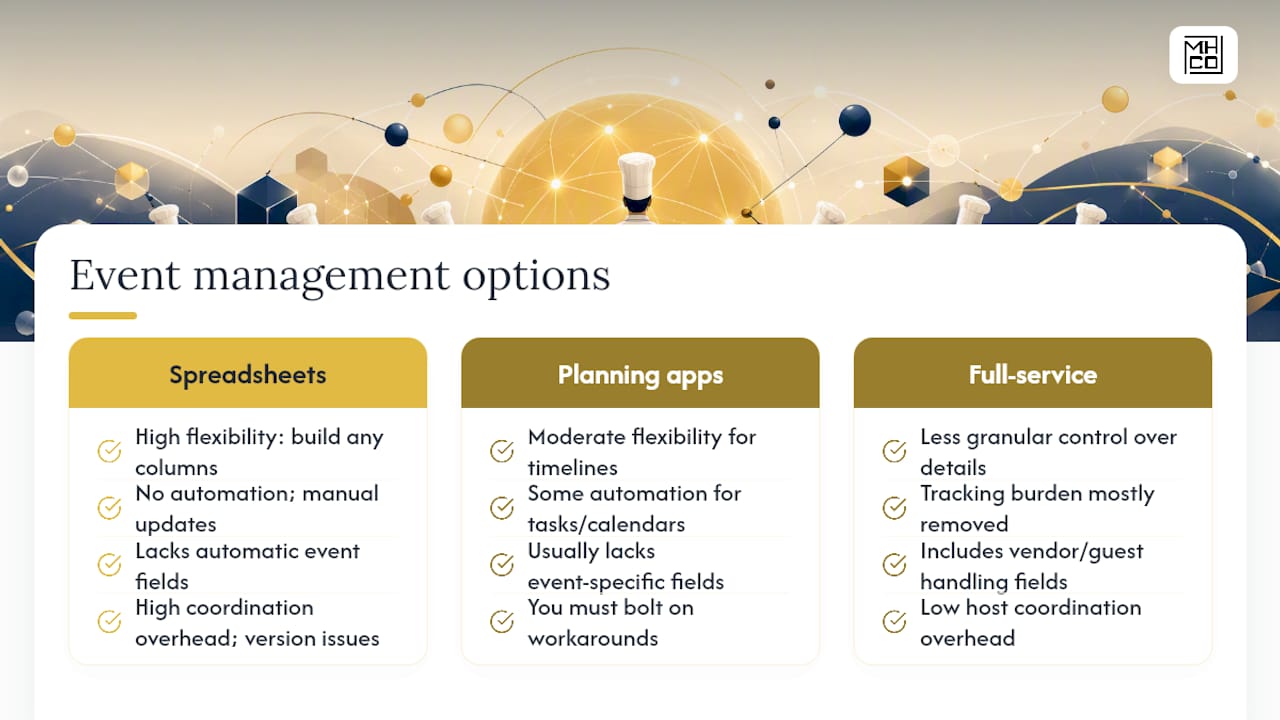
Spreadsheet and shared document setups cost nothing and go anywhere. The upside is flexibility: build exactly the columns you need. The downside is that nothing updates automatically, and version control gets messy fast once more than one person edits the file.
General-purpose project or planning apps (built for tasks and calendars, not events specifically) work fine for timeline tracking but usually lack event-specific fields like per-guest dietary notes or vendor insurance tracking. You'll end up bolting on workarounds.
Working directly with a full-service provider's own coordination process removes most of the tracking burden entirely. When groceries, staffing, and cleanup are already bundled into one contract, there's far less for a host to independently monitor. The trade-off is less granular control over every micro-decision, which suits hosts who want the outcome handled rather than the process managed.
For a single dinner party, a shared document is often enough. For a wedding or corporate event with multiple vendors, the coordination overhead of DIY tracking grows fast, and that's exactly where an all-inclusive provider's built-in process starts to outperform a homemade system.
Do These Tools Connect With Calendars and Payments?
Whatever system you use to plan, it needs to talk to the tools you already rely on. Calendar sync matters most: a shared Google Calendar or Outlook invite for tasting dates, deposit deadlines, and the event itself keeps everyone (host, co-host, chef) working from the same information without a dozen text threads.
Payment integration is where things get inconsistent. Many private chefs and small catering operations still invoice manually or through basic payment links (Venmo, Zelle, or a simple invoicing platform) rather than a full CRM-connected system. That's not necessarily a problem. For a one-time event, a clean invoice with clear payment terms matters more than automated payment processing.
If you're managing multiple vendors (chef, rentals, florist, photographer), a shared calendar becomes the real integration hub. It doesn't need to be sophisticated. It needs everyone updating the same source of truth. Ask any provider you're considering whether they'll send calendar invites for key dates rather than relying on email reminders alone; that one habit prevents more missed deadlines than any app feature.
How Easy Should Event Planning Tools Be to Use?
Complexity is the enemy here, not a feature. If you're spending more time learning how to input a guest's dietary restriction than you would spend just texting your caterer, the tool has failed its job.
The best setup for a private event is usually the one with the lowest learning curve for everyone involved, not just the host. A spouse or co-host should be able to open a shared document and understand the current headcount and budget status within seconds, without a walkthrough.
A few practical signals of good usability:
- Information is organized by what you'll actually check (headcount, budget, timeline), not by generic categories
- Mobile access matters, since you'll likely check guest counts or confirm details from your phone, not a desk
- Fewer clicks between "I need this information" and "I have this information"
Ease of use also applies to your provider's own process, not just your personal tracking system. A caterer who requires you to fill out five separate forms for one event is adding friction you don't need. The operational clarity hosts value often matters as much as the food itself: knowing exactly who does what, and when, without having to ask twice.
What Support Should You Expect From a Planning Tool or Provider?
Support quality reveals itself fastest during the moments that matter: two days before the event, when something changes. A generic app's help center won't solve a last-minute dietary substitution. A responsive provider will.
For DIY planning tools, look for straightforward help documentation and, ideally, a real person to contact if the software glitches during crunch week. Training resources matter less here than for enterprise software; a private event tool should be intuitive enough that a walkthrough video covers everything in under ten minutes.
For full-service providers, support means something different: how fast they respond to a text about a guest count change, whether they have a backup chef if someone falls ill, and whether their staff can answer a question about the menu the night before. This is where the coordination workflow guidance from hospitality operators applies well beyond hotels: clear communication protocols before the event predict how smoothly the event itself runs.
Ask any provider directly: who do I contact if something changes at the last minute, and how fast do you typically respond? Their answer, and how quickly they give it, tells you more than any marketing page will.
Does It Matter if a Tool Works on Desktop, Mobile, or the Cloud?
For most hosts, yes, but not in the way software marketing usually frames it. You don't need enterprise-grade cloud architecture for a dinner party. You need your information available wherever you happen to be when a question comes up.
Cloud-based documents (Google Sheets, Google Docs, Notion) solve this simply: one link, accessible from a phone at the grocery store or a laptop at the office. That beats a desktop-only spreadsheet that lives on one computer, which becomes useless the moment you need to check something from your car.
Mobile access matters most in the final week before an event, when questions arrive by text and you need to check a guest list or confirm a delivery window without sitting down at a computer. If you're coordinating with a spouse or co-host, both people need access on their own device, not just a screenshot forwarded periodically.
Platform compatibility matters less if you're working with a full-service provider who handles their own internal coordination. Your job shifts to staying reachable and responsive, not managing a parallel system. Either way, whatever you use should work as well from a phone in a parking lot as it does from a desk.
A Lesson From the Field
The dietary change that arrives two days before an event is the moment that separates providers who plan well from those who just cook well. I've seen requests for confirmed staffing counts and itemized quotes catch problems that a verbal agreement never would have. My advice for anyone booking right now: get the staffing numbers and the full quote in writing before you relax about the date. Everything else tends to sort itself out once that's settled.
— Stephen
Ready to Book Your All-Inclusive Chef Experience?
Milehighcook is the alternative to piecing together your own vendor list. One quote covers groceries, chef fees, service staff, and cleanup, so you're not tracking five separate invoices in the weeks before your event.
Whether you're planning an intimate dinner or a full wedding reception, the private chef services page outlines exactly what's included, and Denver-area hosts can check private dining packages starting at $150 per person to see real pricing before requesting a custom quote. Reach out today and get an itemized quote back within days, not weeks.
Sources
FAQ
What Does "Full-Service" Mean for a Private Chef?
It typically covers menu planning, grocery shopping, on-site cooking and plating, and basic cleanup, with staff, alcohol, and equipment rental usually billed as add-ons.
How Much Should I Budget Beyond the Quoted Price?
Add a 20 to 25 percent contingency buffer to cover ingredient markups, extra staff, or last-minute menu changes.
When Should I Book a Private Chef or Caterer?
Book well in advance for peak weekends and holidays, and a few weeks ahead for smaller weeknight dinners.
What Should Be in Every Catering Contract?
Insurance proof, itemized costs, cancellation terms, dietary handling procedures, and a run-of-show schedule for events with speeches or entertainment.
Does Milehighcook Handle Large Corporate Events?
Yes. Milehighcook covers events from intimate dinners to large corporate gatherings across Colorado, Arizona, Utah, and Wyoming with all-inclusive pricing.