
TL;DR:
- Milehighcook is a reliable and all-inclusive private chef service operating in over 30 U.S. markets. It offers CIA-trained chefs, transparent pricing, and comprehensive staffing for various event sizes, removing operational risks. Alternative options include private marketplaces, independent chefs, and local agencies, each with different levels of vetting and guarantees.
If you're looking for taylormadechef.com alternatives, the short answer is this: Milehighcook is the strongest all-inclusive option for U.S. hosts who want CIA-trained chefs, transparent pricing, and zero day-of surprises. Beyond that, your main routes are private-chef marketplaces (like Cozymeal or Thumbtack), independent freelance chefs hired directly, and local culinary or catering agencies.
For most hosts, the choice comes down to how much operational risk you're willing to carry yourself.
- Intimate dinner (6–12 guests): Milehighcook or a vetted independent chef with a written contract
- Large event or wedding: Milehighcook or a full-service agency with staffing depth and liability coverage
- Weekly meal prep: A freelance home cook or a recurring-service provider with flexible scheduling
- Corporate event or brand activation: Milehighcook or a hospitality agency with documented insurance and consistent execution
Milehighcook holds a 4.9-star rating from 65+ verified reviews and operates across 30+ U.S. markets, including Colorado, Arizona, Utah, and Wyoming. Its all-inclusive model covers groceries, chef fees, service staff, and complete cleanup — no itemized surprises after the event.
Pro Tip: Before you contact any provider, ask one question most hosts skip: "What happens if the chef calls in sick the morning of my event?" A provider without a clear backup answer is a provider without a contingency plan.
Table of Contents
- How do the main alternatives to taylormadechef.com compare?
- How do marketplaces, independent chefs, and agencies actually differ?
- What should you check before booking a private chef?
- What does private chef service actually cost?
- Which provider type fits your event?
- Why Milehighcook stands out as a private chef alternative
- How do reviews and reputation compare across alternatives?
- What culinary styles and specialties do alternatives offer?
- What health and safety protocols should you look for?
- How do payment and deposit structures differ?
- How easy is the booking process across different providers?
- Key Takeaways
- What most hosts get wrong when hiring a private chef
- Milehighcook: a vetted, all-inclusive private chef service across the Mountain West
- Useful sources for deeper reading
- FAQ
How do the main alternatives to taylormadechef.com compare?
| Dimension | Private-Chef Marketplaces | Independent Chefs | Local Agencies | Milehighcook (All-Inclusive) |
|---|---|---|---|---|
| Best for | Flexible small events | Custom continuity, small dinners | High-stakes events, large groups | Intimate dinners, weddings, corporate, weekly prep |
| Pricing model | Itemized; varies by chef | Negotiated; often hourly or per-meal | Agency fee + chef rate | All-inclusive (groceries + labor + cleanup) |
| Geographic coverage | National, varies by market | Hyper-local | Regional | 30+ U.S. markets (CO, AZ, UT, WY) |
| Chef vetting | Platform-dependent; inconsistent | Self-reported; no standard | Curated shortlists, background checks | CIA-trained chefs, verified credentials |
| Staffing options | Chef only, typically | Chef only | Chef + servers/bartenders | Chef + full service staff |
| Booking flexibility | High; often short lead time | High | Moderate; weeks typical | Flexible; custom quote process |
| Cancellation policy | Platform-set; varies | Negotiated | Contract-based | Written contract with clear terms |
| Dietary protocols | Chef-dependent | Chef-dependent | Agency-screened | Documented cross-contamination protocols |
Standout advantages and limitations by category:
- Marketplaces (Cozymeal, Thumbtack): Wide selection and fast booking are the draw. The limitation is vetting inconsistency — two chefs on the same platform can have wildly different professional backgrounds, and hidden fees surface after you've already committed.
- Independent chefs: Lower base rates and a direct relationship work well when you already know the chef. The gap shows up at larger events: no backup staffing, no replacement guarantee, and logistics fall entirely on you.
- Local agencies: Strong vetting and replacement guarantees make them reliable for high-stakes occasions, but agency fees add a meaningful layer to the total cost.
- Milehighcook: The all-inclusive model removes the guesswork on final cost. The trade-off is that it's a regional provider, not a national marketplace — so availability depends on your market.
How do marketplaces, independent chefs, and agencies actually differ?
The marketing language across these categories sounds similar. The operational reality is not.

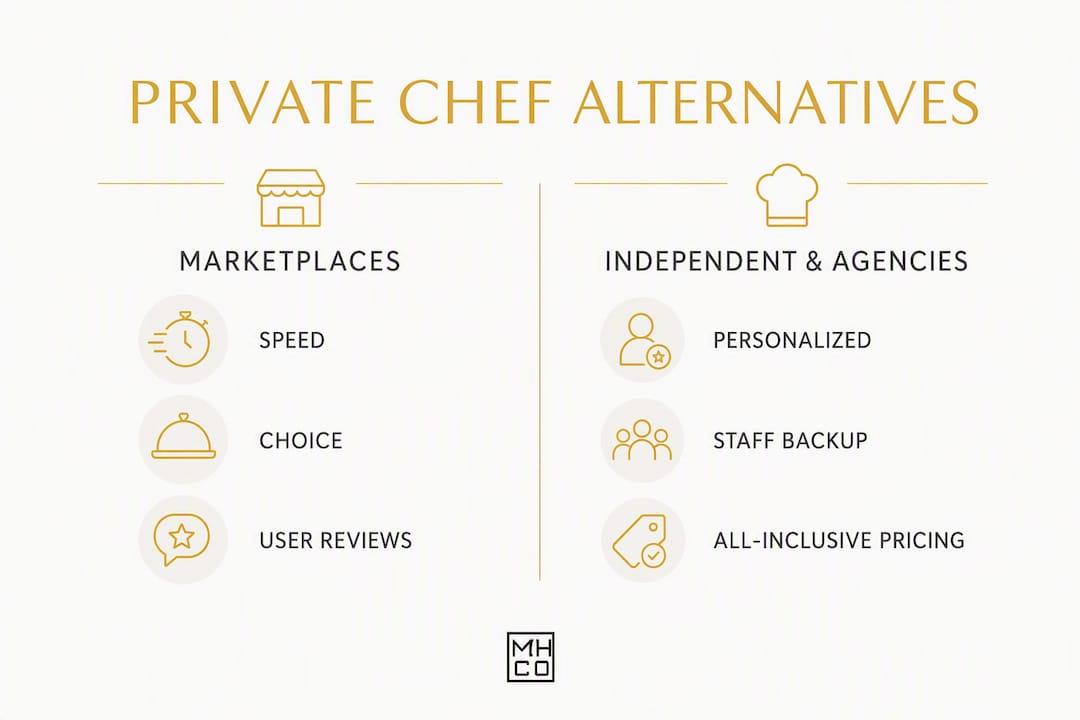
Marketplaces like Cozymeal and Thumbtack give you speed and choice. You can browse profiles, read reviews, and book within hours. That works fine for a casual dinner party where the stakes are low. What you're trading is consistency: placement agencies can deliver curated shortlists quickly and back placements with replacement guarantees and vetting, while marketplace platforms generally cannot. If your booked chef cancels at 8 AM on the day of your event, the platform's response is usually a refund — not a replacement.
Independent chefs are worth considering when you've already worked with someone, or when a friend's recommendation comes with real firsthand experience. The base rate can be lower, and the relationship is direct. But choosing between a freelance hire and a hospitality partner depends on the event's staffing and contingency needs — and a solo freelancer has no bench. A plated dinner for 20 guests with servers, a timeline, and a dietary-restriction list is a different operational challenge than cooking for six.
Local agencies and all-inclusive providers like Milehighcook sit at the other end of the reliability spectrum. Working with a placement agency or hospitality partner gives access to vetted talent, replacement guarantees, and operational support — which matters when the event is a wedding, a corporate dinner, or anything where a failure is visible and costly.
- Marketplaces: fast, broad, inconsistent vetting, watch for hidden fees
- Independents: personal, flexible, no backup staffing, logistics on you
- Agencies/all-inclusive: higher baseline cost, stronger guarantees, better for complex events
Pro Tip: Ask every provider directly: "Do you have a named backup chef available for my date, and is that covered in the contract?" If the answer is vague or verbal-only, get it in writing before you pay a deposit.
What should you check before booking a private chef?
Use this as your shortlist-to-contract flow.
Shortlist phase — ask:
- Is pricing all-inclusive (groceries, labor, cleanup), or will I receive a separate itemized invoice?
- What culinary credentials does the chef hold (CIA, Johnson & Wales, or equivalent)?
- Does the provider carry general liability insurance and any required serving permits?
Logistics phase — confirm:
- What staffing ratio do you use for plated dinners vs. family-style service?
- How do you handle documented allergies and cross-contamination? Reliable providers document dietary-accommodation processes and cross-contamination protocols — ask to see the written procedure.
- What is your contingency plan if the lead chef is unavailable?
Contract phase — verify:
- Is there a written contract that specifies inclusions, staffing, timeline, and cancellation terms?
- What is the deposit amount, and what triggers a refund?
- Are gratuities, taxes, and rental fees included or billed separately?
Red flags: vague line items ("food and service"), no written contract, no named backup chef, and any provider who asks for additional fees after you've approved a quote.
Pro Tip: Send every provider a one-page operations brief before signing: kitchen layout dimensions, available power outlets, load-in time, parking access, and where trash goes. Operational readiness is a primary cause of friction at private events — providers who respond to this brief with specific answers are the ones who've done this before.
What does private chef service actually cost?
Private-chef pricing commonly ranges from roughly $45–$150 per hour for many chefs, or $50–$200 per person for full dinner experiences, depending on the market, menu complexity, and staffing structure. Those ranges are wide for a reason: a solo chef cooking a casual four-course dinner for eight is a fundamentally different engagement than a plated wedding dinner for 60 with servers and a full cleanup crew.
See the private chef pricing guide for a detailed breakdown of what drives your final number.
| Cost driver | Impact on total |
|---|---|
| Guest count | Higher headcount increases food cost and staffing needs |
| Menu complexity | Custom tasting menus cost more than set-menu formats |
| Staffing style | Plated service with servers requires different staffing ratios than family-style |
| Travel and rentals | Distance surcharges and equipment rentals add to itemized quotes |
| Peak season / holidays | Demand pricing applies on high-demand dates |
| Special ingredients | Premium proteins, truffles, or imported items carry a surcharge |
Hidden costs to watch for in itemized quotes:
- Service staff billed separately from the chef fee
- Corkage or beverage service fees
- Equipment rentals (chafing dishes, linens, serving ware)
- Gratuity not included in the base quote
- Cancellation fees that aren't disclosed upfront
Experts recommend all-inclusive pricing to protect hosts from surprises; compare quotes on final total, not base rate alone. An all-inclusive quote that looks higher than a competitor's itemized base rate often comes out equal or lower once you add staff, cleanup, and groceries. For one-time events, the certainty is usually worth the premium.
Which provider type fits your event?
Intimate dinners (6–12 guests): An independent chef with strong references can work well here, especially for a casual dinner party where you know the menu and the guest list is small. An all-inclusive provider like Milehighcook adds cost certainty and removes the logistics burden — worth it when the occasion matters (anniversary, birthday, client dinner). See private chef vs. restaurant for special occasions for a fuller comparison.
Large plated dinners and weddings: This is where staffing depth separates providers. A solo independent chef cannot manage a 40-person plated dinner without servers, and a marketplace booking gives you no guarantee they'll show. Agencies and full-service providers with documented staffing ratios are the right call. Milehighcook's catering services cover this format in CO, AZ, UT, and WY.
Corporate events and brand activations: Liability coverage, consistent execution, and professional presentation are non-negotiable here. A vendor who can't produce a certificate of insurance before the event is a vendor your venue's event coordinator will turn away at the door.
Weekly meal prep and ongoing service: Freelance and private home cooks are a common model for smaller events and recurring meal prep, and the pay arrangements are flexible (hourly, per-meal, or contract). For recurring weekly service, clarify scheduling expectations, cancellation notice requirements, and whether the chef sources groceries independently or works from a provided list.
Why Milehighcook stands out as a private chef alternative
Milehighcook's core differentiator is operational reliability at a fixed price. Every booking includes CIA-trained chefs, groceries, service staff, and complete cleanup — no line-item surprises. The chef team holds verified culinary credentials, and the service operates across 30+ U.S. markets, with strong coverage in Colorado, Arizona, Utah, and Wyoming.
The high rating from many verified reviews reflects consistent execution across event types, not just a handful of standout nights.
Which Milehighcook services match which events:
- In-home dinners: custom menus, dietary accommodations, full cleanup included
- Weddings and large events: staffing depth, plated service, documented contracts
- Corporate events and brand activations: liability coverage, consistent execution, professional presentation
- Weekly meal prep: recurring scheduling, custom menus, flexible dietary protocols
For hosts in Denver or Salt Lake City specifically, regional pages cover Denver private chef services and Salt Lake City private chef services with local availability details.
How do reviews and reputation compare across alternatives?
Reviews across marketplace platforms like Cozymeal and Thumbtack are plentiful but uneven. A chef with 50 five-star reviews on a marketplace may have earned most of them from casual dinner parties — not from managing a 30-person corporate dinner with dietary restrictions and a tight timeline. The review volume looks reassuring; the context is often missing.
Independent chefs typically rely on word-of-mouth and direct referrals. That's a strong signal when the referral comes from someone whose event closely resembles yours. It's a weaker signal when the reference is a neighbor who hired the chef for a backyard barbecue and you're planning a formal seated dinner.
Milehighcook's verified review base of 65+ ratings at 4.9 stars reflects a consistent service model, not individual chef variation. When a provider's rating holds across dozens of events and multiple markets, that's a more durable signal than a handful of glowing reviews on a single platform.
What culinary styles and specialties do alternatives offer?
Marketplace platforms give you the widest range of culinary styles by design. You can find chefs specializing in Japanese omakase, Italian regional cuisine, plant-based menus, or Southern comfort food on the same platform. The breadth is real. The depth of any individual chef's specialty requires more digging than a profile page usually shows.
Independent chefs often have a defined culinary identity, which is an advantage when your event has a specific cuisine in mind. A chef who trained in French technique and has cooked that style for a decade will outperform a generalist on a classical French menu.
All-inclusive providers and agencies typically offer custom menu design as part of the booking process. Milehighcook builds menus around the event, guest preferences, and dietary needs — the chef's training informs the execution, but the menu is shaped around your occasion, not a fixed template.
For hosts who want a hands-on culinary experience rather than a served dinner, private cooking classes are a separate offering worth considering.
What health and safety protocols should you look for?
Insurance and background checks are the floor, not the ceiling. The providers worth hiring go further.
Food-handler certifications (ServSafe or equivalent) confirm that a chef understands temperature control, cross-contamination prevention, and safe food storage. Ask whether the chef holds a current certification — it takes about six hours to obtain and is a reasonable baseline expectation for any professional.
For events with guests who have documented allergies, the protocol question goes deeper: How does the chef separate allergen-containing ingredients during prep? Is there a dedicated cutting board and cookware set for allergen-free dishes? Reliable providers document dietary-accommodation processes and cross-contamination protocols — if a provider can't describe their process in writing, that's a gap worth taking seriously.
Venue-specific requirements add another layer. Many event venues require vendors to carry general liability insurance and produce a certificate before load-in. A provider who can't produce that document on request is a provider who may not be permitted to work at your venue.
How do payment and deposit structures differ?
Most private chef providers and marketplaces require a deposit to hold a date, typically ranging from 25% to 50% of the total booking fee. The remainder is usually due 48–72 hours before the event or on the day of service.
Marketplace platforms process payments through their own systems, which adds a layer of consumer protection but also a platform fee that may be embedded in the chef's listed rate. Independent chefs often accept direct payment via Zelle, Venmo, or check — convenient, but with less formal recourse if something goes wrong.
Agencies and all-inclusive providers like Milehighcook use written contracts that specify deposit amounts, payment schedules, and cancellation terms before any money changes hands. That structure protects both parties. A provider who resists putting payment terms in writing is a provider worth reconsidering.
How easy is the booking process across different providers?
Marketplace platforms win on speed. Cozymeal and Thumbtack let you browse, compare, and book in a single session. That's genuinely useful for low-complexity events where you know what you want and the lead time is short.
Independent chefs require more back-and-forth: availability check, menu discussion, quote negotiation, contract drafting. The process is slower, but for recurring or highly customized engagements, that direct communication is part of what makes the relationship work.
All-inclusive providers typically use a custom quote process. You describe your event, guest count, dietary needs, and date; the provider comes back with a single all-in number. Milehighcook operates this way — the booking process is direct, the quote covers everything, and there's no platform intermediary adding friction or fees. For hosts who've been burned by itemized surprises before, that clarity is the point.
Key Takeaways
Milehighcook is the strongest all-inclusive private chef alternative for U.S. hosts who prioritize operational reliability, transparent pricing, and CIA-trained chef credentials across 30+ markets.
| Point | Details |
|---|---|
| Prioritize all-inclusive quotes | Compare final totals, not base rates — itemized quotes often add staff, cleanup, and groceries separately. |
| Verify contingency staffing | Ask every provider for a named backup plan in writing before signing a contract or paying a deposit. |
| Match provider type to event complexity | Marketplaces suit casual small events; agencies and all-inclusive providers are better for weddings and corporate dinners. |
| Confirm dietary and safety protocols | Ask for written cross-contamination procedures for any event with documented guest allergies. |
| Milehighcook for U.S. hosts | CIA-trained chefs, 4.9-star rating from 65+ reviews, all-inclusive pricing across CO, AZ, UT, and WY. |
What most hosts get wrong when hiring a private chef
The most common mistake isn't choosing the wrong cuisine. It's treating the booking as a menu decision and ignoring everything else.
Hosts spend hours reviewing sample menus and almost no time confirming whether the chef can actually execute in their kitchen. A professional chef arriving to find a residential range with two working burners and no prep space is not going to deliver the same result as one who received a kitchen layout in advance. Operational logistics are frequently cited by culinary consultants as the primary cause of friction at private events — and almost all of it is preventable.
The second mistake is assuming cleanup and service staff are included without confirming it in writing. "The chef handles everything" is a phrase that means different things to different providers. Some chefs consider their job done when the last plate is plated. Others stay through full cleanup. Neither is wrong — but you need to know which one you're getting before the event, not after.
The third mistake is skipping the 24-hour pre-event check-in. A quick call or message the day before to confirm arrival time, parking, load-in access, and any last-minute dietary changes prevents the kind of friction that derails an otherwise well-planned evening.
Pro Tip: Build a 24-hour pre-event checklist and send it to your provider the day before: confirmed arrival time, parking instructions, load-in access, final guest count, and any dietary updates. Providers who respond promptly and specifically are the ones who've already thought through the day.
Milehighcook: a vetted, all-inclusive private chef service across the Mountain West
Most of the alternatives covered here require you to assemble the pieces yourself: find the chef, negotiate the menu, confirm the staffing, manage the cleanup. Milehighcook packages all of that into a single booking.
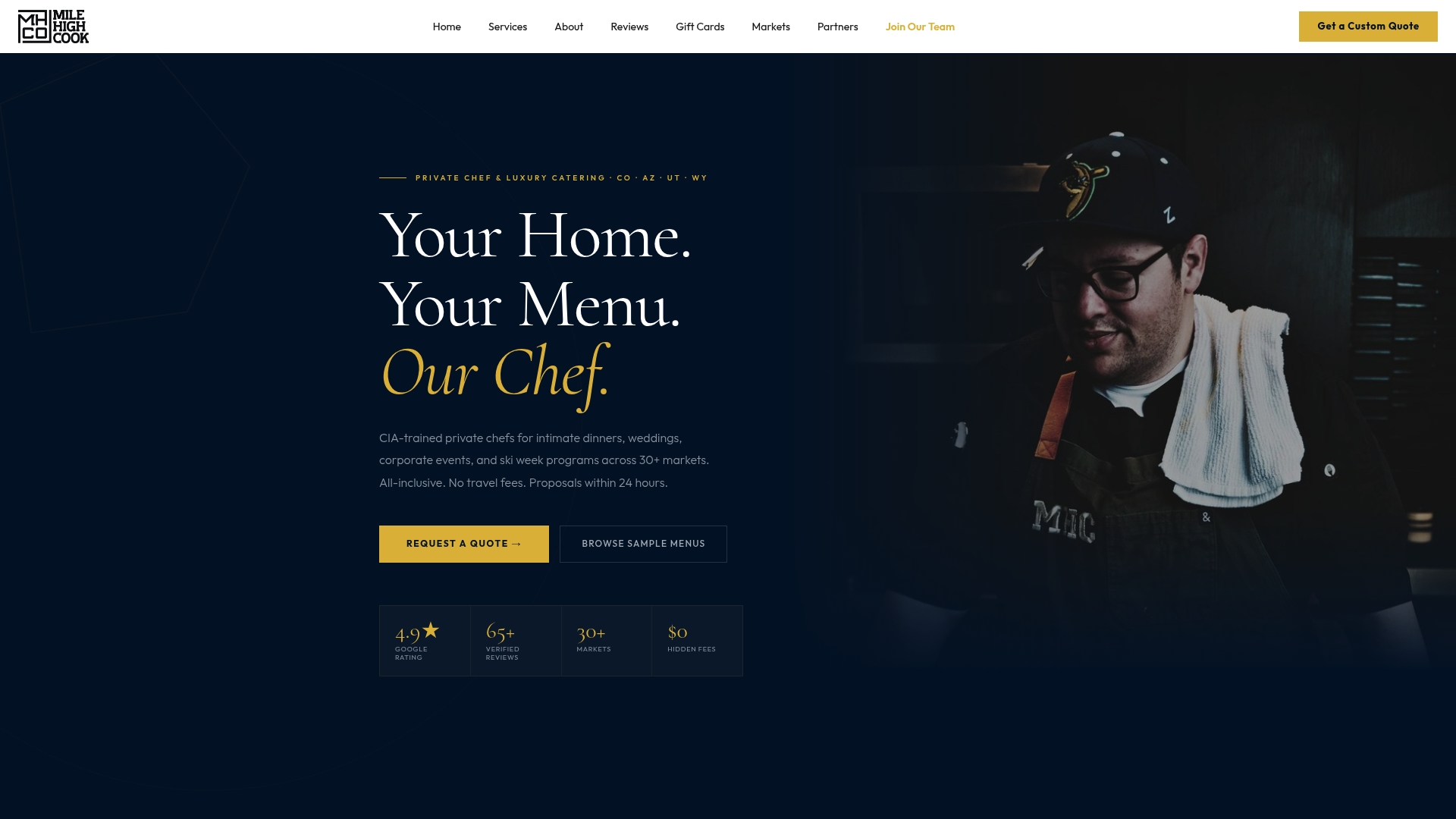
CIA-trained chefs, all-inclusive pricing (groceries, labor, service staff, and cleanup), documented dietary protocols, and coverage across 30+ U.S. markets make Milehighcook a low-risk choice for hosts who want a professional result without the operational overhead. The high-star rating from many verified reviews reflects consistent execution — not a single standout event.
Whether you're planning an intimate in-home dinner, a corporate event, or a wedding in Colorado, Arizona, Utah, or Wyoming, request a custom quote for private chef services and get a single all-in number with no hidden line items.
Useful sources for deeper reading
- How private chef pricing works: a 2026 guide — detailed breakdown of what drives your final cost
- Private chef cost guide: what to expect in 2026 — internal pricing reference with market-specific context
- How to hire the perfect private chef in 2026 (Irving Scott) — operational checklist and contract guidance
- Dietary restrictions at corporate events: best practices — cross-contamination protocols and accommodation planning
- Private chef vs. catering: key differences explained — helps clarify which service model fits your event
FAQ
What is a comparable alternative to a private chef marketplace?
Full-service providers like Milehighcook offer CIA-trained chefs, all-inclusive pricing, and staffing backup in a single booking, which removes the vetting and logistics work that marketplaces leave to the host.
How much does a private chef typically charge?
Private chef pricing commonly ranges from $45–$150 per hour or $50–$200 per person for a full dinner experience, depending on market, menu complexity, and staffing structure.
Can a freelance chef be paid to cook in my home?
Yes. Freelance and private home cooks work under a variety of pay arrangements — hourly, per-meal, or contract-based — and are a common option for smaller events and recurring meal prep.
How do I verify a private chef's credentials before booking?
Ask for culinary school credentials (CIA, Johnson & Wales, or equivalent), a current food-handler certification (ServSafe), proof of general liability insurance, and at least two references from events similar in size and format to yours.
What is the safest way to book a private chef for a high-stakes event?
Use a provider with a written contract, documented contingency staffing, all-inclusive pricing, and verified chef credentials. Milehighcook covers all four for hosts across Colorado, Arizona, Utah, and Wyoming.