
TL;DR:
- Full-service corporate dining includes daily meals, pantry stocking, beverage programs, and event catering managed as a core employee benefit. It improves retention, productivity, and workplace culture by providing reliable and inclusive food options that scale with actual attendance. Choosing the right model and using data-driven management are essential for maximizing its ROI and employee satisfaction.
Full-service corporate dining is defined as a contract-based workplace meal program that covers daily breakfast, lunch, and dinner, pantry stocking, beverage programs, and integrated event catering, all managed as a core employee amenity. As of 2026, 81% of employer-provided meals are free to employees. That figure signals a fundamental shift: food is no longer a nice-to-have perk. It is a primary workplace benefit that directly shapes retention, productivity, and company culture. This guide breaks down what full-service corporate dining includes, why it delivers measurable ROI, and how to choose the right model for your organization.
What is full-service corporate dining?
Full-service corporate dining is the industry term for a managed food service program that goes far beyond ordering sandwiches for a meeting. The recognized standard covers six distinct service areas: daily meal provision, pantry and snack stocking, beverage programs, event catering, operational management, and data-driven reporting. Each area is typically governed by a service contract with a food management partner or in-house team.

The scope matters because it changes how you budget and plan. A simple drop-off catering order ends when the food arrives. A full-service program manages the entire food experience, from sourcing ingredients to cleanup, every single day. That operational depth is what separates corporate dining services from basic catering.
The core components of a full-service program include:
- Daily meals: Breakfast, lunch, and dinner options served on-site, either cafeteria-style or through a staffed dining room
- Pantry and snack programs: Stocked kitchens with healthy snacks, fresh fruit, and grab-and-go items available throughout the day
- Beverage programs: Coffee, tea, juice, and specialty drink stations, often managed as a standalone sub-program
- Event catering integration: Boardroom lunches, all-hands meetings, client dinners, and holiday events handled within the same service contract
- Operational management: Staffing, food safety compliance, vendor sourcing, and waste management handled by the dining partner
- Reporting and optimization: Participation tracking, inventory data, and waste metrics reviewed regularly to control costs
Pro Tip: When evaluating a full-service dining contract, ask specifically which of these six components are included versus billed separately. Many programs advertise "full-service" but exclude event catering or data reporting from the base fee.
How does corporate dining benefit employee experience and performance?
The business case for on-site dining solutions is grounded in hard data, not sentiment. Employees with poor diets are 66% more likely to suffer productivity losses. Hunger affects the work quality, speed, and error rate of 9 in 10 employees. Those two numbers alone justify the investment for most HR and operations leaders.
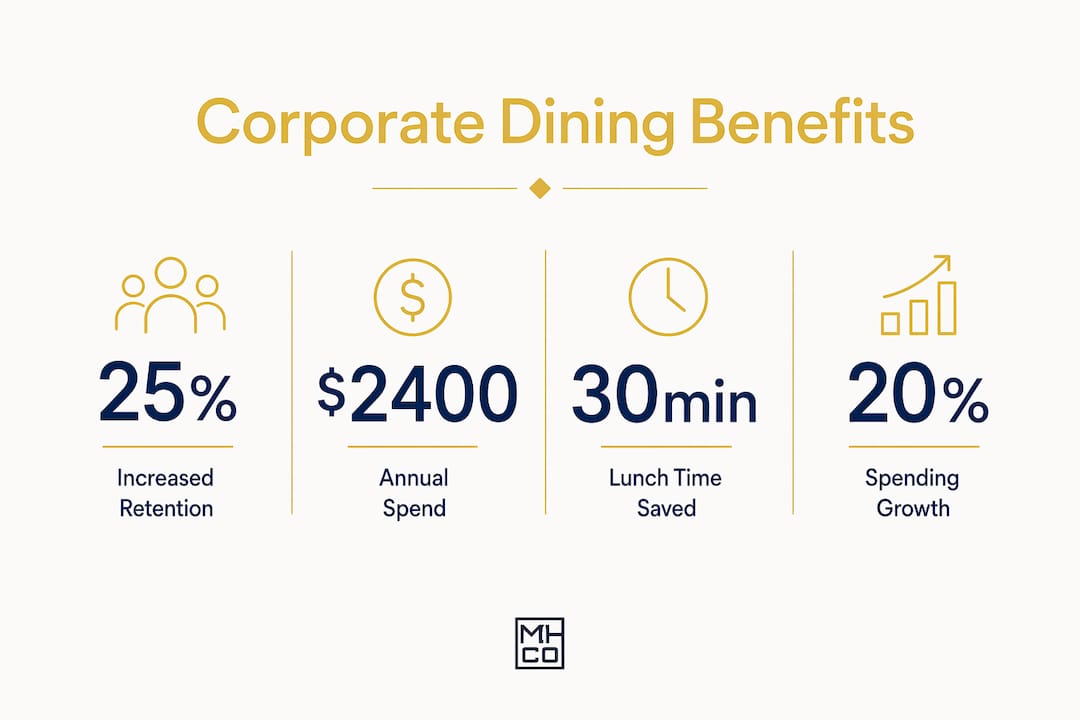
Retention is the second major driver. 79% of hybrid employees say employer-provided food raises the likelihood they will stay with a company that requires office attendance. As hybrid mandates increase across corporate America, food programs have become a direct retention tool, not just a culture signal.
"The highest ROI from workplace food programs comes from daily practical meals that employees find reliable and accessible, rather than complex or gourmet one-off events." — Workplace Food Program ROI research
The logic behind that finding is straightforward. When employees spend 30 minutes deciding where to eat lunch, they return distracted and often eat poorly. A reliable on-site option removes that friction entirely. Well-designed dining spaces also function as social hubs, strengthening cross-team connections that are especially critical for hybrid workforces with limited in-person overlap.
One in five workplaces plan to increase meal program spending by more than 25% in 2026, with average annual investment running approximately $2,400 per employee. That figure reflects how seriously leading organizations now treat food as a measurable business input.
What are the different corporate dining models?
Corporate dining services fall into five distinct models, each with different cost structures, flexibility levels, and suitability by company size. Choosing the wrong model is the most common and most expensive mistake decision-makers make.
| Model | Flexibility | Upfront cost | Best for |
|---|---|---|---|
| In-house cafeteria | Low | High (capital build-out required) | Large campuses, 500+ employees |
| Outsourced cafeteria management | Medium | Medium (management fee plus food costs) | Mid-to-large offices seeking hands-off operations |
| Corporate food hall | High | Medium (lease and vendor coordination) | Urban offices wanting menu variety |
| Pop-up restaurant program | Very high | Low to medium (per-event or monthly fee) | Hybrid offices with variable daily attendance |
| Daily office delivery program | High | Low (per-order or subscription) | Small to mid-size teams, remote-first cultures |
The in-house cafeteria model delivers the most control but requires significant capital investment and dedicated management staff. Outsourced cafeteria management transfers operational responsibility to a food service partner while keeping the physical space on-site. Corporate food halls bring multiple rotating restaurant concepts into a single location, giving employees variety without the company managing multiple vendor relationships.
Pop-up programs and daily delivery models are the fastest-growing options in 2026. Flexible dining models such as pop-ups and modular services better serve hybrid attendance than static cafeteria schedules, reducing both waste and employee frustration. A company with 40% office attendance on any given day cannot justify a full cafeteria operation. A rotating pop-up or delivery subscription scales with actual headcount.
Pro Tip: Before selecting a model, audit your average daily office attendance for a full quarter. Programs sized for peak days generate significant food waste and budget overruns on lighter days.
Key operational best practices for a successful dining program
Running a full-service corporate dining program well requires more than signing a catering contract. The programs that deliver consistent ROI share four operational disciplines.
Data-driven management is non-negotiable. Real-time tracking of inventory, participation rates, and food waste is the primary lever for controlling costs and maintaining quality. Programs that skip this step routinely overspend on food that goes uneaten and underserve on high-attendance days.
Menu design must reflect your workforce. Inclusive menus that respect dietary preferences, cultural backgrounds, and health goals improve program participation and signal genuine inclusivity. A menu built only around one cuisine or one dietary profile will see participation drop within the first quarter.
Sustainability alignment builds long-term credibility. Leading firms treat dining as culture, not commodity, by sourcing locally, reducing single-use packaging, and publishing waste reduction metrics. Employees notice, and it reinforces broader company values.
Avoid the static schedule trap. Programs that lock into fixed menus and rigid service hours fail hybrid teams. Build in quarterly menu rotations, seasonal specials, and flexible service windows that accommodate different work schedules. The goal is a program employees actively choose to use, not one they tolerate.
The operational checklist for any new or restructured program:
- Establish baseline participation data before making changes
- Set waste reduction targets in the first service contract
- Schedule quarterly menu reviews with employee input
- Build event catering into the same operational framework as daily meals
- Review cost-per-meal metrics monthly, not annually
Key takeaways
Full-service corporate dining is a managed, contract-based meal program that covers daily meals, pantry stocking, beverage service, and event catering, and it delivers measurable ROI through improved retention, productivity, and workplace culture.
| Point | Details |
|---|---|
| Definition is broad | Full-service dining covers six service areas, not just catering for meetings. |
| Retention impact is real | 79% of hybrid employees say food benefits raise their likelihood of staying. |
| Model selection matters | Match the dining model to your actual daily attendance, not your peak headcount. |
| Data drives cost control | Track inventory, participation, and waste from day one to avoid budget overruns. |
| Inclusion builds participation | Menus that reflect dietary and cultural diversity consistently outperform generic programs. |
Why food is the workplace benefit most leaders underestimate
Corporate dining gets treated as a facilities decision when it should be treated as a talent decision. I have watched organizations spend six figures on office redesigns to attract employees back to the office, then cut the lunch program to save $15 per person per day. The math never works in their favor.
The data is clear: hunger and poor diet are direct productivity killers. But the subtler point is that a reliable, quality meal program removes a layer of daily friction that compounds over time. Employees who do not have to think about lunch are more present, more collaborative, and more likely to stay in the building for afternoon meetings.
What I find most decision-makers miss is the difference between a dining program and a dining experience. A program delivers food. An experience builds community. The companies getting the highest return from their food investment are the ones treating the dining space as a place where culture actually happens, not just a room where people eat.
Hybrid work has made this harder, not easier. A program designed for five days a week attendance will fail a team that comes in three days a week. The solution is not to cut the program. It is to build one that scales with actual behavior. Flexible models, modular menus, and data-informed scheduling are the tools that make that possible.
If you are evaluating a corporate catering program for the first time, start with the question your employees actually care about: "Is this food I would choose to eat?" If the answer is no, no amount of operational efficiency will drive participation.
— Stephen
Milehighcook brings professional dining to your corporate events
Corporate dining works best when the food is genuinely good. Milehighcook provides private chef and catering services for corporate events across Colorado, Arizona, Utah, and Wyoming, with CIA-trained chefs who build menus around your team's actual preferences and dietary needs.
Every engagement includes groceries, chef fees, service staff, and complete cleanup under a single all-inclusive price. There are no surprise costs after the event. Milehighcook holds a 4.9-star rating from over 65 verified reviews, and its corporate event catering covers everything from boardroom lunches to full company dinners. If your organization is ready to treat food as the workplace benefit it actually is, Milehighcook is built for exactly that standard.
FAQ
What is full-service corporate dining?
Full-service corporate dining is a managed, contract-based meal program that covers daily meals, pantry stocking, beverage programs, and event catering as a core employee amenity. It differs from basic catering by managing the entire food operation on an ongoing basis.
How much does a corporate dining program cost per employee?
Average annual investment runs approximately $2,400 per employee, though costs vary significantly by model. In-house cafeterias require the highest capital outlay, while daily delivery and pop-up programs offer lower entry costs.
What are the main benefits of corporate dining for businesses?
The primary benefits are improved employee retention, higher productivity, and stronger workplace culture. Research shows 79% of hybrid employees are more likely to stay with employers who provide food, and poor diet is linked to 66% higher productivity loss.
Which corporate dining model works best for hybrid offices?
Flexible models such as pop-up restaurant programs and daily delivery subscriptions work best for hybrid offices. Static cafeteria schedules generate waste and frustration when daily attendance varies significantly.
How do you measure the ROI of a corporate dining program?
Track participation rates, cost-per-meal, food waste, and employee retention data quarterly. Programs that monitor these metrics from launch consistently outperform those that review costs only at contract renewal.