
TL;DR:
- Service staff at catering events are essential for guest satisfaction, managing all phases from setup to breakdown. Proper staffing ratios, role allocation, and pre-event briefings ensure smooth service and protect the host's brand reputation. Omitting support roles and staff buffers often leads to service failures that undermine the event's success.
Service staff at catering events are the operational backbone of every successful event, directly responsible for guest satisfaction, food timing, and the host's brand reputation. The role of service staff at catering events spans four distinct phases: pre-event setup, service execution, guest flow management, and post-event breakdown. Get these phases right and guests remember the experience. Get them wrong and no amount of great food recovers the night. 85% of executives link service quality directly to brand perception, which means your servers, captains, and runners are as much a part of your brand as your logo. Milehighcook builds every event around this principle, staffing each engagement with trained professionals who treat service as a craft, not a checklist.
What are the main responsibilities of catering service staff?
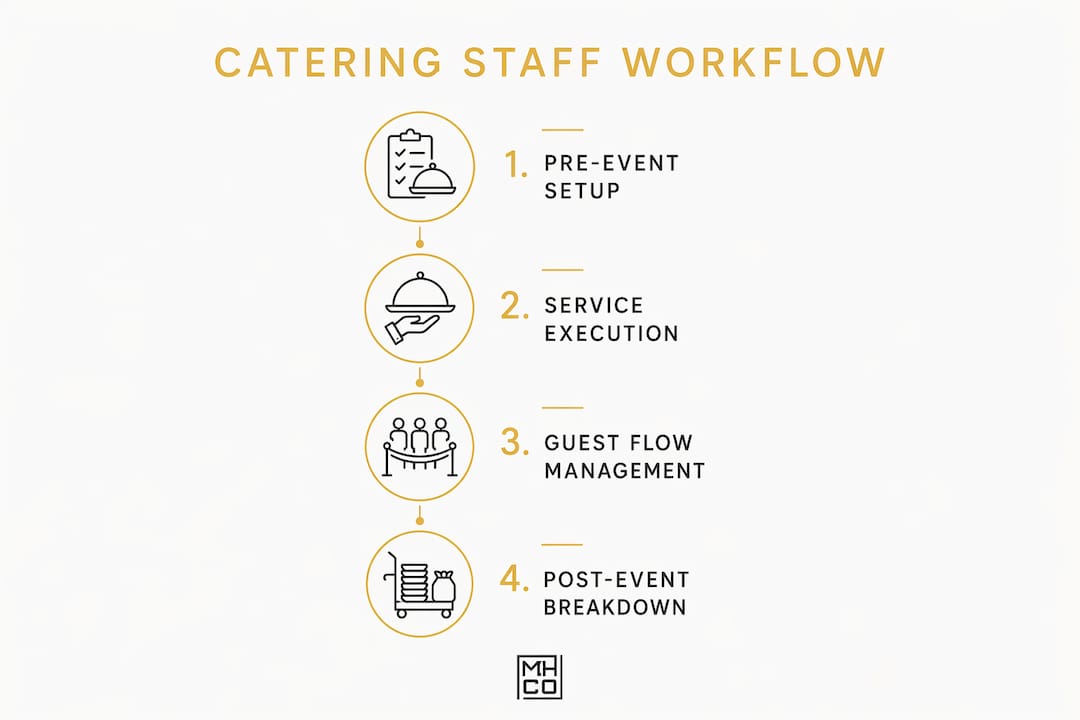
Professional catering staff responsibilities cover the full arc of an event, from the first table set to the final sanitation check. Breaking these duties into phases makes them easier to manage and assign.
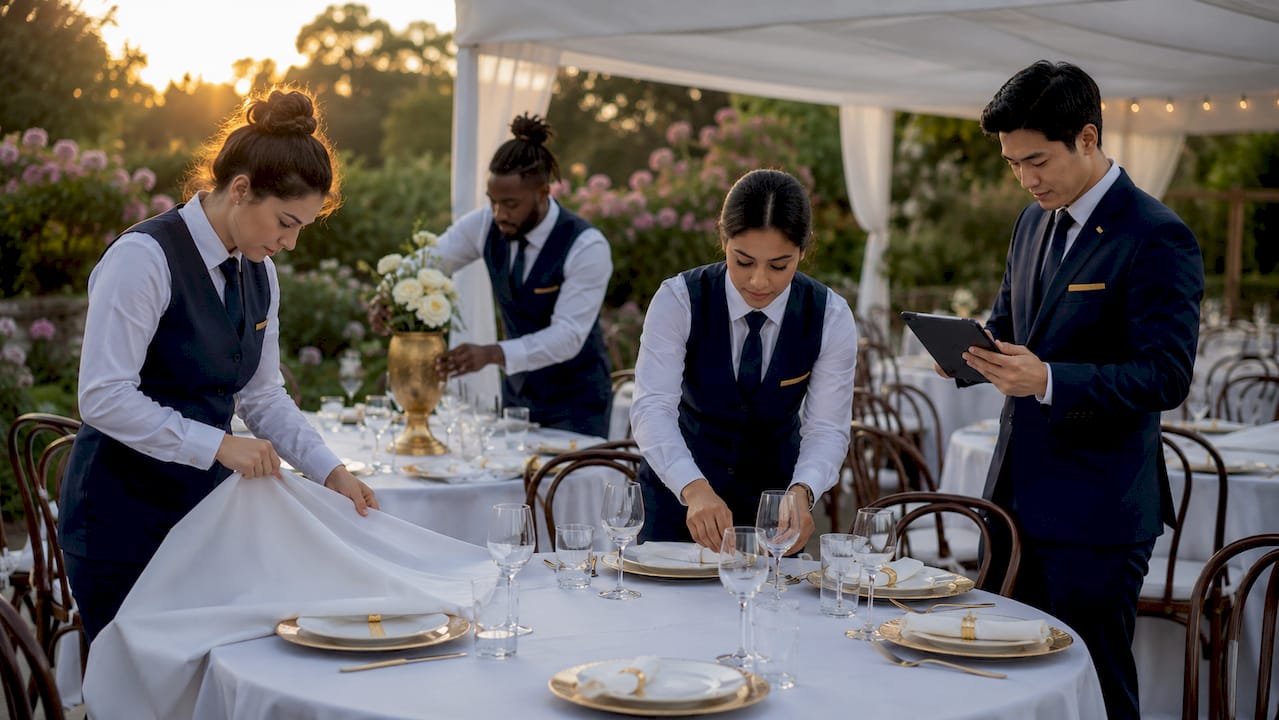
1. Pre-event setup Staff arrive early to stage tables, confirm inventory counts, and arrange the room according to the event diagram. This phase includes linen placement, glassware polishing, and positioning service stations. A missed step here creates visible chaos once guests arrive.
2. Service execution Servers deliver plated courses, pass appetizers on trays, and replenish buffet stations on a timed schedule. Formal plated service operates as a choreographed team led by a captain who calls cues for simultaneous course delivery. This is fundamentally different from restaurant-style serving, where each server works independently at their own pace.
3. Guest flow management Staff monitor seating, direct guests to stations, and spot service issues before they escalate. This includes watching for empty glasses, clearing plates at the right moment, and flagging dietary concerns to the kitchen in real time.
4. Post-event breakdown and sanitation The final phase covers clearing all tableware, breaking down service stations, and disposing of food waste according to HACCP food safety standards. HACCP, which stands for Hazard Analysis and Critical Control Points, is the federal framework governing safe food handling at commercial events. Skipping proper breakdown procedures creates liability for the host.
Pro Tip: Assign one staff member specifically to the breakdown checklist. When everyone assumes someone else is handling it, sanitation steps get missed.
How do staffing ratios and role allocation impact event success?
Staffing ratios are the single most controllable variable in catering event quality. Too few staff and service slows. Too many and labor costs spike without a matching improvement in guest experience.
Industry-standard ratios give event organizers a reliable starting point. The table below shows recommended staffing levels by event style.
| Event style | Guests per server | Bartenders |
|---|---|---|
| Plated dinner | 10–20 guests | 1 per 35–50 guests |
| Cocktail reception | 25–30 guests | 1 per 35–50 guests |
| Buffet (self-serve) | 30–40 guests | 1 per 50 guests |
| Large gala (100+ guests) | 15 guests | 1 per 40 guests |
These ratios assume a standard service pace. High-touch events like VIP dinners or multi-course tasting menus require tighter ratios, closer to 1 server per 8 guests.
Role allocation matters as much as headcount. Runners and captains handle replenishment and clearing, which frees front-of-house servers to focus entirely on guest interaction and timing. Without these support roles, servers split their attention between guests and logistics, and service quality drops noticeably. For events over 100 guests, dedicated floaters for replenishment and clearing are not optional. They are what keeps service flowing without visible gaps.
A 10–15% staffing buffer above your minimum crew size is the standard practice for handling last-minute no-shows. For a 20-person crew, that means booking 3 backup staff. One absent server at a 50-person plated dinner shifts the entire service rhythm for everyone else.
Pro Tip: Confirm all staff attendance 48 hours before the event, not the morning of. This gives you time to activate backup staff without scrambling.
What are common operational errors in catering staff management?
Most service failures at catering events trace back to decisions made before the first guest arrives, not to problems that develop during service.
- Skipping pre-event briefings. Staff who have not been walked through the event timeline, menu, and floor plan make avoidable mistakes. A 15-minute briefing covering service sequence, dietary flags, and captain cues eliminates most real-time confusion. Review common catering budget mistakes that often stem from skipping this step.
- Using restaurant-trained servers without banquet orientation. Restaurant servers are skilled at independent table management. Banquet service requires synchronized team movement directed by a captain. These are different skill sets. Placing restaurant-only servers into a plated banquet without orientation produces timing gaps and uneven course delivery.
- Failing to plan for dietary accommodations. Staff need to know which seats have allergy or dietary flags before service begins, not when a guest raises their hand. A clear dietary accommodation protocol at the staff level prevents both health risks and service disruptions.
- No onsite supervisor. Events without a designated captain or supervisor have no one to call timing cues, intercept complaints, or redirect staff when something goes off-plan. The supervisor role is not optional at events above 30 guests.
- Ignoring contingency planning. Equipment failures, late food deliveries, and unexpected guest count changes happen. Staff who have not been briefed on contingency procedures freeze or improvise poorly. A written backup plan shared with all staff before the event is the standard practice.
The how corporate event catering unfolds framework shows how each of these errors compounds when left unaddressed across a full event timeline.
How do service staff elevate guest experience and brand reputation?
Hospitality staff function as a direct extension of the event brand, meaning every guest interaction either reinforces or undermines the host's investment. A poorly timed course, an inattentive server, or a missed complaint shapes how guests remember the entire event.
The most effective service teams go beyond food delivery. Their roles include:
- Greeters and arrival hosts who manage first impressions, direct guests to coat check or seating, and set the tone before a single dish is served.
- VIP hosts who track high-priority guests, coordinate special requests with the kitchen, and ensure VIP seating and service pacing match expectations.
- Complaint interception. Professional event hostesses manage real-time guest concerns before they escalate, coordinating with catering teams to resolve issues without disrupting the room.
- Pacing coordinators who communicate between the kitchen and the floor to keep courses timed to the program, not just to food readiness.
Communication between the host, the catering team, and service staff is the mechanism that makes all of this work. A pre-event alignment meeting where the host walks staff through VIP guests, program timing, and service priorities is the single highest-return investment in event quality. Staff who understand the event's purpose serve with more intention. Guests feel that difference even when they cannot name it.
Poor service does not just disappoint guests. It undermines the return on investment of the entire event. A corporate dinner that costs thousands to produce loses its value when guests leave remembering slow service or cold food. Professional service staff protect that investment by making execution invisible.
Key takeaways
The role of service staff at catering events determines whether the host's investment in food, venue, and program translates into a guest experience worth remembering.
| Point | Details |
|---|---|
| Four-phase service structure | Staff manage setup, execution, guest flow, and HACCP-compliant breakdown in sequence. |
| Staffing ratios by event type | Plated dinners need 1 server per 10–20 guests; cocktail receptions need 1 per 25–30. |
| Support roles prevent bottlenecks | Runners, captains, and floaters free servers to focus on guests rather than logistics. |
| Buffer staffing reduces risk | Book 10–15% more staff than the minimum to cover no-shows without disrupting service. |
| Staff are a brand extension | Every guest interaction affects event ROI and the host's long-term brand perception. |
What I've learned about staffing events that most guides skip
The part of event staffing that rarely gets discussed is the value of roles guests never notice. A runner who keeps the buffet stocked, a captain who calls timing cues from the back of the room, a floater who clears plates before guests realize they are done. These are the people who make service feel effortless. When they are absent or undertrained, the whole room feels slightly off, even if guests cannot say why.
I have seen well-funded events fall apart because the host focused entirely on headcount and ignored role clarity. Twenty servers with no captain is not a team. It is twenty people making individual decisions in real time, and those decisions rarely align. The captain role is the most undervalued position in event catering, and it is the first one hosts cut when budgets tighten.
The other thing I would push back on is the idea that pre-event briefings are optional for experienced staff. They are not. Experienced staff need briefings more than new staff do, because experienced staff bring habits from other events. Your event has specific timing, specific VIPs, and specific service priorities. A briefing resets those defaults and aligns the team to your event, not the last one they worked.
If you take one thing from this, let it be the staffing buffer. Booking 10–15% above minimum crew size is the cheapest insurance you can buy for an event. The cost of two backup staff is nothing compared to the cost of a service failure in front of 150 guests.
— Stephen
Milehighcook's approach to professional event service
Planning a catered event means making dozens of decisions before the first guest arrives. Staffing should not be one of the stressful ones.
Milehighcook provides professional catering services across Colorado, Arizona, Utah, and Wyoming, with trained servers, bartenders, and captains included in every engagement. The all-inclusive pricing model covers groceries, chef fees, service staff, and complete cleanup, so you are not piecing together a crew from separate vendors. Milehighcook's 4.9-star rating from over 65 verified reviews reflects a consistent standard of service across more than 30 markets. For hosts who want a private chef in Denver or a fully staffed corporate dinner anywhere in the region, Milehighcook handles the execution from setup to final breakdown.
FAQ
What is the role of service staff at catering events?
Service staff manage pre-event setup, food and beverage service, guest flow, and post-event breakdown. Their work directly affects guest satisfaction and the host's brand perception.
What staffing ratio should I use for a plated dinner?
The industry standard is 1 server per 10–20 guests for plated dinners and 1 bartender per 35–50 guests. Tighter ratios apply for multi-course or VIP events.
Why are runners and captains important at catering events?
Runners handle replenishment and clearing so front-of-house servers can focus on guests. Captains direct timing cues for synchronized course delivery, which is the defining feature of professional banquet service.
How much buffer staff should I book for a large event?
Book 10–15% above your minimum crew size. For a 20-person crew, that means 3 backup staff confirmed and ready before the event begins.
What is the most common catering staff management mistake?
Skipping the pre-event briefing is the most common and most costly error. Staff who have not been aligned on timing, dietary flags, and VIP priorities make avoidable mistakes that disrupt service and reflect on the host.