

TL;DR:
- A private chef cooks and manages one household’s full meal experience, unlike a personal shopper who only procures groceries. Private chefs offer ongoing, exclusive service including meal preparation and dietary customization, while personal shoppers focus on ingredient sourcing without cooking. The two roles differ significantly in scope, scheduling, costs, and outcomes, making them suitable for different client needs.
A private chef is defined as a culinary professional hired exclusively to plan, cook, and serve meals for one household, while a personal shopper is a procurement specialist who selects and purchases groceries without cooking them. The distinction matters because clients who confuse the two often end up with the wrong service for their actual needs. Understanding why private chef differs from personal shopper comes down to three core factors: scope of work, client relationship structure, and cost. Milehighcook, which deploys CIA-trained chefs across 30+ markets including Colorado, Arizona, Utah, and Wyoming, operates firmly in the private chef category, offering full meal execution rather than ingredient delivery.
What services does a private chef provide compared to a personal shopper?
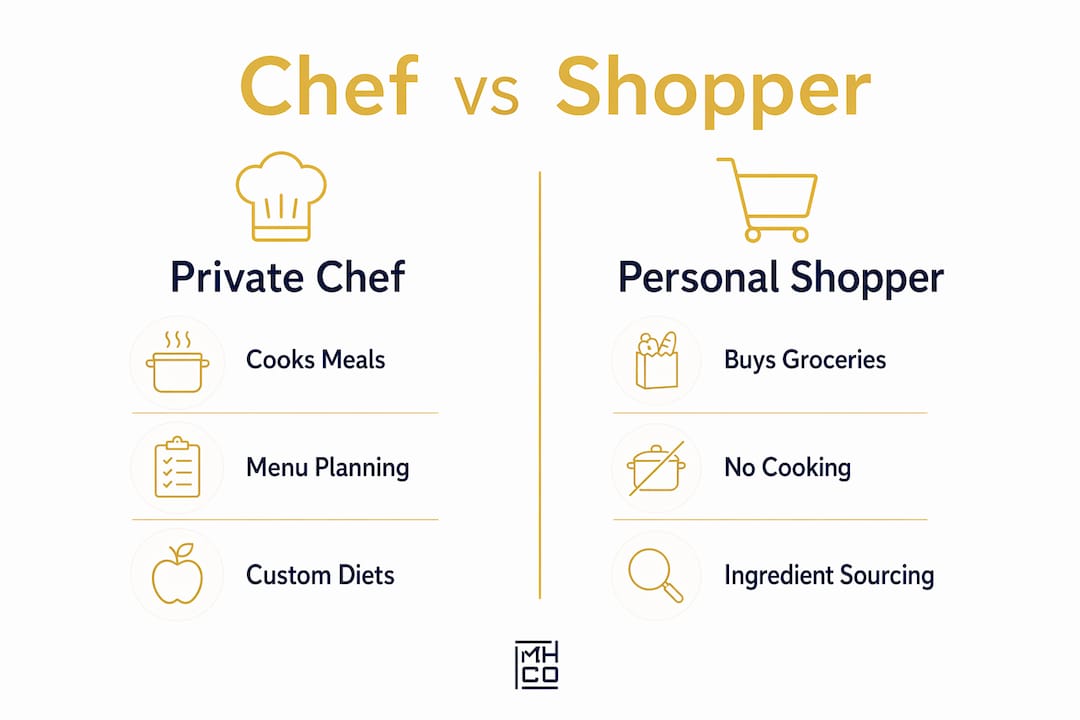
A private chef handles the entire food experience from start to finish. That means menu planning, grocery sourcing, cooking, plating, serving, and full kitchen cleanup after every meal. A personal shopper, by contrast, focuses on grocery procurement and ingredient selection without ever turning on the stove. The two roles share one overlap: both interact with food purchasing. But that overlap ends the moment the bags hit the counter.

Private chefs also manage dietary customization at a professional level. They adapt menus for gluten-free, low-FODMAP, ketogenic, or allergen-specific needs, adjusting recipes in real time based on client feedback. Personal shoppers can purchase the right ingredients for a specific diet, but they cannot guarantee how those ingredients will be prepared or combined. That gap matters enormously for clients managing medical dietary requirements.
A typical personal chef session lasts 3–5 hours and produces 5 to 20 meals, including grocery procurement and kitchen cleanup. That output represents a full-service culinary event, not a shopping trip. The session model is sometimes confused with personal shopping because it includes a grocery run, but the cooking and cleanup are what define it as a chef service.
Key services each role covers:
- Private chef: menu design, ingredient sourcing, cooking, plating, serving, and post-meal cleanup
- Personal shopper: grocery list execution, ingredient selection, brand substitution, and delivery or drop-off
- Private chef only: dietary customization, cook-to-order meals, and kitchen management
- Personal shopper only: multi-client scheduling, store-by-store sourcing, and bulk purchasing
Pro Tip: If you need someone to cook for you, hire a chef. If you need someone to shop for you, hire a shopper. Combining both roles in one job description usually results in neither being done well.
How do work arrangements and client relationships differ?
Private chefs and personal shoppers operate under fundamentally different employment structures. Private chefs often have formal culinary training and typically work exclusively for one household, managing all meals across breakfast, lunch, and dinner. Personal shoppers work on demand for multiple clients simultaneously, often scheduling several households in a single day.
The hiring process for a private chef reflects that exclusivity. The recruitment cycle typically takes 1–2 weeks, including vetting, tasting sessions, and establishing privacy agreements such as NDAs. That timeline exists because the relationship is intimate. A private chef enters your home daily, learns your preferences, and operates inside your household rhythm.
Personal shoppers, by contrast, onboard quickly. Digital questionnaires on diets and preferences enable fast service starts with flexible scheduling. You can book a personal shopper for one session and never use them again. A private chef arrangement rarely works that way.
Four key structural differences between the two roles:
- Exclusivity: Private chefs serve one household; personal shoppers serve many clients.
- Schedule: Private chefs follow the household's daily routine; personal shoppers work per session or per week.
- Vetting depth: Private chef hiring involves personality matching, tasting sessions, and NDAs; personal shopper onboarding is largely digital and fast.
- Communication: Private chef-client relationships often route through house managers or household assistants, with clear boundary protocols in place.
What are the differences in meal preparation style and outcome?
Meal readiness is the clearest line between the two roles. Private chefs prepare cook-to-order fresh meals served daily, while personal shoppers supply ingredients but do not prepare meals. A private chef delivers a finished plate. A personal shopper delivers the raw materials for someone else to cook.
This distinction gets blurry when clients encounter batch meal prep services. Some services offer weekly batch cooking where a chef prepares multiple meals in advance and stores them for reheating. This is still a chef service, not a shopping service, because cooking is involved. Personal shoppers do not batch cook. They may deliver pre-portioned ingredients, but the cooking remains the client's responsibility.
| Feature | Private chef | Personal shopper |
|---|---|---|
| Cooks meals | Yes | No |
| Sources groceries | Yes (integrated) | Yes (primary role) |
| Serves at the table | Often | Never |
| Handles dietary customization | Yes, in real time | Partially, through product selection |
| Kitchen cleanup | Yes | No |
Pro Tip: Ask any service provider one direct question: "Do you cook?" The answer tells you immediately which category they fall into.
Cost implications and typical client profiles
Private chefs represent a significant financial commitment. Annual salaries for private chefs range from $50,000 to $120,000, while personal chefs and session-based services charge $150–$500 per session or week. That cost gap reflects the difference in exclusivity, training, and daily service volume. You can review private chef pricing in detail to understand what drives those numbers.
The client profiles for each service are equally distinct:
- Private chef clients tend to be high-net-worth individuals, executives, or families with complex dietary needs who want daily, restaurant-quality meals at home without the effort of cooking or planning.
- Personal shopper clients are typically busy professionals or couples who want to eat well at home but prefer to cook themselves, or who use a meal kit-style approach with curated ingredients.
- Hybrid clients occasionally hire a personal shopper for weekly groceries and a session chef for special occasions, keeping costs lower while still accessing professional culinary support.
The personal chef consultation checklist from Milehighcook outlines exactly what a full-service session covers, which helps clients understand what they are paying for before committing. Knowing the scope prevents the common mistake of expecting a shopper to cook or a chef to run errands.
How do you decide which service fits your dining needs?
The right choice depends on four factors: budget, frequency, desired cooking involvement, and exclusivity. If you want someone to cook for you every day, a private chef is the correct answer. If you want someone to handle grocery runs while you cook, a personal shopper fits better.
Ask any prospective provider these questions before booking:
- Do you cook, or do you only shop and deliver?
- Are you available exclusively to my household, or do you serve multiple clients?
- What does your onboarding process look like, and how long does it take?
- What is included in your fee: groceries, service, cleanup?
A common misconception is that hiring a personal shopper is a budget version of hiring a private chef. The two services are not substitutes. They solve different problems. A personal shopper cannot replace a private chef for someone who wants cooked meals. A private chef is not the right hire for someone who simply wants better groceries.
Pro Tip: If you are unsure which service you need, describe your ideal Tuesday evening. If the answer involves someone cooking for you, you need a chef. If it involves someone filling your fridge, you need a shopper.
Milehighcook's private chef services include groceries, chef fees, service staff, and cleanup in one all-inclusive price, which removes the guesswork from budgeting entirely. That model works especially well for clients who have previously tried to piece together a shopper and a cook separately and found the coordination exhausting.
Key Takeaways
A private chef delivers fully cooked, customized meals for one household, while a personal shopper handles only ingredient procurement without cooking.
| Point | Details |
|---|---|
| Core role difference | Private chefs cook; personal shoppers shop. The two roles are not interchangeable. |
| Work arrangement | Private chefs serve one household exclusively; personal shoppers work across multiple clients per day. |
| Meal outcome | Private chefs deliver finished, served meals; personal shoppers deliver raw ingredients only. |
| Cost range | Private chefs cost $50,000–$120,000 annually; session-based services run $150–$500 per session. |
| Hiring process | Private chef vetting takes 1–2 weeks with tasting sessions and NDAs; personal shopper onboarding is fast and digital. |
What I have learned from watching clients choose between these two services
Clients almost always underestimate how different these two roles are until they have hired the wrong one. I have seen couples hire a personal shopper expecting restaurant-quality meals to appear, then feel let down when the fridge was full but dinner still required two hours of their own time. The confusion is understandable. Both roles involve food. Both require trust. But the outcomes are completely different.
The most satisfied private chef clients are the ones who treat the relationship like a long-term hire, not a one-time transaction. Personality fit matters as much as culinary skill. A chef who cooks brilliantly but clashes with a household's communication style will not last. That is why the property manager's guide on private chef relationships emphasizes vetting beyond the resume.
Personal shoppers, on the other hand, work best for clients who genuinely enjoy cooking but hate the time cost of grocery runs. They are not a stepping stone to a private chef. They are a separate service for a different kind of client. The trend I see growing is couples who use a personal shopper on weekdays and book a private chef for weekend dinners. That combination gives them control during the week and a genuine dining experience when it matters most. Knowing which role solves which problem is the only thing standing between a great decision and an expensive mistake.
— Stephen
Milehighcook brings private chef expertise to your table
Milehighcook's CIA-trained chefs handle everything from menu planning to post-dinner cleanup, with an all-inclusive pricing model that covers groceries, chef fees, service staff, and cleanup. There are no surprise costs and no coordination between separate vendors.
With a 4.9-star rating from over 65 verified reviews and coverage across 30+ markets, Milehighcook delivers consistent, restaurant-quality dining in your home. Whether you are planning an intimate dinner for two or a larger gathering, the Milehighcook chef team is vetted, trained, and ready to cook. You can also explore private chef services by market to find availability near you.
FAQ
What is the main difference between a private chef and a personal shopper?
A private chef cooks, serves, and manages meals exclusively for one household. A personal shopper only procures groceries and does not cook.
Can a personal shopper replace a private chef?
No. A personal shopper delivers ingredients; a private chef delivers finished meals. The two roles solve different problems and are not substitutes for each other.
How much does a private chef cost compared to a personal shopper?
Private chefs cost $50,000–$120,000 per year, while session-based personal chef or shopper services typically run $150–$500 per session.
How long does it take to hire a private chef?
The hiring process takes 1–2 weeks and includes vetting, tasting sessions, and privacy agreements. Personal shopper onboarding is significantly faster.
Does a private chef also handle grocery shopping?
Yes. Private chefs integrate grocery sourcing into their service. Milehighcook's all-inclusive model covers groceries as part of the chef fee, so clients never manage shopping separately.